Lanyon A Simple Blogger template

Free tutorials, courses, generative tools, and projects built with Javascript, PHP, Python, ML, AI,.Net, C#, Microsoft, Youtube, Github Code Download and more.

April 2022

Archive for April 2022

CoreWCF 1.0 has been Released, WCF for .NET Core and .NET 5+

The CoreWCF Project team has released the 1.0 version of CoreWCF, a port of WCF to the .NET Core platform. It provides a compatible implementation of SOAP, NetTCP, and WSDL. Usage in code is similar to WCF, but updated to use ASP.NET Core as the service host, and to work with .NET Core. This is the first major release of the project, and provides WCF functionality for .NET Core, .NET Framework, and .NET 5+.

The 1.0 release of CoreWCF is compatible with .NET Standard 2.0 so that it will work with:

  • .NET Framework 4.6.2 (and above)
  • .NET Core 3.1
  • .NET 5 & 6

Support for .NET Framework will enable an easier modernization path to .NET Core. Applications with WCF dependencies can be updated to use CoreWCF in-place on .NET framework, which then will work the same when updated to use .NET Core or .NET 5+.

The assemblies are available on Nuget.org, as described in the Release Notes.

Community Project

CoreWCF was announced as a community project in June of 2019, and has had many contributors during the last 3 years. As a community project, CoreWCF has had more commits from other contributors than Microsoft employees, and regular contributions from AWS and other organizations.

A special thanks to all those who have contributed code, issues or suggestions. The community support has been critical to getting the project to this point, and we hope it will continue for subsequent versions. I’d be remiss if I didn’t make a special callout to @mconnew who has been the backbone of the project and contributed most of the code.

As a community project, the voices of the community guide the direction of the project. For example, the Feature Roadmap Vote issue is highly influential to the planning process for what to work on next. If you are a WCF user, please provide feedback on what you would like to see in subsequent releases.

Features

CoreWCF is a subset of the functionality from WCF, but represents what we believe are the most used features, including:

  • Http & NetTCP transports
  • Bindings:
    • BasicHttpBinding
    • NetHttpBinding
    • NetTcpBinding – some WS-* features not supported
    • WebHttpBinding
    • WSHttpBinding – some WS-* features not supported
  • Security:
    • Transport
    • NetTcpBinding supports Certificate and Windows authentication
    • Http bindings require authentication to be configured in ASP.NET Core
    • Transport With Message Credentials
    • Username, Certificate and Windows Authentication are supported
    • WS Federation
  • WSDL generation
  • Partial configuration support including services & endpoints
  • Extensibility (IServiceBehavior and IEndpointBehavior) – most extensibility is available

Major WCF features not yet implemented include:

  • Transports other than Http and NetTCP.
  • Message security beyond Transport & Transport with Message Credentials
  • Distributed transactions
  • Message Queueing

Who should use CoreWCF?

CoreWCF is intended for customers who have been using WCF on .NET Framework and need WCF support in .NET Core to facilitate modernizing the application. While there is nothing stopping you from adopting CoreWCF in greenfield projects, we would recommend you consider more modern alternatives to SOAP such as gRPC. The sweet spot for CoreWCF is to make it easier to modernize server and clients that have a strong dependency on WCF and SOAP.

Microsoft Support

We recognize how important support is to enterprise customers, and so we are pleased to announce that Microsoft Product Support will be available for CoreWCF customers.

Support for CoreWCF 1.x will depend on the support status for the underlying .NET platforms it runs on.

Runtime Version Support dependency duration
.NET Framework 4.x The specific version of .NET Framework, and ASP.NET Core 2.1.
.NET Core 3.1 .NET 3.1 LTS – December 3, 2022
.NET 5 .NET 5 – May 8, 2022
.NET 6 .NET 6 LTS – November 8, 2024

CoreWCF will use Major.Minor versioning strategy:

  • 1.0 will be the first major release of CoreWCF
  • Minor releases will be numbered 1.x, and will have the same underlying platform requirements as 1.0.
  • Minor version releases (1.x) will be API compatible with the 1.0 release.
  • Support will be primarily for the latest major.minor release of each supported major version.
    • When new major or minor versions are released, then the previous release will be supported for 6 months from the date of the new release, provided the underlying runtime dependency being used is still within support.
  • Subsequent major versions, such as 2.0, may reduce the map of runtimes that are supported. In that case 1.x will continue to be supported beyond the 6 months on the runtimes that are not supported by 2.0, and support duration will be limited only by the underlying platform.
    • This will most likely apply to .NET Framework, and means that 1.x will be supported as long as both ASP.NET Core 2.1 and .NET Framework 4.x are under support.

More Support

Other organizations/companies may choose to provide support for CoreWCF in conjunction with the use of their products and services.

Getting started

The definition and implementation of data and service contracts is the same as WCF. The major difference is in the definition of the host which is now based on ASP.NET Core, and the ceremony of how a service is exposed. The following is based on .NET 6, but the same steps apply to other versions of .NET.

Defining the service

1. Create an ASP.NET Core Empty application, this provides the host for the service.

Visual Studio:
Project Template

Command Line:

mkdir CoreWCFDemoServer
dotnet new web -n CoreWCFDemoServer -o CoreWCFDemoServer

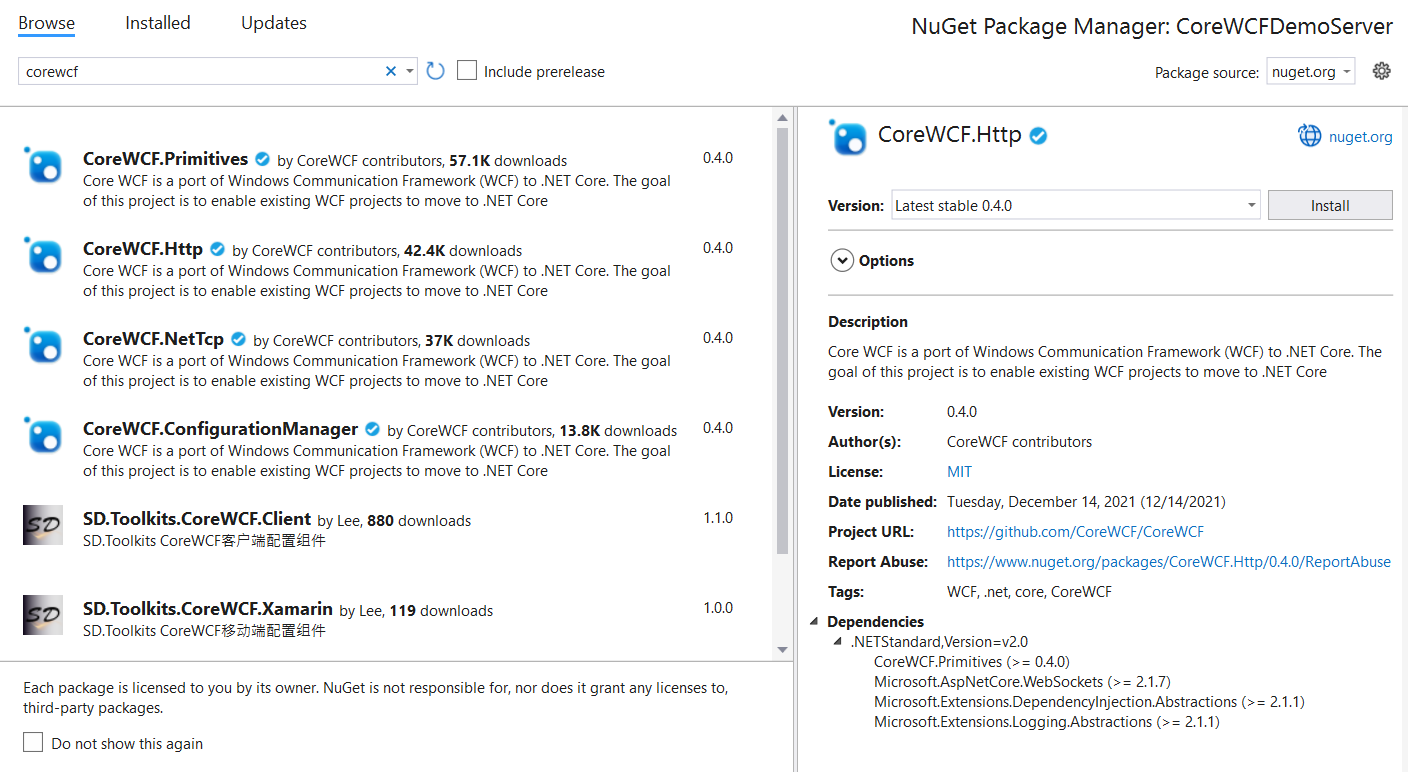
2. Add references to the CoreWCF Nuget Packages

Visual Studio:

Using the package Manager console, add:

  • Primitives
  • Http

Package Manager Console

Command Line:

Edit the project file and add:

<ItemGroup>
  <PackageReference Include="CoreWCF.Http" Version="1.0.0" />
  <PackageReference Include="CoreWCF.Primitives" Version="1.0.0" />
</ItemGroup>

3. Create the Service Contract and Data Contract definitions

These are defined the same as with WCF. When modernizing projects, this code can remain largely unchanged.

File: IEchoService.cs

using System.Diagnostics.CodeAnalysis;
using System.Runtime.Serialization;
using CoreWCF;

namespace CoreWCfDemoServer
{
    [DataContract]
    public class EchoFault
    {
        [AllowNull]
        private string _text;

        [DataMember]
        [AllowNull]
        public string Text
        {
            get { return _text; }
            set { _text = value; }
        }
    }

    [ServiceContract]
    public interface IEchoService
    {
        [OperationContract]
        string Echo(string text);

        [OperationContract]
        string ComplexEcho(EchoMessage text);

        [OperationContract]
        [FaultContract(typeof(EchoFault))]
        string FailEcho(string text);

    }

    [DataContract]
    public class EchoMessage
    {
        [AllowNull]
        [DataMember]
        public string Text { get; set; }
    }
}

File: EchoService.cs

using CoreWCF;

namespace CoreWCfDemoServer
{
    public class EchoService : IEchoService
    {
        public string Echo(string text)
        {
            System.Console.WriteLine($"Received {text} from client!");
            return text;
        }

        public string ComplexEcho(EchoMessage text)
        {
            System.Console.WriteLine($"Received {text.Text} from client!");
            return text.Text;
        }

        public string FailEcho(string text)
            => throw new FaultException<EchoFault>(new EchoFault() { Text = "WCF Fault OK" }, new FaultReason("FailReason"));

    }
}

4. The Service host needs to be told which services to expose via which bindings.

Update Program.cs to expose the Bindings:

using CoreWCF;
using CoreWCF.Configuration;
using CoreWCF.Description;
using CoreWCfDemoServer;

var builder = WebApplication.CreateBuilder(args);
builder.WebHost.ConfigureKestrel((context, options) =>
{
options.AllowSynchronousIO = true;
});

// Add WSDL support
builder.Services.AddServiceModelServices().AddServiceModelMetadata();
builder.Services.AddSingleton<IServiceBehavior, UseRequestHeadersForMetadataAddressBehavior>();

var app = builder.Build();
app.UseServiceModel(builder =>
{
builder.AddService((serviceOptions) => { })
// Add a BasicHttpBinding at a specific endpoint
.AddServiceEndpoint<EchoService, IEchoService>(new BasicHttpBinding(), "/EchoService/basichttp")
// Add a WSHttpBinding with Transport Security for TLS
.AddServiceEndpoint<EchoService, IEchoService>(new WSHttpBinding(SecurityMode.Transport), "/EchoService/WSHttps");
});
var serviceMetadataBehavior = app.Services.GetRequiredService();
serviceMetadataBehavior.HttpGetEnabled = true;

app.Run();

5. Update the appsettings.json to specify fixed ports for the service to listen on

Add the following line before the "Logging" line in appsettings.json:

"Urls": "http://localhost:5000;https://localhost:5001",

6. Run the project so that the services can be called

To consume the service:

1. Create a console application

2. Add a Service Reference

Visual Studio

Use the "Add Service Reference" command, and select "WCF Web Service" as the service type.
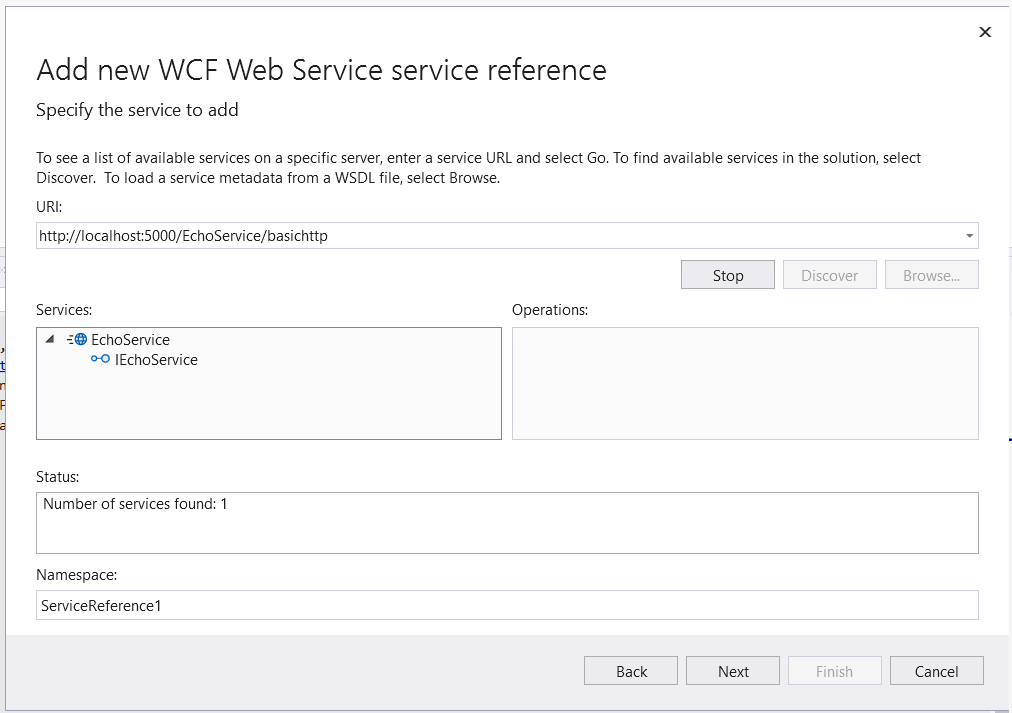
Add Service Reference Dialog

Use http://localhost:5000/EchoService/basichttp as the URL for WSDL discovery.

Command line

From the Command Line, the same code can be generated using svcutil:

dotnet tool install --global dotnet-svcutil
dotnet-svcutil --roll-forward LatestMajor http://localhost:5000/EchoService/basichttp?wsdl

3. Replace the code of the console app with:

using ServiceReference1;
// Instantiate the Service wrapper specifying the binding and optionally the Endpoint URL. The BasicHttpBinding could be used instead.
var client = new EchoServiceClient(EchoServiceClient.EndpointConfiguration.WSHttpBinding_IEchoService, "https://localhost:5001/EchoService/WSHttps");

var simpleResult = await client.EchoAsync("Hello");
Console.WriteLine(simpleResult);

var msg = new EchoMessage() { Text = "Hello2" };
var msgResult = await client.ComplexEchoAsync(msg);
Console.WriteLine(msgResult);

Other Samples

Other samples, including samples for desktop framework are available at CoreWCF/src/Samples

See it in action

On an recent episode of On .NET, Matthew Connew joined James Montemagno to walk through all of the new features and roadmap for CoreWCF:

Summary

We are pleased to see the community investment in the CoreWCF project, and congratulate them on this release. The project is ongoing and they welcome your feedback via issues and discussions in GitHub, in particular which features you think should be worked on next.

The post CoreWCF 1.0 has been Released, WCF for .NET Core and .NET 5+ appeared first on .NET Blog.


CoreWCF 1.0 has been Released, WCF for .NET Core and .NET 5+

The CoreWCF Project team has released the 1.0 version of CoreWCF, a port of WCF to the .NET Core platform. It provides a compatible implementation of SOAP, NetTCP, and WSDL. Usage in code is similar to WCF, but updated to use ASP.NET Core as the service host, and to work with .NET Core. This is the first major release of the project, and provides WCF functionality for .NET Core, .NET Framework, and .NET 5+.

The 1.0 release of CoreWCF is compatible with .NET Standard 2.0 so that it will work with:

  • .NET Framework 4.6.2 (and above)
  • .NET Core 3.1
  • .NET 5 & 6

Support for .NET Framework will enable an easier modernization path to .NET Core. Applications with WCF dependencies can be updated to use CoreWCF in-place on .NET framework, which then will work the same when updated to use .NET Core or .NET 5+.

The assemblies are available on Nuget.org, as described in the Release Notes.

Community Project

CoreWCF was announced as a community project in June of 2019, and has had many contributors during the last 3 years. As a community project, CoreWCF has had more commits from other contributors than Microsoft employees, and regular contributions from AWS and other organizations.

A special thanks to all those who have contributed code, issues or suggestions. The community support has been critical to getting the project to this point, and we hope it will continue for subsequent versions. I’d be remiss if I didn’t make a special callout to @mconnew who has been the backbone of the project and contributed most of the code.

As a community project, the voices of the community guide the direction of the project. For example, the Feature Roadmap Vote issue is highly influential to the planning process for what to work on next. If you are a WCF user, please provide feedback on what you would like to see in subsequent releases.

Features

CoreWCF is a subset of the functionality from WCF, but represents what we believe are the most used features, including:

  • Http & NetTCP transports
  • Bindings:
    • BasicHttpBinding
    • NetHttpBinding
    • NetTcpBinding – some WS-* features not supported
    • WebHttpBinding
    • WSHttpBinding – some WS-* features not supported
  • Security:
    • Transport
    • NetTcpBinding supports Certificate and Windows authentication
    • Http bindings require authentication to be configured in ASP.NET Core
    • Transport With Message Credentials
    • Username, Certificate and Windows Authentication are supported
    • WS Federation
  • WSDL generation
  • Partial configuration support including services & endpoints
  • Extensibility (IServiceBehavior and IEndpointBehavior) – most extensibility is available

Major WCF features not yet implemented include:

  • Transports other than Http and NetTCP.
  • Message security beyond Transport & Transport with Message Credentials
  • Distributed transactions
  • Message Queueing

Who should use CoreWCF?

CoreWCF is intended for customers who have been using WCF on .NET Framework and need WCF support in .NET Core to facilitate modernizing the application. While there is nothing stopping you from adopting CoreWCF in greenfield projects, we would recommend you consider more modern alternatives to SOAP such as gRPC. The sweet spot for CoreWCF is to make it easier to modernize server and clients that have a strong dependency on WCF and SOAP.

Microsoft Support

We recognize how important support is to enterprise customers, and so we are pleased to announce that Microsoft Product Support will be available for CoreWCF customers.

Support for CoreWCF 1.x will depend on the support status for the underlying .NET platforms it runs on.

Runtime Version Support dependency duration
.NET Framework 4.x The specific version of .NET Framework, and ASP.NET Core 2.1.
.NET Core 3.1 .NET 3.1 LTS – December 3, 2022
.NET 5 .NET 5 – May 8, 2022
.NET 6 .NET 6 LTS – November 8, 2024

CoreWCF will use Major.Minor versioning strategy:

  • 1.0 will be the first major release of CoreWCF
  • Minor releases will be numbered 1.x, and will have the same underlying platform requirements as 1.0.
  • Minor version releases (1.x) will be API compatible with the 1.0 release.
  • Support will be primarily for the latest major.minor release of each supported major version.
    • When new major or minor versions are released, then the previous release will be supported for 6 months from the date of the new release, provided the underlying runtime dependency being used is still within support.
  • Subsequent major versions, such as 2.0, may reduce the map of runtimes that are supported. In that case 1.x will continue to be supported beyond the 6 months on the runtimes that are not supported by 2.0, and support duration will be limited only by the underlying platform.
    • This will most likely apply to .NET Framework, and means that 1.x will be supported as long as both ASP.NET Core 2.1 and .NET Framework 4.x are under support.

More Support

Other organizations/companies may choose to provide support for CoreWCF in conjunction with the use of their products and services.

Getting started

The definition and implementation of data and service contracts is the same as WCF. The major difference is in the definition of the host which is now based on ASP.NET Core, and the ceremony of how a service is exposed. The following is based on .NET 6, but the same steps apply to other versions of .NET.

Defining the service

1. Create an ASP.NET Core Empty application, this provides the host for the service.

Visual Studio:
Project Template

Command Line:

mkdir CoreWCFDemoServer
dotnet new web -n CoreWCFDemoServer -o CoreWCFDemoServer

2. Add references to the CoreWCF Nuget Packages

Visual Studio:

Using the package Manager console, add:

  • Primitives
  • Http

Package Manager Console

Command Line:

Edit the project file and add:

<ItemGroup>
  <PackageReference Include="CoreWCF.Http" Version="1.0.0" />
  <PackageReference Include="CoreWCF.Primitives" Version="1.0.0" />
</ItemGroup>

3. Create the Service Contract and Data Contract definitions

These are defined the same as with WCF. When modernizing projects, this code can remain largely unchanged.

File: IEchoService.cs

using System.Diagnostics.CodeAnalysis;
using System.Runtime.Serialization;
using CoreWCF;

namespace CoreWCfDemoServer
{
    [DataContract]
    public class EchoFault
    {
        [AllowNull]
        private string _text;

        [DataMember]
        [AllowNull]
        public string Text
        {
            get { return _text; }
            set { _text = value; }
        }
    }

    [ServiceContract]
    public interface IEchoService
    {
        [OperationContract]
        string Echo(string text);

        [OperationContract]
        string ComplexEcho(EchoMessage text);

        [OperationContract]
        [FaultContract(typeof(EchoFault))]
        string FailEcho(string text);

    }

    [DataContract]
    public class EchoMessage
    {
        [AllowNull]
        [DataMember]
        public string Text { get; set; }
    }
}

File: EchoService.cs

using CoreWCF;

namespace CoreWCfDemoServer
{
    public class EchoService : IEchoService
    {
        public string Echo(string text)
        {
            System.Console.WriteLine($"Received {text} from client!");
            return text;
        }

        public string ComplexEcho(EchoMessage text)
        {
            System.Console.WriteLine($"Received {text.Text} from client!");
            return text.Text;
        }

        public string FailEcho(string text)
            => throw new FaultException<EchoFault>(new EchoFault() { Text = "WCF Fault OK" }, new FaultReason("FailReason"));

    }
}

4. The Service host needs to be told which services to expose via which bindings.

Update Program.cs to expose the Bindings:

using CoreWCF;
using CoreWCF.Configuration;
using CoreWCF.Description;
using CoreWCfDemoServer;

var builder = WebApplication.CreateBuilder(args);
builder.WebHost.ConfigureKestrel((context, options) =>
{
options.AllowSynchronousIO = true;
});

// Add WSDL support
builder.Services.AddServiceModelServices().AddServiceModelMetadata();
builder.Services.AddSingleton<IServiceBehavior, UseRequestHeadersForMetadataAddressBehavior>();

var app = builder.Build();
app.UseServiceModel(builder =>
{
builder.AddService((serviceOptions) => { })
// Add a BasicHttpBinding at a specific endpoint
.AddServiceEndpoint<EchoService, IEchoService>(new BasicHttpBinding(), "/EchoService/basichttp")
// Add a WSHttpBinding with Transport Security for TLS
.AddServiceEndpoint<EchoService, IEchoService>(new WSHttpBinding(SecurityMode.Transport), "/EchoService/WSHttps");
});
var serviceMetadataBehavior = app.Services.GetRequiredService();
serviceMetadataBehavior.HttpGetEnabled = true;

app.Run();

5. Update the appsettings.json to specify fixed ports for the service to listen on

Add the following line before the "Logging" line in appsettings.json:

"Urls": "http://localhost:5000;https://localhost:5001",

6. Run the project so that the services can be called

To consume the service:

1. Create a console application

2. Add a Service Reference

Visual Studio

Use the "Add Service Reference" command, and select "WCF Web Service" as the service type.

Add Service Reference Dialog

Use http://localhost:5000/EchoService/basichttp as the URL for WSDL discovery.

Command line

From the Command Line, the same code can be generated using svcutil:

dotnet tool install --global dotnet-svcutil
dotnet-svcutil --roll-forward LatestMajor http://localhost:5000/EchoService/basichttp?wsdl

3. Replace the code of the console app with:

using ServiceReference1;
// Instantiate the Service wrapper specifying the binding and optionally the Endpoint URL. The BasicHttpBinding could be used instead.
var client = new EchoServiceClient(EchoServiceClient.EndpointConfiguration.WSHttpBinding_IEchoService, "https://localhost:5001/EchoService/WSHttps");

var simpleResult = await client.EchoAsync("Hello");
Console.WriteLine(simpleResult);

var msg = new EchoMessage() { Text = "Hello2" };
var msgResult = await client.ComplexEchoAsync(msg);
Console.WriteLine(msgResult);

Other Samples

Other samples, including samples for desktop framework are available at CoreWCF/src/Samples

See it in action

On an recent episode of On .NET, Matthew Connew joined James Montemagno to walk through all of the new features and roadmap for CoreWCF:

Summary

We are pleased to see the community investment in the CoreWCF project, and congratulate them on this release. The project is ongoing and they welcome your feedback via issues and discussions in GitHub, in particular which features you think should be worked on next.

The post CoreWCF 1.0 has been Released, WCF for .NET Core and .NET 5+ appeared first on .NET Blog.


source https://devblogs.microsoft.com/dotnet/corewcf-v1-released/

.NET MAUI Release Candidate 2 – With 100% More Tizen

We are excited to release .NET Multi-platform App UI (.NET MAUI) Release Candidate 2. This release is covered by a “go-live” support policy, meaning .NET MAUI is supported by Microsoft for your production apps. The team has been focused on stabilizing the toolkit, resolving the high impact issues you have been helping us to identify through your valuable feedback. Thank you!

Get Started Today

To acquire .NET MAUI RC2 on Windows, install or update Visual Studio 2022 Preview to version 17.2 Preview 5. In the installer, confirm .NET MAUI (preview) is checked under the “Mobile Development with .NET” workload.

To use .NET MAUI RC2 on Mac, follow the command-line instructions on the wiki. Support for .NET MAUI in Visual Studio 2022 for Mac will ship formally in a future preview.

Release Candidate 2 release notes are on GitHub. For additional information about getting started with .NET MAUI, refer to our documentation and the migration tip sheet for a list of changes to adopt when upgrading projects.

Reminder about Xamarin support The Xamarin Support Policy is still in effect, which covers those products for 2 years after initial release. The last release was in November of 2021, so support will continue through November 2023.

Adding Tizen Platform

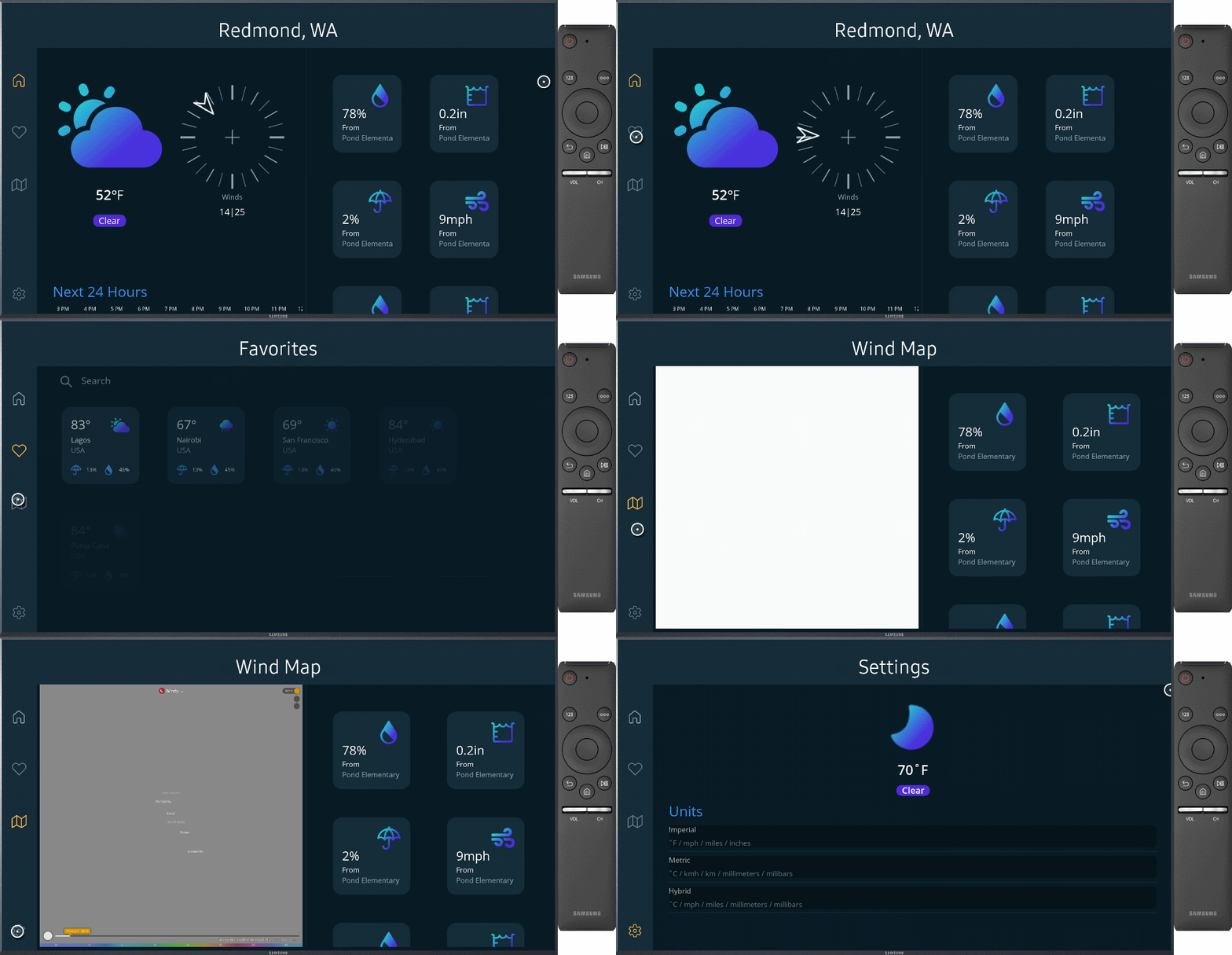
Tizen.NET has long enabled .NET applications to run on millions of Samsung TVs, phones, and other devices running Tizen. Today, Tizen joins Android, iOS, macOS, and Windows as one of the target platforms you can reach with .NET MAUI. Congratulations to the Samsung Tizen.NET team on this great milestone!

Visit the Tizen .NET introduction to get started. While the platform support is part of .NET MAUI SDK and we’ve added the scaffolding for Tizen to the .NET MAUI template project, the required workload dependencies are distributed through a separate installation experience maintained by Tizen.

Looking for samples? The Tizen team keeps up to date with all our beautiful sample apps to make sure they run great on Tizen mobile and Tizen TV.

The official Tizen Emulator supporting .NET 6 will be released by the Tizen team soon.

HelloMaui

Tizen emulator

Source

WeatherTwentyOne

Tizen TV emulator running WeatherTwentyOne

Source

.NET Podcast

Tizen emulator and browser running dot net podcasts

Tizen TV emulator running dot net podcasts

Source

Getting the most from platforms

.NET MAUI excels at giving you the same UI and styling for native controls across all supported platforms, while also giving you broad access to native platform features all from a single .NET language. .NET does this by taking full advantage of multi-targeting to organize code and resources that may span several platforms from a single project.

There may also be scenarios in your applications where you’ll want to customize how it looks and behaves on a specific platform in order to take full advantage of native features only present on that platform, or to unify an experience to be more consistent with other platforms. There are 3 main ways in which you can do this in .NET MAUI:

1. Platform folders

Within the single project structure, we’ve paved the way for you to put platform-specific code and files into folders by platform. The build tasks for .NET MAUI are pre-configured to know that anything you place there will apply only to that platform.

Solution shows platform folders

2. Filename convention

The .NET MAUI build tasks will also look at filename conventions to determine what code should run for each platform. The source code is actually setup this way as well. The Button handlers suffix the filenames by platform: Android, iOS, Tizen, and Windows.

Button handler files by platform

3. Conditional compilation

Multi-targeting also works via conditional compilation arguments. By using #if, you can segment code per platform from anywhere in your project. For example, in the WeatherTwentyOne app’s MauiProgram.cs, we configure services for local notifications and the system tray, which are very platform-specific APIs.

    var services = builder.Services;
#if WINDOWS
    services.AddSingleton<ITrayService, WinUI.TrayService>();
    services.AddSingleton<INotificationService, WinUI.NotificationService>();
#elif MACCATALYST
    services.AddSingleton<ITrayService, MacCatalyst.TrayService>();
    services.AddSingleton<INotificationService, MacCatalyst.NotificationService>();
#endif
    services.AddSingleton<HomeViewModel>();
    services.AddSingleton<HomePage>();

By default, the following options are available to you:

  • ANDROID
  • IOS
  • MACCATALYST
  • TIZEN
  • WINDOWS

You’ll notice IntelliSense will additionally offer you more specific options to target each platform such as “WINDOWS10_0_17763_0_OR_GREATER” in case you need it.

For additional information on writing platform-specific code, check out the .NET MAUI documentation:

.NET MAUI provides other helpful strategies for adapting your applications to different platforms, screen sizes, idioms, and more. For example, you can leverage these markup extensions and strategies:

  • OnPlatformWidthRequest="{OnPlatform 250, iOS=200, Android=300}"
  • OnIdiomWidthRequest="{OnIdiom 100, Phone=200, Tablet=300, Desktop=400}"
  • Triggers – Property, Data, Event, Multi-triggers, EnterActions, ExitActions, and State

We need your feedback

Install the latest preview of Visual Studio 2022 for Windows (17.2 Preview 5) following our simple guide and build your first multi-platform application today.

We’d love to hear from you! As you encounter any issues, file a report on GitHub at dotnet/maui.

The post .NET MAUI Release Candidate 2 – With 100% More Tizen appeared first on .NET Blog.



source https://devblogs.microsoft.com/dotnet/dotnet-maui-rc-2/

C# 11 Preview Updates – Raw string literals, UTF-8 and more!

Features for C# 11 are coming along nicely! You can check these features out by downloading Visual Studio 17.2 Preview 3 or .NET 7 Preview 3 for other editors. You can find more about C# 11 features that appeared earlier in What’s new in C# 11 and Early peek at C# 11 features and you can follow the progress of C# 11 on the Feature Status page. You can find out about other .NET 7 Preview 3 features in this .NET Blog post and more about Visual Studio 17.2 in the release notes.

We evolve C# to improve your development productivity, the resiliency of your applications in production, performance and support for new features. The C# team works on both the performance of your application in production, and how the compiler performance affects your development. Features in this post include:

This post also explains why we removed parameter null-checking from C# 11 and are adding a warning for lowercase type names.

Raw string literals

If you work with strings literal that contain quotes or embedded language strings like JSON, XML, HTML, SQL, Regex and others, raw literal strings may be your favorite feature of C# 11. Previously if you copied a literal string with quotes into a C# literal, the string ended at the first double quote with compiler errors until you escaped each one. Similarly, if you copied text with curly braces into an interpolated string literal, each curly bracket was interpreted as the beginning of a nested code expression unless you escape it, generally by doubling the curly bracket.

Raw string literals have no escaping. For example, a backslash is output as a backslash, and t is output as the backslash and a t, not as the tab character.

Raw string literals start and end with at least three double quotes ("""..."""). Within these double quotes, single " are considered content and included in the string. Any number of double quotes less than the number that opened the raw string literal are treated as content. So, in the common case of three double quotes opening the raw string literals, two double quotes appearing together would just be content. If you need to output a sequence of three or more double quotes, just open and close the raw string literal with at least one more quote than that sequence.

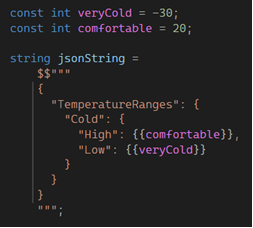
Raw string literals can be interpolated by preceding them with a $. The number of $ that prefixes the string is the number of curly brackets that are required to indicate a nested code expression. This means that a $ behaves like the existing string interpolation – a single set of curly brackets indicate nested code. If a raw string literal is prefixed with $$, a single curly bracket is treated as content and it takes two curly brackets to indicate nested code. Just like with quotes, you can add more $ to allow more curly brackets to be treated as content. For example:

JSON example of raw string literal

Raw string literals also have new behavior around automatically determining indentation of the content based on leading whitespace. To learn more about this and to see more examples on this feature, check out the docs article Raw String Literals.

This feature will make it much easier to work with literals that contain certain characters. You can now copy code into or from a literal string without being hindered by adding or removing escape sequences.

UTF-8 String Literals

UTF-8 is used in many scenarios, particularly in web scenarios. Prior to C# 11, programmers had to either translate UTF-8 into hexadecimal – which led to verbose, unreadable, error prone code – or encode string literals at runtime.

C# 11 allows converting string literals containing only UTF-8 characters to their byte representation. This is done at compile-time, so the bytes are ready to use without additional runtime cost. So you can write code like:

byte[] array = "hello";             // new byte[] { 0x68, 0x65, 0x6c, 0x6c, 0x6f }
Span<byte> span = "dog";            // new byte[] { 0x64, 0x6f, 0x67 }
ReadOnlySpan<byte> span = "cat";    // new byte[] { 0x63, 0x61, 0x74 }

There are ongoing discussions about details such as whether a type suffix is required and what natural type that would imply. If you expect to use UTF-8 string literals, we would really like your feedback and you can see the UTF-8 String Literal proposal and the links contained in it for more information.

This feature brings a welcome simplification to everyone currently building byte arrays to represent UTF-8. If you are doing this, you will probably want to convert your code to use it after C# 11 releases. If you are not using UTF-8 string literals you can ignore this feature. For ASP.NET users, your response is encoding to UTF-8 from strings automatically, so you can ignore this feature.

Checked user-defined operators

One of the major motivations for the static abstract members in interfaces feature of C# 11 is the ability to support generic math. .NET developers can write algorithms that rely on interfaces that include static abstract members as the generic constraint. One such interface is INumber<TSelf> which provides access to APIs such as Max, Min, Parse, and even operators such as +, -, *, and /, as well as user defined conversions.

User-defined operators respect the arithmetic overflow and underflow checking context of the calling code, controlled via the <CheckForOverflowUnderflow> project property or the checked/unchecked regions and operators. Check out the language reference for about checked and unchecked behavior for arithmetic operators. Prior to C# 11, a user-defined operator was unaware of the context in which it was used.

C# 11 adds the ability to declare certain operators as checked, identified with the checked modifier. Operators that do not have this modifier will be unchecked when paired with a checked operator. The compiler will select the right operator to use based on the context of the calling code. The operators that can support checked versions are the ++, -- and - unary operators and the +, -, *, and / binary operators.

The distinction between checked and unchecked is the context in which they are used. There is no requirement that checked operators throw if the bounds of the type are exceeded or that unchecked operators not throw, but this is the behavior users expect. For example, for integer types MAX_VALUE+1 is MIN_VALUE in the unchecked context and throws an exception in the checked context. Some types, such as floating point numbers, do not overflow and therefore do not need separate checked and unchecked operators.

This feature is important to developers creating user-defined operators that operate on types where arithmetic overflow is a valid concept. It will allow new user-defined operators to respect the context in which the operator is used. We anticipate that only a small number of developers will use this feature directly, but the impact of their implementations will make the entire ecosystem more reliable and predictable.

Auto-default structs

In C# 10 and earlier, you needed to initialize all fields of a struct by initializing fields and auto-properties or setting them in the constructors. This can be awkward, particularly with the expected introduction of the field keyword and semi-auto properties in a later C# 11 preview. If you did not set these values, you received a compiler error. If we have sufficient information to provide the error, perhaps we should just set these values to default for you!

Starting with this preview, the compiler does exactly that. It initializes any fields and auto-properties that are not set based on definite assignment rules, and assigns the default value to them. If you do not want this behavior, there is a warning you can turn on.

This feature simplifies initialization for anyone using structs that include explicit constructors. This is likely to feel like the way structs with initializers always should have worked, and so you may take advantage of this feature without even thinking about it. If you are explicitly initializing fields to their default value in response to the previous compiler errors, you can remove that code.

Pattern matching with spans

Starting with this preview, you can pattern match a Span<char> or a ReadonlySpan<char> with a string literal. This code now works:

static bool IsABC(Span<char> s)
{
    return s switch { 
        "ABC" => true, 
        _ => false };
}

The input type must be statically known to be a Span<char> or a ReadonlySpan<char>. Also, the compiler reports an error if you match a Span<char> or a ReadonlySpan<char> to a null constant.

This feature will allow Span<char> or ReadonlySpan<char> to participate as patterns in switch statements and switch expressions for matching string literals. If you are not using Span<char> and ReadonlySpan<char> you can ignore this feature.

Special thanks to YairHalberstadt for implementing this feature.

Use a cached delegate for method group conversion

This feature will improve runtime performance by caching static method groups, rather than creating fresh delegate instances. This is to improve your application’s performance, particularly for ASP.NET. You will get the benefit of this feature with no effort on your part.

Special thanks to pawchen for implementing this feature

Remove parameter null-checking from C# 11

We previewed parameter null-checking as early as possible because we anticipated feedback. This feature allows !! on the end of a parameter name to provide parameter null checking before the method begins execution. We included this feature early in C# 11 to maximize feedback, which we gathered from GitHub comments, MVPs, social media, a conference audience, individual conversations with users, and the C# design team’s ongoing reflection. We received a wide range of feedback on this feature, and we appreciate all of it.

The feedback and the wide range of insight we gained from this feedback led us to reconsider this as a C# 11 feature. We do not have sufficient confidence that this is the right feature design for C# and are removing it from C# 11. We may return to this area again at a later date.

While there are several valid ways you can do null check on a single line, if you are using .NET 6 we recommend using ArgumentNullException.ThrowIfNull method:

public static void M(string myString)
{
    ArgumentNullException.ThrowIfNull(myString);
    // method 
}

One of the benefits of using the ThrowIfNull method is it uses CallerArgumentExpression to include the parameter name in the exception message automatically:

System.ArgumentNullException: 'Value cannot be null. (Parameter 'myString')'

Warning wave: Warnings on lowercase type names

C# 11 introduces a Warning Wave 7 that includes a warning for any type that is declared with all lowercase ASCII characters. This has been a common stylistic rule in the C# ecosystem for years. We are making it a warning because C# needs to occasionally introduce new keywords in order to evolve. These keywords will be lowercase and may conflict with your type’s name, if it is lowercase. We introduced this warning so you can avoid a possible future breaking change.

You can find out more about this change at Warning on lowercase type names in C# 11. Warning waves allow new warnings in C# in a manner that allows you to delay adoption if the warning causes issues you cannot currently resolve.

This warning is expected to affect very few people. But if you encounter it, we recommend updating your type name, or prefixing usages of it with @, such as @lower.

Closing

Please download Visual Studio 17.2 Preview 3 or .NET 7 Preview 3, try out the new features, and tell us what you think in the Discussions section of the CSharpLang repo.

The post C# 11 Preview Updates – Raw string literals, UTF-8 and more! appeared first on .NET Blog.



source https://devblogs.microsoft.com/dotnet/csharp-11-preview-updates/

.NET Automatic Updates for Server Operating Systems

We’re excited to announce that starting April 2022, we will be making monthly updates for modern .NET (.NET Core) available for server operating systems via Microsoft Update (MU) on an opt-in basis.

If you do not want to have your servers updated automatically for you no action is required. If on the other hand you do want to leverage this for your servers review continue reading below.

There is no change for client operating systems which will continue to receive updates via Automatic Updates, WSUS, and MU Catalog as earlier.

More Information

Updates for supported versions of .NET Core 3.1, .NET 5.0 and .NET 6.0 are currently offered to server operating systems via Windows Server Update Services (WSUS) and Microsoft Update Catalog but not the Automatic Updates (AU) channel. You can now get your server operating system automatically updated by opting in for this behavior.

Opting in

You can opt in for automatic updates by setting one or more of these registry keys on your server.

.NET Version Registry Key Name Value
Allow All .NET Updates [HKEY_LOCAL_MACHINESOFTWAREMicrosoft.NET] “AllowAUOnServerOS” dword:00000001
Allow .NET 6.0 Updates [HKEY_LOCAL_MACHINESOFTWAREMicrosoft.NET6.0] “AllowAUOnServerOS” dword:00000001
Allow .NET 5.0 Updates [HKEY_LOCAL_MACHINESOFTWAREMicrosoft.NET5.0] “AllowAUOnServerOS” dword:00000001
Allow .NET 3.1 Updates [HKEY_LOCAL_MACHINESOFTWAREMicrosoft.NET3.1] “AllowAUOnServerOS” dword:00000001

Setting the registry key can be achieved by adding the entry (this is an example for enabling 6.0 updates) in a “.reg” file and running this.

[HKEY_LOCAL_MACHINE\SOFTWARE\Microsoft\.NET\6.0] "AllowAUOnServerOS"=dword:00000001

Alternatively, you can use Group Policy to deploy the registry key to many computers at once.

Why are we making this change?

From the first time we started shipping updates for modern .NET via Microsoft Update we have continued to refine this delivery channel including the recent addition of updates for the Hosting Bundle. The vast majority of customers use servers in a managed environment and deployments are handled using a management tool such as Microsoft Intune, Microsoft Endpoint Manager (MEP), System Center Config Manager (SCCM) or Windows Server Update Services (WSUS) and these customers prefer their servers are not directly patched outside of this management environment so they can exercise control over scheduling potential service downtime, reboots, etc. So when we started offering updates via MU we excluded Automatic Updates (AU).

A small number of customers have told us they don’t use a deployment management tool and would like to leverage AU to update their servers similar to clients. We believe the opt in approach we’re rolling out today will allow these customers to get the benefit of AU for their server operating systems without impacting the larger set of customers that do not want this.

In Closing

We’re excited to start delivering updates for modern .NET to server operating systems via Microsoft Update on an opt-in basis and look forward to your feedback on this experience. If you do not want to have your server operating systems updated automatically for you no action is required. If on the other hand you do want to leverage this for your servers review the guidance above.

The post .NET Automatic Updates for Server Operating Systems appeared first on .NET Blog.


.NET April 2022 Updates – .NET 6.0.4, .NET 5.0.16 and, .NET 3.1.24

Today, we are releasing the .NET April 2022 Updates. These updates contain reliability and non-security improvements. See the individual release notes for details on updated packages.

You can download 6.0.4, 5.0.16 and, 3.1.24 versions for Windows, macOS, and Linux, for x86, x64, Arm32, and Arm64.

Additionally, starting this month, we will be making updates for .NET Core available for server operating systems via Microsoft Update (MU) on an opt-in basis. If you do not want to have your server operating systems updated automatically for you no action is required. If on the other hand you do want to leverage this for your servers, please review our blog post on automatic updates for server operating systems.

Improvements

Visual Studio

See release notes for Visual Studio compatibility for .NET 6.0, .NET 5.0 and .NET Core 3.1.

OS Lifecycle Update

We will officially support Ubuntu 22.04 starting with May 2022 servicing updates.

We are also aware of an Open SSL error on Arm32 architecture and are actively working to address. This issue is being tracked here.

The post .NET April 2022 Updates – .NET 6.0.4, .NET 5.0.16 and, .NET 3.1.24 appeared first on .NET Blog.


.NET MAUI Release Candidate – Ready for cross-platform app development

Today we are excited to announce the availability of .NET Multi-platform App UI (.NET MAUI) Release Candidate. The SDK is now API complete, ready for libraries to update and make ready for GA (general availability) compatibility. As with other .NET release candidates, this release is covered by a “go live” support policy, meaning .NET MAUI is supported by Microsoft for your production apps.

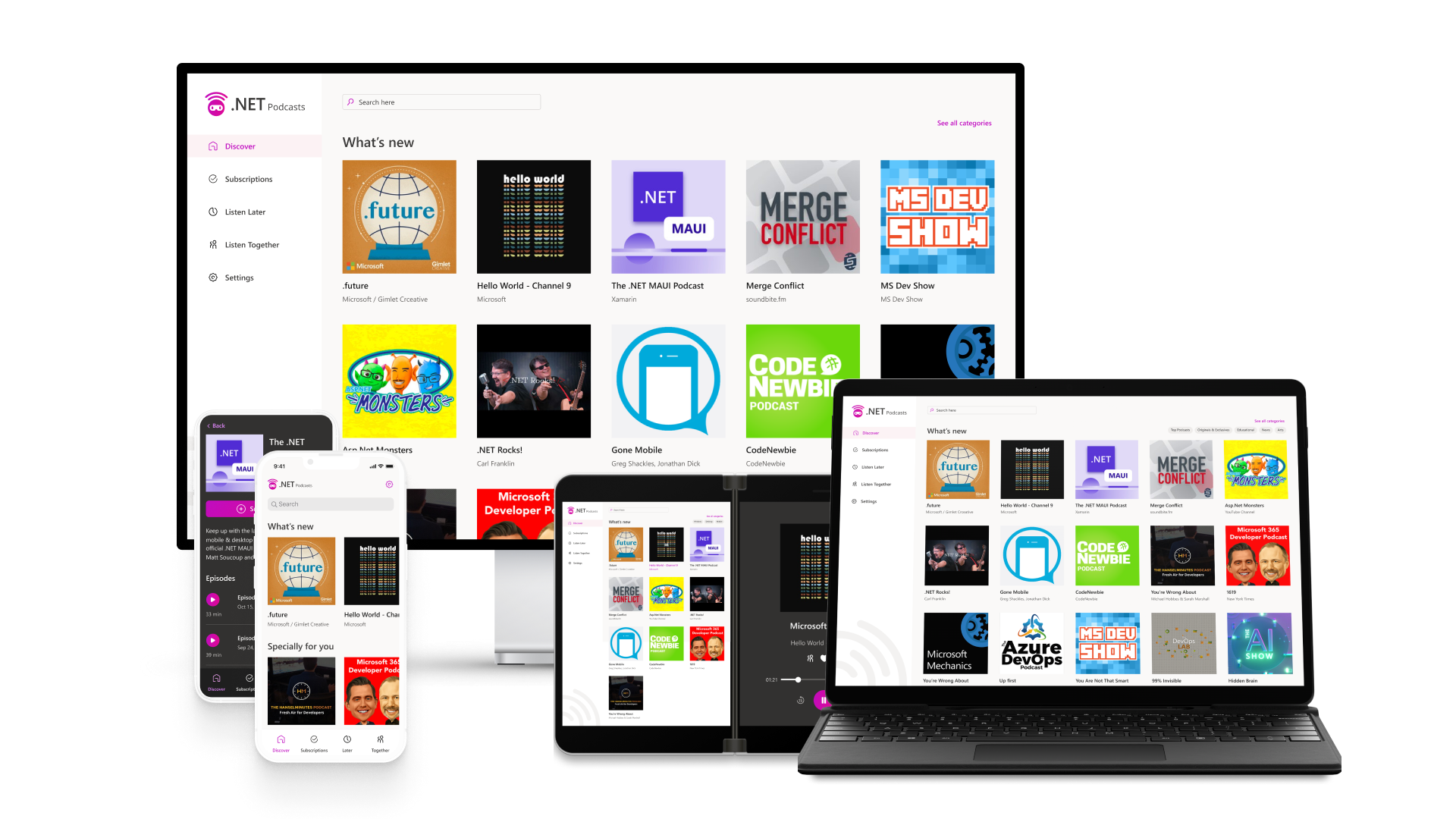
Image dotnet podcasts

Get Started Today

To acquire .NET MAUI RC1, install or update Visual Studio 2022 Preview to version 17.2 Preview 3. In the installer confirm .NET MAUI (preview) is checked under the “Mobile Development with .NET workload”.

To use .NET MAUI RC1 on Mac, follow the command line instructions on the wiki. Support for .NET MAUI in Visual Studio 2022 for Mac will ship formally in a future preview.

Release Candidate release notes are on GitHub. For additional information about getting started with .NET MAUI, refer to our documentation, and the migration tip sheet for a list of changes to adopt when upgrading projects.

Jump start your journey with the .NET Podcasts app (pictured above) which runs on Android, iOS, macOS, and Windows, and showcases both native app UI as well as Blazor Hybrid.

What about Xamarin support? The Xamarin Support Policy is still in effect which covers those products for 2 years after initial release. The last release was November of 2021, and so support will continue through November 2023.

What’s in the .NET MAUI release candidate?

As a multi-platform app building framework, .NET MAUI leverages platform SDKs for Android, iOS, macOS, and Windows. These foundational pieces are included in this release, and you can use them directly with C# in addition to maximizing your code sharing and productivity with .NET MAUI.

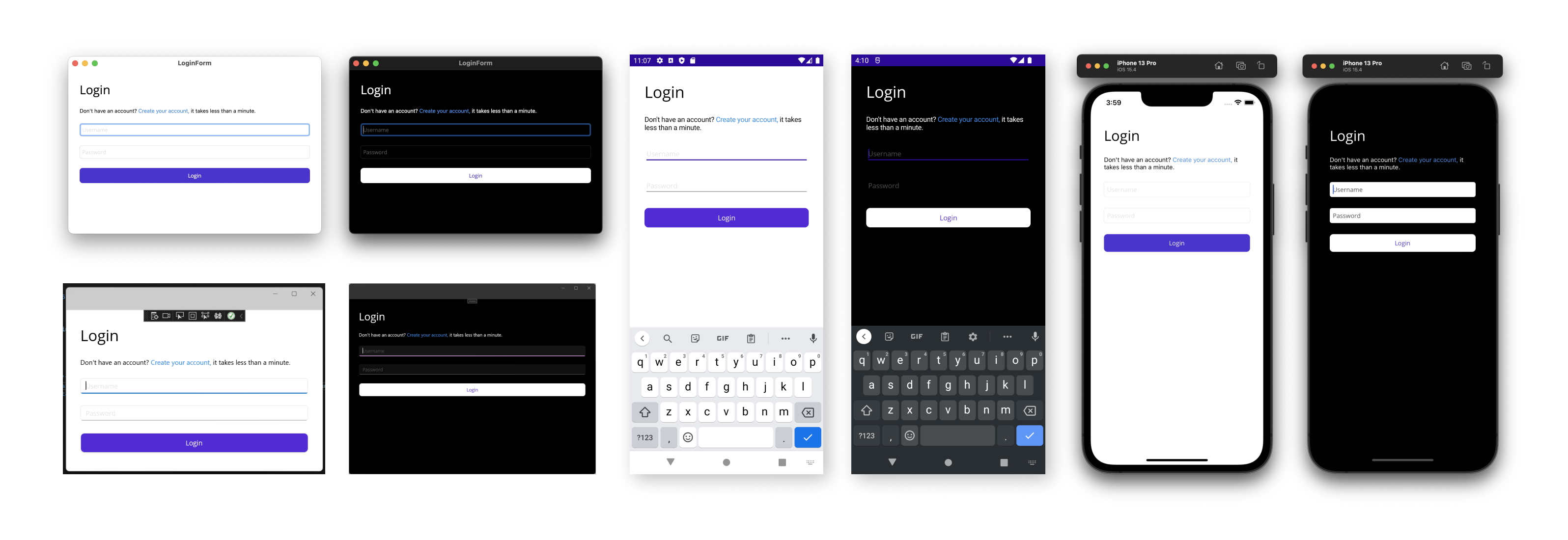
base theme for all controls

.NET MAUI ships with 40+ layouts and controls optimized for building adaptive UIs across both desktop and mobile platforms. You can also incorporate Blazor components or entire Blazor applications to distribute the same experiences on desktop and mobile as you may today on web.

How does this compare to Xamarin.Forms? You get every UI control that ships with Xamarin.Forms, plus new controls such as BlazorWebView, Border, GraphicsView, MenuBar, Shadow, and Window.

Layouts CarouselView Line Stepper
AbsoluteLayout Checkbox ListView SwipeView
BindableLayout CollectionView Path Switch
FlexLayout ContentView Picker TableView
GridLayout DatePicker Polygon TimePicker
HorizontalStackLayout Editor Polyline WebView
StackLayout Ellipse ProgressBar Pages
VerticalStackLayout Entry RadioButton ContentPage
Views Frame Rectangle FlyoutPage
ActivityIndicator GraphicsView RefreshView NavigationPage
BlazorWebView Image RoundRectangle TabbedPage
Border ImageButton ScrollView Shell
BoxView IndicatorView SearchBar
Button Label Slider

These are all documented in addition to related topics such as:

The new .NET MAUI project template now includes a default stylesheet in “Resourcesstyles.xaml” with a color palette and styling for all the controls. Take for example the Entry. When starting a new application these text inputs will now begin with a shared theme while still being true to the platform on which it runs.

<Style TargetType="Entry">
    <Setter Property="TextColor" Value="{AppThemeBinding Light={StaticResource Black}, Dark={StaticResource White}}" />
    <Setter Property="FontFamily" Value="OpenSansRegular"/>
    <Setter Property="FontSize" Value="14" />
    <Setter Property="PlaceholderColor" Value="{AppThemeBinding Light={StaticResource LightGray}, Dark={StaticResource DarkGray}}" />
    <Setter Property="VisualStateManager.VisualStateGroups">
        <VisualStateGroupList>
            <VisualStateGroup x:Name="CommonStates">
                <VisualState x:Name="Normal">
                    <VisualState.Setters>
                        <Setter Property="TextColor" Value="{AppThemeBinding Light={StaticResource Black}, Dark={StaticResource White}}" />
                    </VisualState.Setters>
                </VisualState>
                <VisualState x:Name="Disabled">
                    <VisualState.Setters>
                        <Setter Property="TextColor" Value="{AppThemeBinding Light={StaticResource LightGray}, Dark={StaticResource DarkGray}}" />
                    </VisualState.Setters>
                </VisualState>
            </VisualStateGroup>
        </VisualStateGroupList>
    </Setter>
</Style>

For views that support different states we’ve created a sensible default, and provided light and dark mode color options. For more information check out:

Customizing Controls

One of the things .NET MAUI does to improve upon the Xamarin.Forms architecture is adding low-code hooks to modify just about anything. Let’s consider the canonical example of removing the distinctive Android underline on an Entry field. How might you go about doing this when there is no multi-platform style for “underline” because it only exists on Android?

#if ANDROID
Microsoft.Maui.Handlers.EntryHandler.Mapper.ModifyMapping("NoUnderline", (h, v) =>
{
    h.PlatformView.BackgroundTintList = ColorStateList.ValueOf(Colors.Transparent.ToPlatform());
});
#endif

That’s all the code there is. This code just needs to run somewhere in the start of your application before the handler is called.

Let’s explain what is going on here. Firstly, the #if ANDROID is a conditional compilation directive that indicates this code should only run for Android. In other cases where you are modifying the control for ALL platforms, this isn’t necessary.

Next, we need need access to the control. The Entry you use is a .NET MAUI control. Each property, command, event, etc. of the Entry is “mapped” by a “handler” to a platform implementation. To modify a mapping you can tap into it via the handler’s map such as Microsoft.Maui.Handlers.EntryHandler.Mapper. From the mapper we have 3 methods:

  • PrependToMapping which runs before the .NET MAUI code
  • ModifyMapping which runs instead of the .NET MAUI code
  • AppendToMapping which runs after the .NET MAUI code

For this case it doesn’t matter which one we use, as it will be called at least once, and no other implementation on the Entry will touch the native properties we need to modify. Here the coded uses ModifyMapping and adds an entry called “NoUnderline”. Typically the property matches the name of an actual property, however in this case we are introducing a new one.

The h in the action is the handler which gives us access to the PlatformView which in this case is of Android type TextView. At this point the code is working directly with the Android SDK.

With the underline now out of the way, you can implement your own design of, say, a bordering box like old-school Windows Phone.

border around an entry view

<Border Stroke="{StaticResource Black}"
        StrokeThickness="2"
        StrokeShape="Rectangle">
    <Entry
        Margin="20,4"
        Placeholder="Username" />
</Border>

For more examples on how you can easily modify the look and feel of controls at the cross-platform as well as platform specific layers, check out the documentation for customizing controls.

We need your feedback

Install the latest preview of Visual Studio 2022 for Windows (17.2 Preview 3) following our simple guide and build your first multi-platform application today.

We’d love to hear from you! As you encounter any issues, file a report on GitHub at dotnet/maui.

The post .NET MAUI Release Candidate – Ready for cross-platform app development appeared first on .NET Blog.


source https://devblogs.microsoft.com/dotnet/dotnet-maui-rc-1/

.NET Automatic Updates for Server Operating Systems

We’re excited to announce that starting April 2022, we will be making monthly updates for modern .NET (.NET Core) available for server operating systems via Microsoft Update (MU) on an opt-in basis.

If you do not want to have your servers updated automatically for you no action is required. If on the other hand you do want to leverage this for your servers review continue reading below.

There is no change for client operating systems which will continue to receive updates via Automatic Updates, WSUS, and MU Catalog as earlier.

More Information

Updates for supported versions of .NET Core 3.1, .NET 5.0 and .NET 6.0 are currently offered to server operating systems via Windows Server Update Services (WSUS) and Microsoft Update Catalog but not the Automatic Updates (AU) channel. You can now get your server operating system automatically updated by opting in for this behavior.

Opting in

You can opt in for automatic updates by setting one or more of these registry keys on your server.

.NET Version Registry Key Name Value
Allow All .NET Updates [HKEY_LOCAL_MACHINESOFTWAREMicrosoft.NET] “AllowAUOnServerOS” dword:00000001
Allow .NET 6.0 Updates [HKEY_LOCAL_MACHINESOFTWAREMicrosoft.NET6.0] “AllowAUOnServerOS” dword:00000001
Allow .NET 5.0 Updates [HKEY_LOCAL_MACHINESOFTWAREMicrosoft.NET5.0] “AllowAUOnServerOS” dword:00000001
Allow .NET 3.1 Updates [HKEY_LOCAL_MACHINESOFTWAREMicrosoft.NET3.1] “AllowAUOnServerOS” dword:00000001

Setting the registry key can be achieved by adding the entry (this is an example for enabling 6.0 updates) in a “.reg” file and running this.

[HKEY_LOCAL_MACHINE\SOFTWARE\Microsoft\.NET\6.0] "AllowAUOnServerOS"=dword:00000001

Alternatively, you can use Group Policy to deploy the registry key to many computers at once.

Why are we making this change?

From the first time we started shipping updates for modern .NET via Microsoft Update we have continued to refine this delivery channel including the recent addition of updates for the Hosting Bundle. The vast majority of customers use servers in a managed environment and deployments are handled using a management tool such as Microsoft Intune, Microsoft Endpoint Manager (MEP), System Center Config Manager (SCCM) or Windows Server Update Services (WSUS) and these customers prefer their servers are not directly patched outside of this management environment so they can exercise control over scheduling potential service downtime, reboots, etc. So when we started offering updates via MU we excluded Automatic Updates (AU).

A small number of customers have told us they don’t use a deployment management tool and would like to leverage AU to update their servers similar to clients. We believe the opt in approach we’re rolling out today will allow these customers to get the benefit of AU for their server operating systems without impacting the larger set of customers that do not want this.

In Closing

We’re excited to start delivering updates for modern .NET to server operating systems via Microsoft Update on an opt-in basis and look forward to your feedback on this experience. If you do not want to have your server operating systems updated automatically for you no action is required. If on the other hand you do want to leverage this for your servers review the guidance above.

The post .NET Automatic Updates for Server Operating Systems appeared first on .NET Blog.


source https://devblogs.microsoft.com/dotnet/server-operating-systems-auto-updates/

.NET April 2022 Updates – .NET 6.0.4, .NET 5.0.16 and, .NET 3.1.24

Today, we are releasing the .NET April 2022 Updates. These updates contain reliability and non-security improvements. See the individual release notes for details on updated packages.

You can download 6.0.4, 5.0.16 and, 3.1.24 versions for Windows, macOS, and Linux, for x86, x64, Arm32, and Arm64.

Additionally, starting this month, we will be making updates for .NET Core available for server operating systems via Microsoft Update (MU) on an opt-in basis. If you do not want to have your server operating systems updated automatically for you no action is required. If on the other hand you do want to leverage this for your servers, please review our blog post on automatic updates for server operating systems.

Improvements

Visual Studio

See release notes for Visual Studio compatibility for .NET 6.0, .NET 5.0 and .NET Core 3.1.

OS Lifecycle Update

We will officially support Ubuntu 22.04 starting with May 2022 servicing updates.

We are also aware of an Open SSL error on Arm32 architecture and are actively working to address. This issue is being tracked here.

The post .NET April 2022 Updates – .NET 6.0.4, .NET 5.0.16 and, .NET 3.1.24 appeared first on .NET Blog.


source https://devblogs.microsoft.com/dotnet/april-2022-updates/

Let's Play Break The Code 2 – Code Cracking Game for Developers with Tom and Shaun


Curriculum for the course Let's Play Break The Code 2 – Code Cracking Game for Developers with Tom and Shaun

Break The Code 2 is a new browser game that sends you back in time to the year 1999. You complete codebreaking missions using your programming knowledge and your puzzle-solving skills. Watch freeCodeCamp software engineers Tom and Shaun rack their brains as they try to crack codes. This video was made possible by a grant from .Tech Domains, who developed this game. You can play Break The Code 2 yourself for free right in your browser: https://go.tech/btcfcc This video will show you how to play the game, and how to solve the first two missions. There are 11 missions in total. -- You can also check out Tom's Relational Database curriculum at: https://www.freecodecamp.org/learn/relational-database/ And check out Shaun's Rust curriculum: https://www.freecodecamp.org/news/rust-in-replit/

Watch Online Full Course: Let's Play Break The Code 2 – Code Cracking Game for Developers with Tom and Shaun


Click Here to watch on Youtube: Let's Play Break The Code 2 – Code Cracking Game for Developers with Tom and Shaun


This video is first published on youtube via freecodecamp. If Video does not appear here, you can watch this on Youtube always.


Udemy Let's Play Break The Code 2 – Code Cracking Game for Developers with Tom and Shaun courses free download, Plurasight Let's Play Break The Code 2 – Code Cracking Game for Developers with Tom and Shaun courses free download, Linda Let's Play Break The Code 2 – Code Cracking Game for Developers with Tom and Shaun courses free download, Coursera Let's Play Break The Code 2 – Code Cracking Game for Developers with Tom and Shaun course download free, Brad Hussey udemy course free, free programming full course download, full course with project files, Download full project free, College major project download, CS major project idea, EC major project idea, clone projects download free

Design a Scalable Mobile App With Figma Variants


Curriculum for the course Design a Scalable Mobile App With Figma Variants

Learn how to use Figma Variants to design a scalable mobile app. Variants can streamline your frontend design process by allowing you to group and organize similar components into a single container. ✏️ Ahmet Efeoglu developed this course. Check out his channel: https://www.youtube.com/channel/UCSziSLMFFNT4PaRQhEwANzg 🔗 Tutorial file link: https://www.figma.com/file/FrLR3t9jZ9X8psPdmztdlh/Activista-Tutorial-Initial-Screens?node-id=0%3A1 🔗 Homework file link: https://www.figma.com/file/8js2feuv6LdhmvVtBXkC2L/Figma-Activista-Tutorial-Homework?node-id=0%3A1 ⌨️ (0:00:18) Intro ⌨️ (0:02:13) Accessing Tutorial and Homework Files ⌨️ (0:04:24) Project Overview ⌨️ (0:05:27) Recommending Personal and freeCodeCamp Channel ⌨️ (0:06:25) Basics Overview ⌨️ (0:08:22) Learning The Frame Functionality ⌨️ (0:10:25) Learning The Autolayout Functionality ⌨️ (0:14:39) Learning The Component Functionality ⌨️ (0:18:55) Learning The Variant Functionality ⌨️ (0:21:42) Creating The Type System ⌨️ (0:28:41) Creating The Color Palette/System ⌨️ (0:35:54) Creating The Icon Set ⌨️ (0:41:34) Creating Input Variants ⌨️ (0:52:23) Creating Large Button Variant ⌨️ (1:00:47) Designing Sign Up and Login Screen ⌨️ (1:18:46) Creating Status Bar Variant ⌨️ (1:23:14) Creating The Filter Variant ⌨️ (1:27:40) Creating Bottom Navigation Variant ⌨️ (1:35:02) Creating Image Card Variant ⌨️ (1:49:27) Updating Input Variant ⌨️ (1:57:31) Designing The Discover Screens ⌨️ (2:15:20) Creating Large Avatar Variant ⌨️ (2:24:05) Creating Small Button Variant ⌨️ (2:32:45) Creating The Benefit Card Variant ⌨️ (2:46:45) Designing Details Screen 🎉 Thanks to our Champion and Sponsor supporters: 👾 Raymond Odero 👾 Agustín Kussrow 👾 aldo ferretti 👾 Otis Morgan 👾 DeezMaster -- Learn to code for free and get a developer job: https://www.freecodecamp.org Read hundreds of articles on programming: https://freecodecamp.org/news And subscribe for new videos on technology every day: https://youtube.com/subscription_center?add_user=freecodecamp

Watch Online Full Course: Design a Scalable Mobile App With Figma Variants


Click Here to watch on Youtube: Design a Scalable Mobile App With Figma Variants


This video is first published on youtube via freecodecamp. If Video does not appear here, you can watch this on Youtube always.


Udemy Design a Scalable Mobile App With Figma Variants courses free download, Plurasight Design a Scalable Mobile App With Figma Variants courses free download, Linda Design a Scalable Mobile App With Figma Variants courses free download, Coursera Design a Scalable Mobile App With Figma Variants course download free, Brad Hussey udemy course free, free programming full course download, full course with project files, Download full project free, College major project download, CS major project idea, EC major project idea, clone projects download free

Share this post

Search This Blog

What's New

The "AI is going to replace devs" hype is over – 22-year dev veteran Jason Lengstorf [Podcast #201]

Image
Curriculum for the course The "AI is going to replace devs" hype is over – 22-year dev veteran Jason Lengstorf [Podcast #201] Today Quincy Larson interviews Jason Lengstorf. He's a college dropout who taught himself programming while building websites for his emo band. 22 years later he's worked as a developer at IBM, Netlify, run his own dev consultancy, and he now runs CodeTV making reality TV shows for developers. We talk about: - How many CEOs over-estimated the impact of AI coding tools and laid off too many devs, whom they're now trying to rehire - Why the developer job market has already rebounded a bit, but will never be the same - Tips for how to land roles in the post-LLM résumé spam job search era - How devs are working to rebuild the fabric of the community through in-person community events Support for this podcast is provided by a grant from AlgoMonster. AlgoMonster is a platform that teaches data structure and algorithm patterns in a structure...

Labels

Programming Video Tutorials Coursera Video Tutorials Plurasight Programming Tutorials Udemy Tutorial C# Microsoft .Net Dot Net Udemy Tutorial, Plurasight Programming Tutorials, Coursera Video Tutorials, Programming Video Tutorials Asp.Net Core Asp.Net Programming AWS Azure GCP How To WordPress Migration C sharp AWS Project Git Commands FREE AWS Tutorial OldNewThings Git Tutorial Azure vs AWS vs GCP New in .Net javascript AI Google I/O 2025 Wordpress jquery Generative Video Git Git Squash Google Flow AI PHP SQL Veo 3 squash commit CSS Cloud Services React Tutorial With Live Project Source Code git rebase CPR Nummer Dropdown Reset Javascript Figma Figma Beginner Tutorial Geolocation Non-Programmer Content Python Free Course Think Simply Awesome Tutorial UI UX Live Project UI/UX Full Course Wireframing dotnet core runtime error html API Gateway AWS EKS vs Azure AKS All in one WP stuck C++ C++ Coroutines CPR Denmark ChatGPT Cloud Database Cloud DevOps Cloud Security Cloud Storage Contact Form 7 Dropdown Unselect Javascript E commerce Free AWS Terraform Project Training Git Commit Google Drive Files Google Drive Tips Http Error 500.30 Http Error 500.31 Interview Questions Learn Courutines C++ Microservices for Live Streaming PII Denmark Pub Sub SQL Server SSIS Terraform Course Free Terraform Tutorial Free USA E commerce strategies UpdraftPlus UpdraftPlus Manual Restore Website Optimization Strategies dropdown javascript select drop down javascript smarttube apk error 403 smarttube next 403 Error 413 Error 503 504 524 AI & ML AI Assistants AI Course CS50 AI in daily life AWS API Gateway AWS EBS AWS EC2 vs Azure VMs vs GCP Compute Engine AWS EFS AWS IAM AWS Lamda AWS RDS vs Azure SQL AWS Redshift AWS S3 AZ-104 AZ-104 Free Course AZ-104 Full Course AZ-104 Pass the exam Abstract Class C# Abstract Method Ajax Calender Control Ajax Control Toolkit All In One Extension Compatibility All In One WP Freeze All In One WP Migration All in one WP All-in-One WP Migration Android 15 Android TV Applying Theme html Asp.net core runtime Error Audio Auto Complete Azure AD Azure APIM Azure Administrator Certification Azure Blob Storage Azure Data Lake Azure Files Azure Function Azure Managed Disk Azure Synapse Base Class Child Class Best Grocery Price Big Data BigBasket vs Grofers Bing Homepage Quiz Blogger Import Blogger Post Import Blogger XML Import Bluetooth Connectivity Browser Detail Building Real-Time Web Applications Bulk Insert CI/CD CPR Address Update CPR Generator CPR Generator Denmark CS50 AI Course CS50 AI Python Course CS50 Artificial Intelligence Full Course CVR Centrale Virksomhedsregister Change Workspace TFS ChatGPT Essay Guide ChatGPT Usage ChatGPT vs Humans Cloud API Management Cloud CDN Cloud Computing Cloud Data Warehouse Cloud Event Streaming Cloud IAM Cloud Messaging Queue Cloud Monitoring and Logging Cloud Networking CloudFront Cloudflare Cloudwatch Compute Services Connect a Bluetooth Device to my PC site:microsoft.com Containers ControlService FAILED 1062 Corona Lockdown MP CosmosDB Covid19 Covid19 Bhopal Covid19 Home Delivery MP Covid19 Indore Covid19 Susner Covid19 Ujjain Cypress Javascript Cypress Javascript framework Cypress Javascript testing Cypress Javascript tutorial Cypress Javascript vs typescript DNS Danish CVR Data Analytics Data Analytics Course Free Data Engineering Data Structure Full Course Data Visualization Database Database Diagram Visualizer Davek Na Dodano Vrednost Dbdiagram export seeder Deep Learning Course Denmark Numbers Det Centrale Personregister Det Centrale Virksomhedsregister DevOps Device Compatibility Dictionary Dictionary in C# Digital Economy Disaster Recovery for Web Applications Disaster-Proof Infrastructure Dmart Frenchise Dmart Home Delibery Dmart Mumbai Address Dmart Pickup Points Doodle Jump Drive Images On Blog Drive Images On Website Driver Problems DropDown Dropbox Dropdown jquery DynamoDB ETL ETL Package Ecommerce Store using AWS & React Embed Drive Images Escape Sequences in c#.Net Event Hub Explicit Join Extract Facebook App Fake CVR Denmark Fake DDV Slovenia Fake VAT Number Fake Virk Number Faker Feature Toggle Find CPR Information Find a Word on Website Firestore Flappy Bird Game Form Selectors using jQuery Free React Portfolio Template FreeCodeCamp Frontend Best Practices for Millions of Users Full Text Index View G Drive Hosting GAN certification course GCP Cloud Data Lake GCP Filestore GCP Functions GCP IAM GCP Persistent Disk Gemini Git Checkout Google Adsense Setting Google Beam Google BigQuery Google Conversion Tracking Google Docs Advanced Tutorial Google Drive Clone Google Drive Clone Bot Google Drive Clone HTML CSS Google Drive Clone PHP Google Drive Clone React Google Drive Clone Tutorial Google Drive Clone VueJS Google Drive File Sharing Google Drive Images Google Drive Sharing Permissions Grocery Price Compare Online Grocery in Corona Grocery in Covid19 Grofers vs DMart vs Big basket HAXM installation HTML Storage HTML to PDF Javascript HTML2Canvas HTML5 HTML5 Append Data HTML5 Audio HTML5 Data Storage HTML5 Storage HTML5 Video Harvard University AI Course Header Sent Height Jquery High Availability in Live Streaming Platforms High-Concurrency Frontend Design High-Concurrency Web Applications How to Search for a Word on Mac Html2Canvas Black Background issue Http Error 413 Http Error 500.35 IIS INNER Join Image Gallery Blogger Image Gallery Blogger Picasa Image Gallery Blogger Template Image Gallery Blogger Template Free Implicit Join Indexing in SQL Instagram Clone React Instagram Clone Script Install NodeJS Ubuntu Internet Infrastructure Interview IoT IoT Core IoT Hub JS Game Tutorial Java Feature Toggle Javascript game tutorial JioCinema Case Study Keep Me Login Key Management Kinesis Learn Scrappy with a live project List Live Streaming Data Delivery Live Streaming Performance Optimization Load Load Balancer Looping Dictionary MTech First Semester Syllabus MTech Syllabus MVC Mac Mac Finder Shortcut Media Controller Media Group Attribute Microservices Architecture for Scalability Missing MySQL Extension Mobile Optimization Multiple Audio Sync Multiple Video Sync Mumbai Dmart List MySQL MySQL ERD Generator Next.js Beginner Tutorial Ngnix NodeJS NodeJS Ubuntu Commands Numpy OOPS Concepts OOPS in C# Object Oriented Programming Object Storage Outer Join PHP Installation Error PHP WordPress Installation Error Pandas Personligt identifikations nummer Pipedrive Pipedrive Quickbooks Integration Portfolio Website using React Project Astra PyTorch Quickbooks Quote Generator RGPV Syllabus Download Random SSN Generator ReCaptcha Dumbass React Feature Toggle Real-Time Video Processing Architecture Real-Time Video Processing Backend RegExp Regular Expression Reinstall Bluetooth Drivers Remember Me Remove NodeJS Ubuntu Renew DHCP Lease Reset IP Address Linux Reset IP Address Mac Reset IP Address Windows Reset Remote Connection Reset Remote Connection Failure Resize Textarea Restore Errors Restore Failed UpdraftPlus Route 53 SOS Phone SQL Indexed Tables SQL Joins SQL Seed generator SQS SSIS Package SSIS Tutorial SSN Generator for Paypal SSN Number SSN Number Generator SSN Validator Safari 8 Safari Video Delay SageMaker Scalable Backend for High Concurrency Scalable Cloud Infrastructure for Live Streaming Scalable Frontend Architectures Scalable Live Streaming Architecture Scrapy course for beginners Search A word Search for a Word in Google Docs Secret Management Serverless Service Bus Slovenian VAT Generator SmartTube Software Architect Interview Questions Software Architect Mock Interview Sparse Checkout Spotlight Mac Shortcut Stored Procedure Subtree Merge T-Mobile IMEI Check TFS TMobile IMEI check unlock Team Foundation Server Terraform Associate Certification Training Free Text Search Text color Textarea Resize Jquery Theme Top WordPress Plugins Transform Trim javascript Troubleshooting TypeScript Beginner Tutorial Ubuntu Unleash Feature Toggle Update Computer Name UpdraftPlus 500 UpdraftPlus Backup Restore UpdraftPlus Error 500 UpdraftPlus Error 504 UpdraftPlus Error 524 UpdraftPlus HTTP Error UpdraftPlus New Domain UpdraftPlus Restore Not Working UpdraftPlus Troubleshooting Upstream Reset Error Use Google Drive Images VAT Number Generator Verizon imei check Verizon imei check paid off Verizon imei check unlock Verizon imei check\ Version Control Vertex AI Video View Indexing SQL Views in SQL Virksomhedsregister Virtual friends Visual Studio 2013 WHERE Clause WHPX expo Web Security Web scraping full course with project Web3 What is Feature Toggle WordPress Backup Troubleshooting WordPress Backup UpdraftPlus WordPress Database Backup WordPress Error 503 WordPress Installation Error WordPress Migration UpdraftPlus Wordpress Restore Workspaces Commands Your ip has been banned Zero Click angle between two points bing homepage quiz answers bing homepage quiz answers today bing homepage quiz not working bing homepage quiz reddit bing homepage quiz today byod Verizon imei check chatgpt essay example chatgpt essay writer chatgpt essay writing check tmobile imei contact form 7 captcha contact form 7 captcha plugin contact form 7 recaptcha v3 cpr-nummer engelsk cpr-nummer liste cpr-nummer register cpr-nummer tjek dbdiagram dom load in javascript dotnet core hosting bundle dotnet failed to load dotnet runtime error get url in php how to search for a word on a page how to search for a word on a page windows ipconfig release is cypress javascript istio transport failure jQuery AutoComplete jQuery Input Selector jQuery Menu jQuery Options joins in mySql jquery selector jquery selectors jsPDF jsPDF images missing key key-value keypress event in jQuery kubernetes upstream error localStorage metro by t-mobile imei check nemid cpr-nummer react native expo setup react native on Windows react native setup recaptcha v3 contact form 7 recaptcha wordpress contact form 7 reset connection failure resize control jQuery response code 403 smarttube round number in javascript select sessionStorage smarttube 403 エラー smarttube apk smarttube beta smarttube download smarttube reddit smarttube unknown source error 403 smartube sos iphone top right sos on iphone 13 sos only iphone substr substr in javascript tmobile imei tmobile imei check paid off tmobile imei number total by Verizon imei check trim trim jquery turn off sos iphone turn off sos on iphone 11 unknown source error 403 unknown source error response code 403 smarttube upstream connect error url in php view hidden files mac finder zuegQmMdy8M ошибка 403 smarttube
  • ()
  • ()
Show more
an "open and free" initiative. Powered by Blogger.