Lanyon A Simple Blogger template

Free tutorials, courses, generative tools, and projects built with Javascript, PHP, Python, ML, AI,.Net, C#, Microsoft, Youtube, Github Code Download and more.

February 2022

Archive for February 2022

Training a ML.NET Model with Azure ML

Model Builder makes it easy to get started with Machine Learning and create your first model. As you gather more data over time, you may want to continuously refine or retrain your model. Using a combination of CLI and Azure tooling, you can train a new ML.NET model and integrate the training into a pipeline. This blog post shows an example of a training pipeline that can be easily rerun using Azure.

We’re going to use Azure Machine Learning Datasets to track data and an Azure ML Pipeline to train a new model. This retraining pipeline can then be triggered by Azure DevOps. In this post, we will cover:

  1. Creating an Azure Machine Learning Dataset
  2. Training a ML.NET model via the Azure Machine Learning CLI (v2)
  3. Creating a pipeline in Azure DevOps for re-training

Prerequisites

  1. Azure Machine Learning Workspace
  2. Compute Cluster in the workspace

Creating an Azure Machine Learning Dataset

  1. Open the workspace in the Microsoft Azure Machine Learning Studio.

  2. We need to create a file dataset. Navigate to Datasets. Click + Create Dataset.

  3. Choose the datasource. We will upload a copy of this song popularity dataset available from Kaggle. It’s a fairly large dataset that I don’t want to maintain locally.

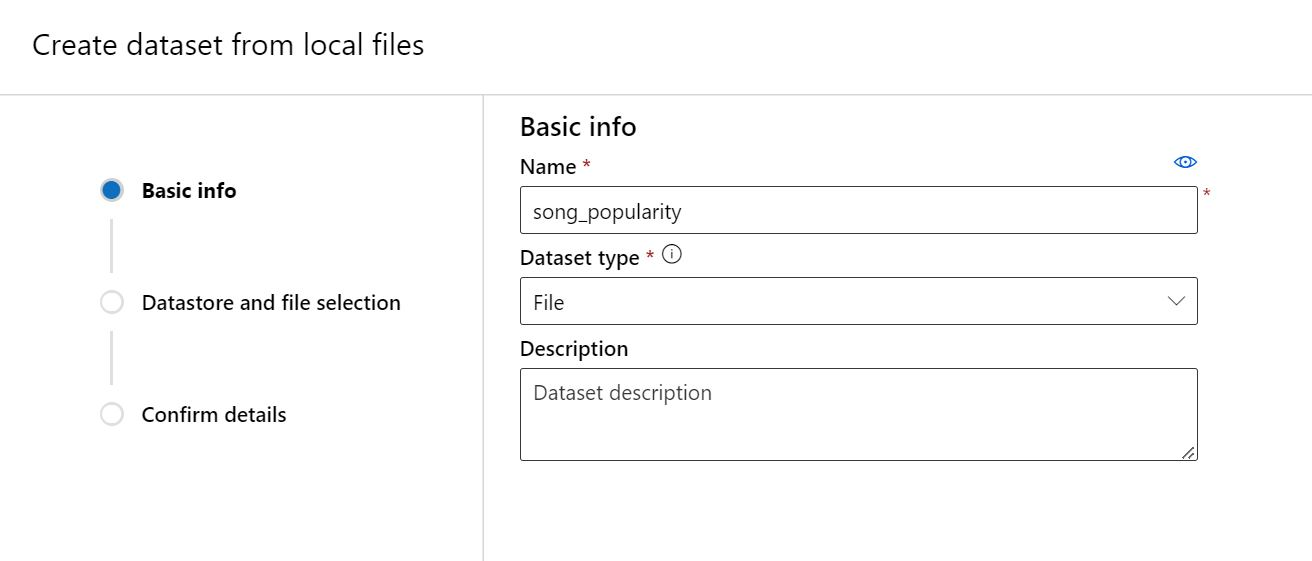
  4. Give the dataset a unique name and make sure to choose “File” as the Dataset type. Screenshot of Azure ML Create Dataset Basic Info step
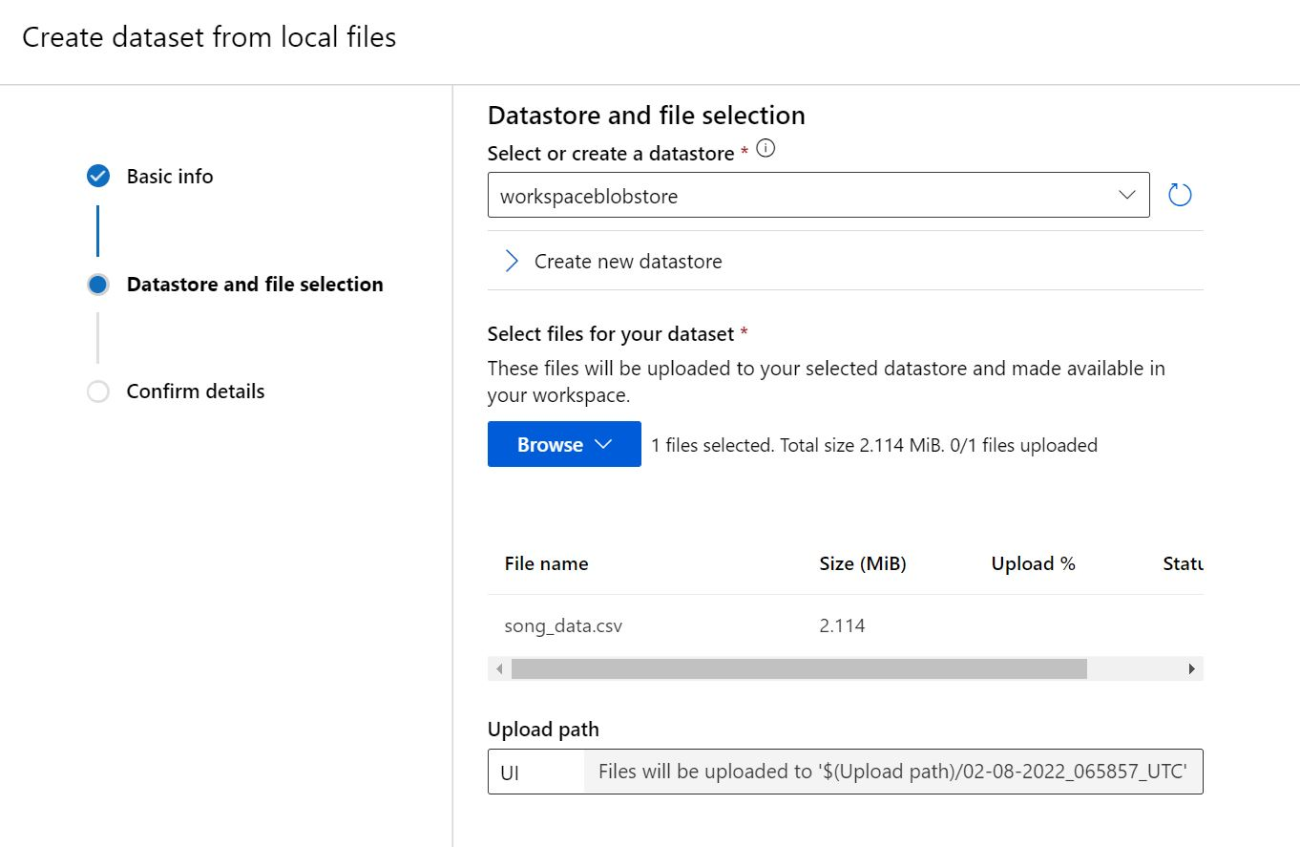
  5. Upload from a local file to the default workspaceblobstore. Take note of the file name. Screenshot of Azure ML Create Dataset Datastore and file selection step
  6. When the data upload finishes, create the dataset.

  7. Click on the completed dataset to view it. Confirm the preview available in the Explore tab looks correct.

  8. Make note of the dataset name, file name, and if you uploaded multiple versions, the version number. We will use these values in the next step.

Training a ML.NET model via Azure Machine Learning

Now that we have a dataset uploaded to Azure ML we can create an Azure ML training pipeline, and use Azure CLI v2 to run it. The pipeline below will create a Docker container with a ML.NET CLI instance that will conduct the training.

  1. Create the Dockerfile and save it in a new folder for this experiment. If not familiar with Dockerfiles, these file types don’t have an extension. The file should be called “Dockerfile” with no extension, and contain the following:

    FROM mcr.microsoft.com/dotnet/sdk:6.0
    RUN dotnet tool install -g microsoft.mlnet-linux-x64
    ENV PATH="$PATH:/root/.dotnet/tools"
  2. We will need to figure out our ML.NET CLI command to train our model. If needed, see installation instructions for the ML.NET CLI. ML.NET CLI Regression command information
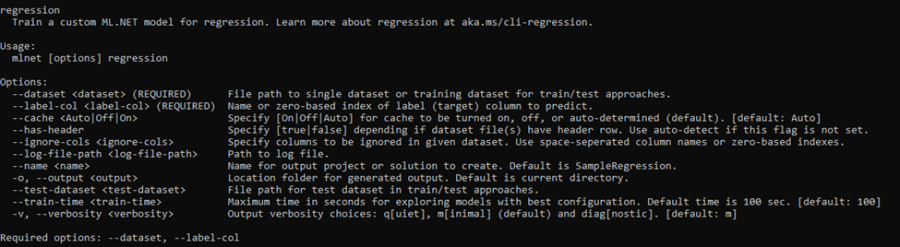
    We’re doing regression and will specify a dataset and label column. Text classification and recommendation are also supported for tabular files. Check the command information or ML.NET CLI docs for more details on other training scenarios.

    Make sure to include the option --verbosity q, as some of the CLI features can cause problems in the Linux environment.

    mlnet regression --dataset <YOUR_DATA_FILE_NAME> --label-col <YOUR_LABEL> --output outputs --log-file-path outputs/logs --verbosity q

  3. Create the AzureTrain.yml file in the same folder as the Dockerfile. This is what will be passed to the Azure CLI. By using input data in the pipeline, Azure ML will download the file dataset to our compute. The training file can then be referenced directly. We just need to specify the path in the command to the ML.NET CLI. Do the following:

    • Replace with the unique dataset name, and with the version number (likely 1). Both values are visible in the Dataset tab. In this example the value is dataset: azureml:song_popularity:1.
    • Replace command with the local ML.NET CLI command. Instead of the local file path, we’ll use {inputs.data} to tell the pipeline to use the download path on the Azure compute. Add the data file name. In this example it is --dataset {inputs.data}/song_data.csv.
    • Replace the compute with our compute name. The available compute clusters in the workspace are visible under Computes -> Compute clusters.

For more information see command job YAML schema documentation.

inputs:
  data:
    dataset: azureml:<DATASET_NAME>:<VERSION>
    mode: download
experiment_name: mldotnet-training
code:
  local_path: .
command: mlnet regression --dataset {inputs.data}/<YOUR_DATA_FILE_NAME> --label-col <YOUR_LABEL_COLUMN> --output outputs --log-file-path outputs/logs --verbosity q
compute: azureml:<YOUR-COMPUTE-NAME>
environment: 
  build:
    local_path: .
    dockerfile_path: Dockerfile

Run manually

To kick off training from a local machine, or just test the functionality of the run, we can install and setup the Azure CLI (v2) with ML extension. In these instructions I’m running ml extension version 2.0.7.

  1. Machine learning subcommands require the –workspace/-w and –resource-group/-g parameters. Configure the defaults for the group and workspace of the dataset.
    az configure –-defaults group=<YOUR_RESOURCE_GROUP> workspace=<YOUR_WORKSPACE>

  2. Run the retraining pipeline created in the previous step.
    az ml job create –-file AzureTrain.yml

  3. Check the results of the run online in the Azure Machine Learning Studio under Experiments -> mldotnet-training

Automate training with Azure DevOps Services pipelines

We can run the Azure ML training via Azure DevOps Pipelines. This allows the use of any trigger, including time based or file changes.

Below are the steps to get the Azure ML pipeline running. For more details, see step-by-step instructions for setting up Azure DevOps and Azure ML.

  1. Check the Dockerfile and AzureTrain.yml into source control. It is best to create a new subfolder to put these files into. Azure CLI will upload the whole containing folder when running the experiment.
  2. Create a service connection between Azure ML and Azure DevOps. In Azure DevOps:
    1. Go to Project settings. Select Pipelines -> Service connections
    2. Create a new connection of type Azure Resource Manager
    3. Select Service principal (automatic) and Scope Level Machine Learning Workspace. Configure it to the Resource Group of your Machine Learning workspace. Name it aml-ws.
  3. In Azure DevOps create a new pipeline, using the following file as a template. Replace the variables and trigger (if applicable). The ml-ws-connection is the connection created in step 2. Depending on where the file is checked in, add the AzureTrain.yml file path to the ‘Create training job’ step.
variables:
  ml-ws-connection: 'aml-ws' # Workspace Service Connection name
  ml-ws: '<YOUR_VALUE>' # AML Workspace name
  ml-rg: '<YOUR_VALUE>' # AML resource Group name

trigger:
  <YOUR_TRIGGER>

pool:
  vmImage: ubuntu-latest

steps:

- task: AzureCLI@2
  displayName: 'Set config functionality'
  inputs:
    azureSubscription: $(ml-ws-connection)
    scriptLocation: inlineScript
    scriptType: 'bash'
    inlineScript: 'az config set extension.use_dynamic_install=yes_without_prompt'

- task: AzureCLI@2
  displayName: 'Install AML CLI (azureml-v2-preview)'
  inputs:
    azureSubscription: $(ml-ws-connection)
    scriptLocation: inlineScript
    scriptType: 'bash'
    inlineScript: 'az extension add -n ml'

- task: AzureCLI@2
  displayName: 'Setup default config values'
  inputs:
    azureSubscription: $(ml-ws-connection)
    scriptLocation: inlineScript
    scriptType: 'bash'
    inlineScript: 'az configure --defaults group=$(ml-rg) workspace=$(ml-ws)'

- task: AzureCLI@2
  displayName: 'Create training job'
  inputs:
    azureSubscription: $(ml-ws-connection)
    scriptLocation: inlineScript
    scriptType: 'bash'
    inlineScript: 'az ml job create --file <YOUR_PATH>/AzureTrain.yml'

Running the Azure CLI job either locally or from Azure DevOps will create an output model in Azure. To see the model, go to Microsoft Azure Machine Learning Studio and navigate to your ML workspace. Click on Experiments -> mldotnet-training. Toggle “View only my runs” to see runs started by the Azure Pipelines Service Principal. The completed training run should be visible. The trained model, and example code, is generated in the Outputs + Logs section, in the outputs folder.

In this post, we’ve created a flexible way to track our data and model via Azure ML. The Azure ML Dataset can be added to and updated while maintaining historical data. This Azure ML retraining pipeline can be run manually or automatically in Azure DevOps. Once your model is trained, you can deploy it using Azure ML custom containers.

Set up your own ML.NET retraining pipeline with Azure Machine Learning Datasets and Azure DevOps? Let us know of any issues, feature requests, or general feedback by filing an issue in the ML.NET Tooling (Model Builder & ML.NET CLI) GitHub repo.

The post Training a ML.NET Model with Azure ML appeared first on .NET Blog.



Learn JavaScript by Building 7 Games - Full Course


Curriculum for the course Learn JavaScript by Building 7 Games - Full Course

Learn JavaScript by building 7 retro games. ✏️ Ania Kubów created this course. Check out her channel: https://www.youtube.com/aniakubow 💻 GitHub Links: Rock Paper Scissors: https://github.com/kubowania/rock-paper-scissors-x3 Memory Game: https://github.com/kubowania/memory-game Whac-a-mole: https://github.com/kubowania/whac-a-mole Breakout: https://github.com/kubowania/breakout Frogger: https://github.com/kubowania/Frogger Connect Four: https://github.com/kubowania/connect-four Space Invaders: https://github.com/kubowania/space-invaders ⭐️ Course Contents ⭐️ ⌨️ (0:00:00) Introduction ⌨️ (0:01:56) Rock Paper Scissors ⌨️ (0:18:42) Memory Game ⌨️ (1:04:37) Whac-a-mole ⌨️ (1:30:39) Breakout ⌨️ (2:31:10) Frogger ⌨️ (3:40:02) Connect Four ⌨️ (4:08:23) Space Invaders 🎉 Thanks to our Champion and Sponsor supporters: 👾 Raymond Odero 👾 Agustín Kussrow 👾 aldo ferretti 👾 Otis Morgan 👾 DeezMaster -- Learn to code for free and get a developer job: https://www.freecodecamp.org Read hundreds of articles on programming: https://freecodecamp.org/news And subscribe for new videos on technology every day: https://youtube.com/subscription_center?add_user=freecodecamp

Watch Online Full Course: Learn JavaScript by Building 7 Games - Full Course


Click Here to watch on Youtube: Learn JavaScript by Building 7 Games - Full Course


This video is first published on youtube via freecodecamp. If Video does not appear here, you can watch this on Youtube always.


Udemy Learn JavaScript by Building 7 Games - Full Course courses free download, Plurasight Learn JavaScript by Building 7 Games - Full Course courses free download, Linda Learn JavaScript by Building 7 Games - Full Course courses free download, Coursera Learn JavaScript by Building 7 Games - Full Course course download free, Brad Hussey udemy course free, free programming full course download, full course with project files, Download full project free, College major project download, CS major project idea, EC major project idea, clone projects download free

.NET 💜 GitHub Actions

Hi friends, I put together two posts where I’m going to teach you the basics of the GitHub Actions platform. In this first post, you’ll learn how GitHub Actions can improve your .NET development experience and team productivity. I’ll show you how to use them to automate common .NET app dev scenarios with workflow composition. In the next post, I’ll show you how to create a custom GitHub Action written in .NET.

An introduction to GitHub Actions

Developers that use GitHub for managing their git repositories have a powerful continuous integration (CI) and continuous delivery (CD) feature with the help of GitHub Actions. A common developer scenario is when developers propose changes to the default branch (typically main) of a GitHub repository. These changes, while often scrutinized by reviewers, can have automated checks to ensure that the code compiles and tests pass.

GitHub Actions allow you to build, test, and deploy your code right from your source code repository on https://github.com. GitHub Actions are consumed by GitHub workflows. A GitHub workflow is a YAML (either *.yml or *.yaml) file within your GitHub repository. These workflow files reside in the .github/workflows/ directory from the root of the repository. A workflow references one or more GitHub Action(s) together as a series of instructions, where each instruction executes a specific task.

The GitHub Action terminology

To avoid mistakenly using some of these terms inaccurately, let’s define them:

  • GitHub Actions: GitHub Actions is a continuous integration and continuous delivery (CI/CD) platform that allows you to automate your build, test, and deployment pipeline.
  • workflow: A workflow is a configurable automated process that will run one or more jobs.
  • event: An event is a specific activity in a repository that triggers a workflow run.
  • job: A job is a set of steps in a workflow that execute on the same runner.
  • action: An action is a custom application for the GitHub Actions platform that performs a complex but frequently repeated task.
  • runner: A runner is a server that runs your workflows when they’re triggered.

For more information, see GitHub Docs: Understanding GitHub Actions

Inside the GitHub workflow file

A workflow file defines a sequence of jobs and their corresponding steps to follow. Each workflow has a name and a set of triggers, or events to act on. You have to specify at least one trigger for your workflow to run unless it’s a reusable workflow. A common .NET GitHub workflow would be to build and test your C# code when changes are either pushed or when there’s a pull request targeting the default branch. Consider the following workflow file:

name: build and test
on:
  push:
  pull_request:
    branches: [ main ]
    paths-ignore:
    - 'README.md'
env:
  DOTNET_VERSION: '6.0.x'
jobs:
  build-and-test:
    name: build-and-test-$
    runs-on: $
    strategy:
      matrix:
        os: [ubuntu-latest, windows-latest, macOS-latest]
    steps:
    - uses: actions/checkout@v2
    - name: Setup .NET
      uses: actions/setup-dotnet@v1
      with:
        dotnet-version: $
    - name: Install dependencies
      run: dotnet restore
    - name: Build
      run: dotnet build --configuration Release --no-restore
    - name: Test
      run: dotnet test --no-restore --verbosity normal

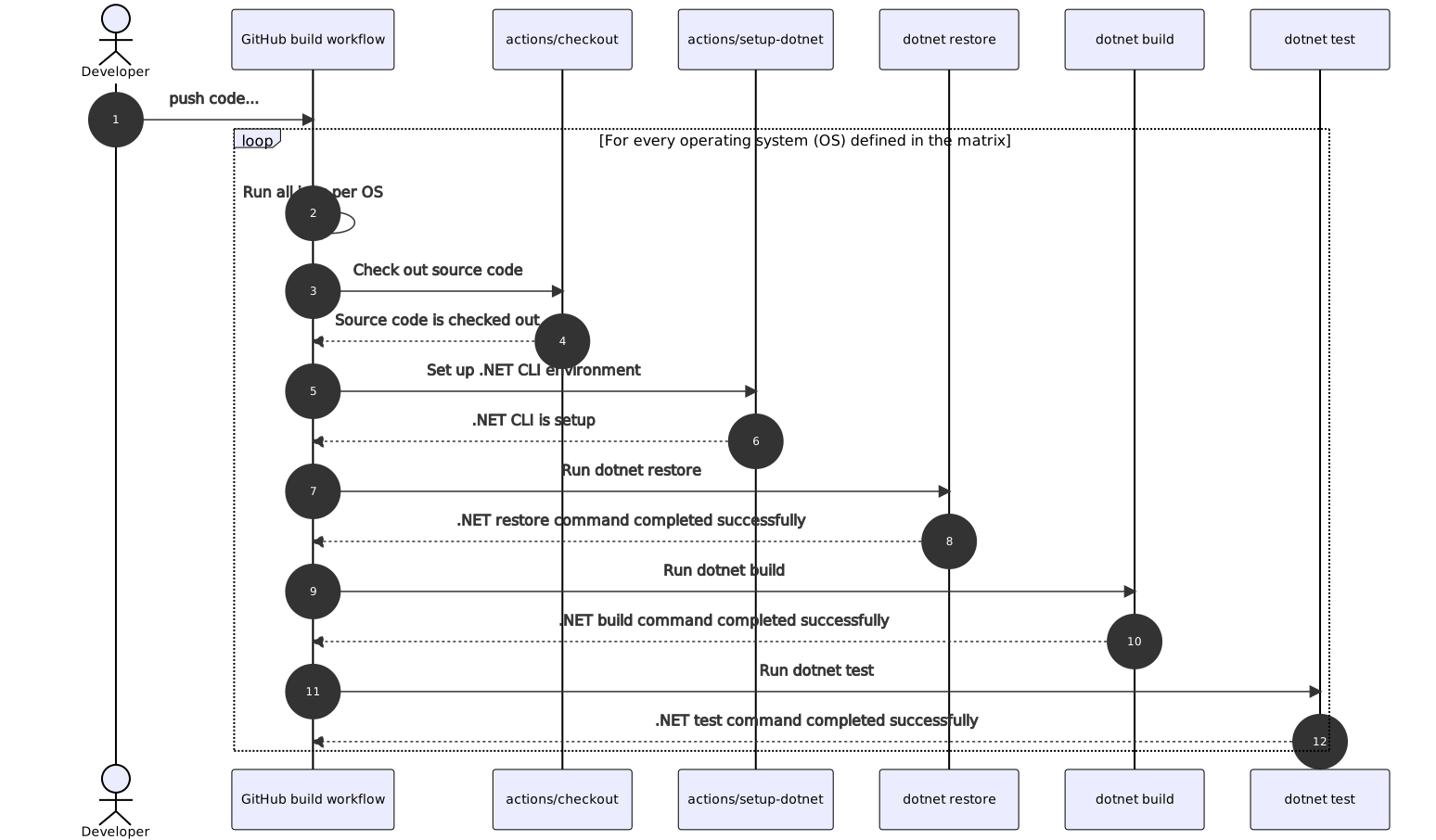
I’m not going to assume that you have a deep understanding of this workflow, and while it’s less than thirty lines — there is still a lot to unpack. I put together a sequence diagram (powered by Mermaid), that shows how a developer might visualize this workflow.

GitHub build and test workflow sequence diagram.

Here’s the same workflow file, but this time it is expanded with inline comments to add context (if you’re already familiar with the workflow syntax, feel free to skip past this):

# The name of the workflow.
# This is the name that's displayed for status
# badges (commonly embedded in README.md files).
name: build and test

# Trigger this workflow on a push, or pull request to
# the main branch, when either C# or project files changed
on:
  push:
  pull_request:
    branches: [ main ]
    paths-ignore:
    - 'README.md'

# Create an environment variable named DOTNET_VERSION
# and set it as "6.0.x"
env:
  DOTNET_VERSION: '6.0.x' # The .NET SDK version to use

# Defines a single job named "build-and-test"
jobs:
  build-and-test:

    # When the workflow runs, this is the name that is logged
    # This job will run three times, once for each "os" defined
    name: build-and-test-$
    runs-on: $
    strategy:
      matrix:
        os: [ubuntu-latest, windows-latest, macOS-latest]

    # Each job run contains these five steps
    steps:

    # 1) Check out the source code so that the workflow can access it.
    - uses: actions/checkout@v2

    # 2) Set up the .NET CLI environment for the workflow to use.
    #    The .NET version is specified by the environment variable.
    - name: Setup .NET
      uses: actions/setup-dotnet@v1
      with:
        dotnet-version: $

    # 3) Restore the dependencies and tools of a project or solution.
    - name: Install dependencies
      run: dotnet restore

    # 4) Build a project or solution and all of its dependencies.
    - name: Build
      run: dotnet build --configuration Release --no-restore

    # 5) Test a project or solution.
    - name: Test
      run: dotnet test --no-restore --verbosity normal

The preceding workflow file contains many comments to help detail each area of the workflow. You might have noticed that the steps define various usages of GitHub Actions or simple run commands. The relationship between a GitHub Action and a consuming GitHub workflow is that workflows consume actions. A GitHub Action is only as powerful as the consuming workflow. Workflows can define anything from simple tasks to elaborate compositions and everything in between. For more information on creating GitHub workflows for .NET apps, see the following .NET docs resources:

I hope that you’re asking yourself, “why is this important?” Sure, we can create GitHub Actions, and we can compose workflows that consume them — but why is that important?! That answer is GitHub status checks 🤓.

GitHub status checks

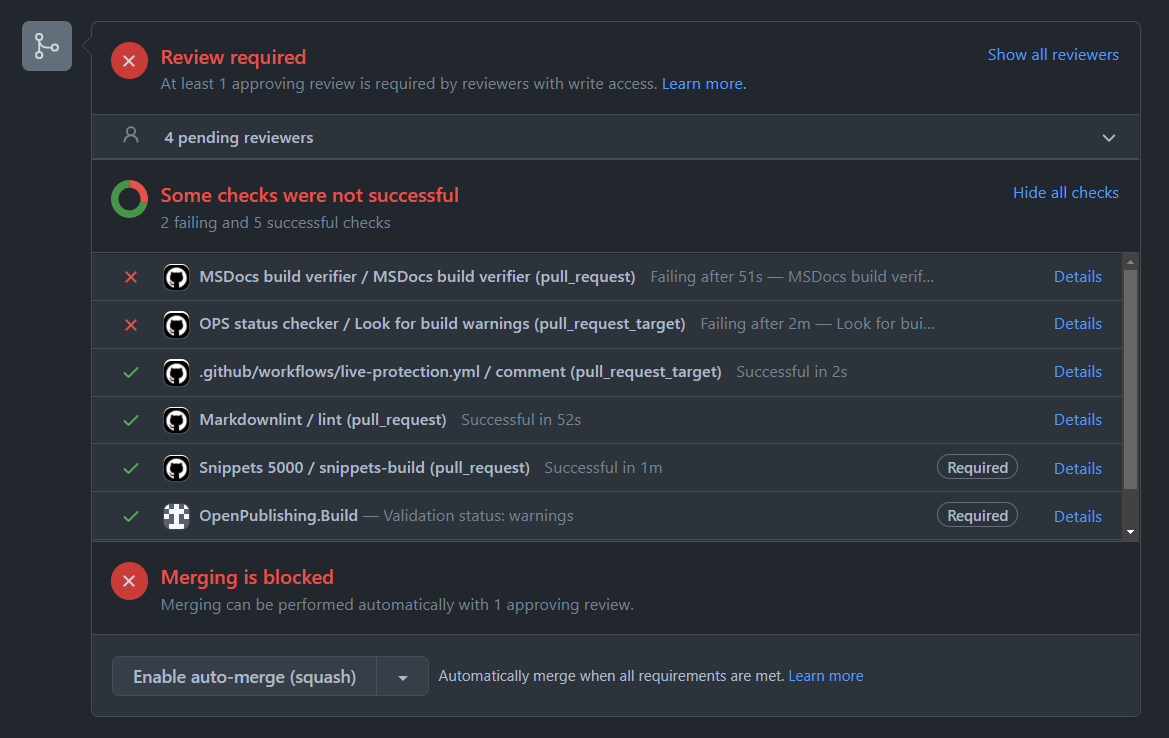
One of the primary benefits of using workflows is to define conditional status checks that can deterministically fail a build. A workflow can be configured as a status check for a pull request (PR), and if the workflow fails, for example the source code in the pull request doesn’t compile — the PR can be blocked from being merged. Consider the following screen capture, which shows that two checks have failed, thus blocking the PR from being merged.

Example GitHub pull request with failing status checks.

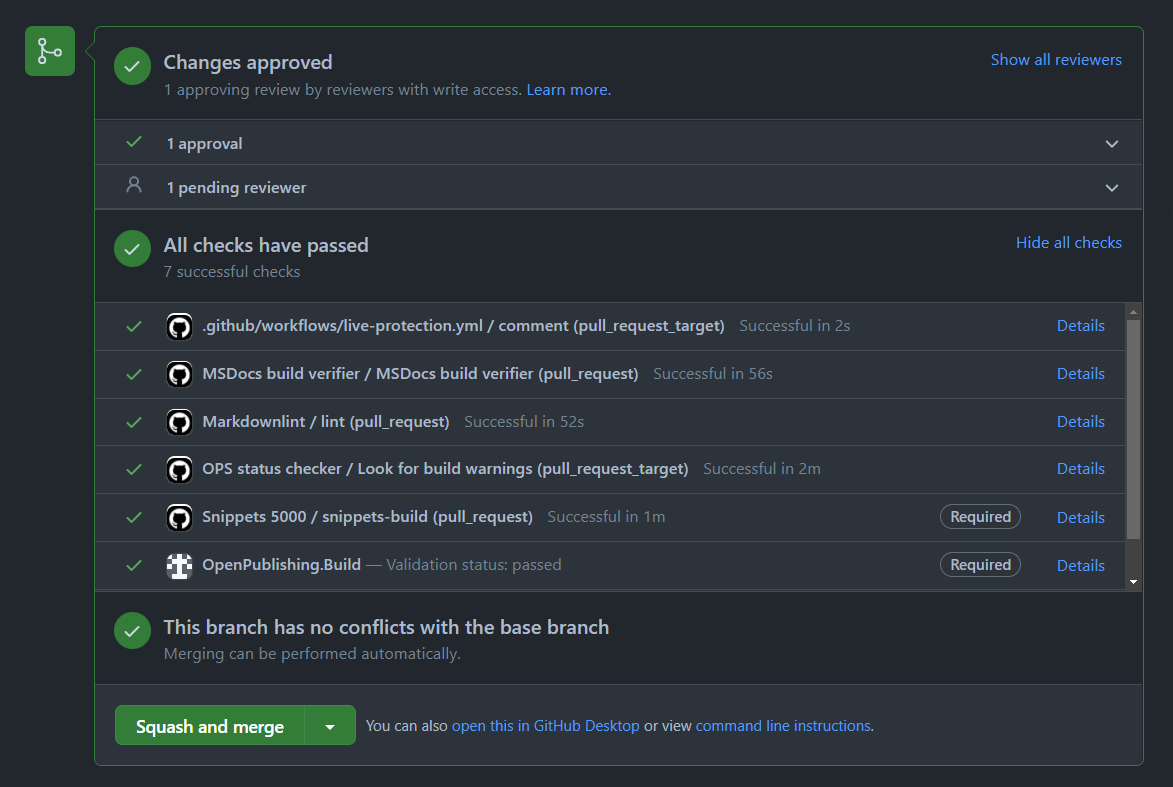
As the developer who is responsible for reviewing a PR, you’d immediately see that the pull request has failing status checks. You’d work with the developer who proposed the PR to get all of the status checks to pass. The following is a screen capture showing a “green build”, a build that has all of its status checks as passing.

Example GitHub pull request with passing status checks.

For more information, see GitHub Docs: GitHub status checks.

GitHub Actions that .NET developers should know

As a .NET developer, you’re likely familiar with the .NET CLI. The .NET CLI is included with the .NET SDK. If you don’t already have the .NET SDK, you can download the .NET 6 SDK.

Using the previous workflow file as a point of reference, there are five steps — each step includes either the run or uses syntax:

Action or command Description
uses: actions/checkout@v2 This action checks-out your repository under $GITHUB_WORKSPACE, so your workflow can access it. For more information, see actions/checkout
uses: actions/setup-dotnet@v1 This action sets up a .NET CLI environment for use in actions. For more information, see actions/setup-dotnet
run: dotnet restore Restores the dependencies and tools of a project or solution. For more information, see dotnet restore
run: dotnet build Builds the project or solution. For more information, see dotnet build
run: dotnet test Runs the tests for the project or solution. For more information, see dotnet test

Some steps rely on GitHub Actions and reference them with the uses syntax, while others run commands. For more information on the differences, see Workflow syntax for GitHub Actions: uses and run.

.NET applications rely on NuGet packages. You can optimize your workflows by caching various dependencies that change infrequently, such as NuGet packages. As an example, you can use the actions/cache to cache NuGet packages:

steps:
- uses: actions/checkout@v2
- name: Setup dotnet
  uses: actions/setup-dotnet@v1
  with:
    dotnet-version: '6.0.x'
- uses: actions/cache@v2
  with:
    path: ~/.nuget/packages
    # Look to see if there is a cache hit for the corresponding requirements file
    key: $-nuget-$
    restore-keys: |
      $-nuget
- name: Install dependencies
  run: dotnet add package Newtonsoft.Json --version 12.0.1

For more information, see GitHub Docs: Building and testing .NET - Caching dependencies.

In addition to using the standard GitHub Actions or invoking .NET CLI commands using the run syntax, you might be interested in learning about some additional GitHub Actions.

Additional GitHub Actions

Several .NET GitHub Actions are hosted on the dotnet GitHub organization:

.NET GitHub Action Description
dotnet/versionsweeper This action sweeps .NET repos for out-of-support target versions of .NET. The .NET docs team uses the .NET version sweeper GitHub Action to automate issue creation. The action runs as a cron job (or on a schedule). When it detects that .NET projects target out-of-support versions, it creates issues to report its findings. The output is configurable and helpful for tracking .NET version support concerns.
dotnet/code-analysis This action runs the code analysis rules that are included in the .NET SDK as part of continuous integration (CI). The action runs both code-quality (CAXXXX) rules and code-style (IDEXXXX) rules.

.NET developer community spotlight

The .NET developer community is building GitHub Actions that might be useful in your organizations. As an example, check out the zyborg/dotnet-tests-report which is a GitHub Action to run .NET tests and generate reports and badges. If you use this GitHub Action, be sure to give their repo a star ⭐.

There are many .NET GitHub Actions that can be consumed from workflows, see the GitHub Marketplace: .NET.

A word on .NET workloads

.NET runs anywhere, and you can use it to build anything. There are optional workloads that may need to be installed when building from a GitHub workflow. There are many workloads available, see the output of the dotnet workload search command as an example:

dotnet workload search

Workload ID         Description
-----------------------------------------------------------------------------------------
android             .NET SDK Workload for building Android applications.
android-aot         .NET SDK Workload for building Android applications with AOT support.
ios                 .NET SDK Workload for building iOS applications.
maccatalyst         .NET SDK Workload for building macOS applications with MacCatalyst.
macos               .NET SDK Workload for building macOS applications.
maui                .NET MAUI SDK for all platforms
maui-android        .NET MAUI SDK for Android
maui-desktop        .NET MAUI SDK for Desktop
maui-ios            .NET MAUI SDK for iOS
maui-maccatalyst    .NET MAUI SDK for Mac Catalyst
maui-mobile         .NET MAUI SDK for Mobile
maui-windows        .NET MAUI SDK for Windows
tvos                .NET SDK Workload for building tvOS applications.
wasm-tools          .NET WebAssembly build tools

If you're writing a workflow for Blazor WebAssembly app, or .NET MAUI as an example — you'll likely run the dotnet workload install command as one of your steps. For example, an individual run step to install the WebAssembly build tools would look like:

run: dotnet workload install wasm-tools

Summary

In this post, I explained the key differences between GitHub Actions and GitHub workflows. I explained and scrutinized each line in an example workflow file. I then showed you how a developer might visualize the execution of a GitHub workflow as a sequence diagram. I shared a few additional resources you may not have known about. For more information, see .NET Docs: GitHub Actions and .NET.

In the next post, I'll show how to create GitHub Actions using .NET. I'll walk you through upgrading an existing .NET GitHub Action that is used to automatically maintain a _CODEMETRICS.md file within the root of the repository. The code metrics analyze the C# source code of the target repository to determine things such as cyclomatic complexity and the maintainability index. In addition to these metrics, we'll add the ability to generate Mermaid class diagrams, which is now natively supported by GitHub flavored markdown.

The post .NET 💜 GitHub Actions appeared first on .NET Blog.


.NET 💜 GitHub Actions

Hi friends, I put together two posts where I’m going to teach you the basics of the GitHub Actions platform. In this first post, you’ll learn how GitHub Actions can improve your .NET development experience and team productivity. I’ll show you how to use them to automate common .NET app dev scenarios with workflow composition. In the next post, I’ll show you how to create a custom GitHub Action written in .NET.

An introduction to GitHub Actions

Developers that use GitHub for managing their git repositories have a powerful continuous integration (CI) and continuous delivery (CD) feature with the help of GitHub Actions. A common developer scenario is when developers propose changes to the default branch (typically main) of a GitHub repository. These changes, while often scrutinized by reviewers, can have automated checks to ensure that the code compiles and tests pass.

GitHub Actions allow you to build, test, and deploy your code right from your source code repository on https://github.com. GitHub Actions are consumed by GitHub workflows. A GitHub workflow is a YAML (either *.yml or *.yaml) file within your GitHub repository. These workflow files reside in the .github/workflows/ directory from the root of the repository. A workflow references one or more GitHub Action(s) together as a series of instructions, where each instruction executes a specific task.

The GitHub Action terminology

To avoid mistakenly using some of these terms inaccurately, let’s define them:

  • GitHub Actions: GitHub Actions is a continuous integration and continuous delivery (CI/CD) platform that allows you to automate your build, test, and deployment pipeline.
  • workflow: A workflow is a configurable automated process that will run one or more jobs.
  • event: An event is a specific activity in a repository that triggers a workflow run.
  • job: A job is a set of steps in a workflow that execute on the same runner.
  • action: An action is a custom application for the GitHub Actions platform that performs a complex but frequently repeated task.
  • runner: A runner is a server that runs your workflows when they’re triggered.

For more information, see GitHub Docs: Understanding GitHub Actions

Inside the GitHub workflow file

A workflow file defines a sequence of jobs and their corresponding steps to follow. Each workflow has a name and a set of triggers, or events to act on. You have to specify at least one trigger for your workflow to run unless it’s a reusable workflow. A common .NET GitHub workflow would be to build and test your C# code when changes are either pushed or when there’s a pull request targeting the default branch. Consider the following workflow file:

name: build and test
on:
  push:
  pull_request:
    branches: [ main ]
    paths-ignore:
    - 'README.md'
env:
  DOTNET_VERSION: '6.0.x'
jobs:
  build-and-test:
    name: build-and-test-$
    runs-on: $
    strategy:
      matrix:
        os: [ubuntu-latest, windows-latest, macOS-latest]
    steps:
    - uses: actions/checkout@v2
    - name: Setup .NET
      uses: actions/setup-dotnet@v1
      with:
        dotnet-version: $
    - name: Install dependencies
      run: dotnet restore
    - name: Build
      run: dotnet build --configuration Release --no-restore
    - name: Test
      run: dotnet test --no-restore --verbosity normal

I’m not going to assume that you have a deep understanding of this workflow, and while it’s less than thirty lines — there is still a lot to unpack. I put together a sequence diagram (powered by Mermaid), that shows how a developer might visualize this workflow.

GitHub build and test workflow sequence diagram.

Here’s the same workflow file, but this time it is expanded with inline comments to add context (if you’re already familiar with the workflow syntax, feel free to skip past this):

# The name of the workflow.
# This is the name that's displayed for status
# badges (commonly embedded in README.md files).
name: build and test

# Trigger this workflow on a push, or pull request to
# the main branch, when either C# or project files changed
on:
  push:
  pull_request:
    branches: [ main ]
    paths-ignore:
    - 'README.md'

# Create an environment variable named DOTNET_VERSION
# and set it as "6.0.x"
env:
  DOTNET_VERSION: '6.0.x' # The .NET SDK version to use

# Defines a single job named "build-and-test"
jobs:
  build-and-test:

    # When the workflow runs, this is the name that is logged
    # This job will run three times, once for each "os" defined
    name: build-and-test-$
    runs-on: $
    strategy:
      matrix:
        os: [ubuntu-latest, windows-latest, macOS-latest]

    # Each job run contains these five steps
    steps:

    # 1) Check out the source code so that the workflow can access it.
    - uses: actions/checkout@v2

    # 2) Set up the .NET CLI environment for the workflow to use.
    #    The .NET version is specified by the environment variable.
    - name: Setup .NET
      uses: actions/setup-dotnet@v1
      with:
        dotnet-version: $

    # 3) Restore the dependencies and tools of a project or solution.
    - name: Install dependencies
      run: dotnet restore

    # 4) Build a project or solution and all of its dependencies.
    - name: Build
      run: dotnet build --configuration Release --no-restore

    # 5) Test a project or solution.
    - name: Test
      run: dotnet test --no-restore --verbosity normal

The preceding workflow file contains many comments to help detail each area of the workflow. You might have noticed that the steps define various usages of GitHub Actions or simple run commands. The relationship between a GitHub Action and a consuming GitHub workflow is that workflows consume actions. A GitHub Action is only as powerful as the consuming workflow. Workflows can define anything from simple tasks to elaborate compositions and everything in between. For more information on creating GitHub workflows for .NET apps, see the following .NET docs resources:

I hope that you’re asking yourself, “why is this important?” Sure, we can create GitHub Actions, and we can compose workflows that consume them — but why is that important?! That answer is GitHub status checks 🤓.

GitHub status checks

One of the primary benefits of using workflows is to define conditional status checks that can deterministically fail a build. A workflow can be configured as a status check for a pull request (PR), and if the workflow fails, for example the source code in the pull request doesn’t compile — the PR can be blocked from being merged. Consider the following screen capture, which shows that two checks have failed, thus blocking the PR from being merged.

Example GitHub pull request with failing status checks.

As the developer who is responsible for reviewing a PR, you’d immediately see that the pull request has failing status checks. You’d work with the developer who proposed the PR to get all of the status checks to pass. The following is a screen capture showing a “green build”, a build that has all of its status checks as passing.

Example GitHub pull request with passing status checks.

For more information, see GitHub Docs: GitHub status checks.

GitHub Actions that .NET developers should know

As a .NET developer, you’re likely familiar with the .NET CLI. The .NET CLI is included with the .NET SDK. If you don’t already have the .NET SDK, you can download the .NET 6 SDK.

Using the previous workflow file as a point of reference, there are five steps — each step includes either the run or uses syntax:

Action or command Description
uses: actions/checkout@v2 This action checks-out your repository under $GITHUB_WORKSPACE, so your workflow can access it. For more information, see actions/checkout
uses: actions/setup-dotnet@v1 This action sets up a .NET CLI environment for use in actions. For more information, see actions/setup-dotnet
run: dotnet restore Restores the dependencies and tools of a project or solution. For more information, see dotnet restore
run: dotnet build Builds the project or solution. For more information, see dotnet build
run: dotnet test Runs the tests for the project or solution. For more information, see dotnet test

Some steps rely on GitHub Actions and reference them with the uses syntax, while others run commands. For more information on the differences, see Workflow syntax for GitHub Actions: uses and run.

.NET applications rely on NuGet packages. You can optimize your workflows by caching various dependencies that change infrequently, such as NuGet packages. As an example, you can use the actions/cache to cache NuGet packages:

steps:
- uses: actions/checkout@v2
- name: Setup dotnet
  uses: actions/setup-dotnet@v1
  with:
    dotnet-version: '6.0.x'
- uses: actions/cache@v2
  with:
    path: ~/.nuget/packages
    # Look to see if there is a cache hit for the corresponding requirements file
    key: $-nuget-$
    restore-keys: |
      $-nuget
- name: Install dependencies
  run: dotnet add package Newtonsoft.Json --version 12.0.1

For more information, see GitHub Docs: Building and testing .NET - Caching dependencies.

In addition to using the standard GitHub Actions or invoking .NET CLI commands using the run syntax, you might be interested in learning about some additional GitHub Actions.

Additional GitHub Actions

Several .NET GitHub Actions are hosted on the dotnet GitHub organization:

.NET GitHub Action Description
dotnet/versionsweeper This action sweeps .NET repos for out-of-support target versions of .NET. The .NET docs team uses the .NET version sweeper GitHub Action to automate issue creation. The action runs as a cron job (or on a schedule). When it detects that .NET projects target out-of-support versions, it creates issues to report its findings. The output is configurable and helpful for tracking .NET version support concerns.
dotnet/code-analysis This action runs the code analysis rules that are included in the .NET SDK as part of continuous integration (CI). The action runs both code-quality (CAXXXX) rules and code-style (IDEXXXX) rules.

.NET developer community spotlight

The .NET developer community is building GitHub Actions that might be useful in your organizations. As an example, check out the zyborg/dotnet-tests-report which is a GitHub Action to run .NET tests and generate reports and badges. If you use this GitHub Action, be sure to give their repo a star ⭐.

There are many .NET GitHub Actions that can be consumed from workflows, see the GitHub Marketplace: .NET.

A word on .NET workloads

.NET runs anywhere, and you can use it to build anything. There are optional workloads that may need to be installed when building from a GitHub workflow. There are many workloads available, see the output of the dotnet workload search command as an example:

dotnet workload search

Workload ID         Description
-----------------------------------------------------------------------------------------
android             .NET SDK Workload for building Android applications.
android-aot         .NET SDK Workload for building Android applications with AOT support.
ios                 .NET SDK Workload for building iOS applications.
maccatalyst         .NET SDK Workload for building macOS applications with MacCatalyst.
macos               .NET SDK Workload for building macOS applications.
maui                .NET MAUI SDK for all platforms
maui-android        .NET MAUI SDK for Android
maui-desktop        .NET MAUI SDK for Desktop
maui-ios            .NET MAUI SDK for iOS
maui-maccatalyst    .NET MAUI SDK for Mac Catalyst
maui-mobile         .NET MAUI SDK for Mobile
maui-windows        .NET MAUI SDK for Windows
tvos                .NET SDK Workload for building tvOS applications.
wasm-tools          .NET WebAssembly build tools

If you're writing a workflow for Blazor WebAssembly app, or .NET MAUI as an example — you'll likely run the dotnet workload install command as one of your steps. For example, an individual run step to install the WebAssembly build tools would look like:

run: dotnet workload install wasm-tools

Summary

In this post, I explained the key differences between GitHub Actions and GitHub workflows. I explained and scrutinized each line in an example workflow file. I then showed you how a developer might visualize the execution of a GitHub workflow as a sequence diagram. I shared a few additional resources you may not have known about. For more information, see .NET Docs: GitHub Actions and .NET.

In the next post, I'll show how to create GitHub Actions using .NET. I'll walk you through upgrading an existing .NET GitHub Action that is used to automatically maintain a _CODEMETRICS.md file within the root of the repository. The code metrics analyze the C# source code of the target repository to determine things such as cyclomatic complexity and the maintainability index. In addition to these metrics, we'll add the ability to generate Mermaid class diagrams, which is now natively supported by GitHub flavored markdown.

The post .NET 💜 GitHub Actions appeared first on .NET Blog.


source https://devblogs.microsoft.com/dotnet/dotnet-loves-github-actions/

.NET Microservices – Full Course for Beginners


Curriculum for the course .NET Microservices – Full Course for Beginners

Learn the foundational elements of a microservices architecture with .NET in this beginner level course. You will incrementally building a real microservices-based application with the .NET platform and C#. 💻 Get the code: https://youtube.dotnetmicroservices.com/netmicroservicesbasics ✏️ Course created by Julio Casal. Check out his channel: https://www.youtube.com/channel/UCw8aBxRvQ2ksWNFuO5eHdmA 🔥 Want to master microservices? Learn more from Julio here: https://dotnetmicroservices.com ⭐️ Course Contents ⭐️ ⌨️ (0:00:14) Module 1- Welcome to the course! ⌨️ (0:04:52) Development environment setup ⌨️ (0:12:39) Customizing VS Code for C# Development ⌨️ (0:17:37) What's wrong with the monolith? ⌨️ (0:25:32) What are microservices? ⌨️ (0:35:18) Module 2- Your first microservice ⌨️ (0:35:53) Creating a microservice via the .NET CLI ⌨️ (0:45:46) Introduction to the REST API and DTOs ⌨️ (0:47:35) Adding the DTOs ⌨️ (0:50:52) Adding the REST API operations ⌨️ (1:15:57) Handling invalid inputs ⌨️ (1:27:04) Module 3- Adding database storage ⌨️ (1:27:51) Introduction to the repository pattern and MongoDB ⌨️ (1:30:13) Implementing a MongoDB repository ⌨️ (1:44:18) Using the repository in the controller ⌨️ (1:55:11) Introduction to Docker ⌨️ (1:56:57) Trying out the REST API with a MongoDB container ⌨️ (2:09:50) Introduction to Dependency Injection and Configuration ⌨️ (2:14:47) Implementing dependency injection and configuration ⌨️ (2:31:40) Module 4- Preparing for the next microservice ⌨️ (2:32:37) Using Postman ⌨️ (2:48:01) Reusing common code via NuGet ⌨️ (2:52:12) Refactoring into a generic MongoDB repository ⌨️ (3:03:02) Refactoring MongoDB registration into extension methods ⌨️ (3:10:07) Moving generic code into a reusable NuGet package ⌨️ (3:26:04) Introduction to Docker Compose ⌨️ (3:28:24) Moving MongoDB to docker compose ⌨️ (3:39:18) Module 5- Synchronous inter-service communication ⌨️ (3:40:12) Creating the Inventory microservice ⌨️ (4:06:47) Introduction to synchronous communication ⌨️ (4:10:29) Implementing synchronous communication via IHttpClientFactory ⌨️ (4:22:15) Understanding timeouts and retries with exponential backoff ⌨️ (4:25:45) Implementing a timeout policy via Polly ⌨️ (4:35:41) Implementing retries with exponential backoff ⌨️ (4:46:53) Understanding the circuit breaker pattern ⌨️ (4:49:59) Implementing the circuit breaker pattern ⌨️ (4:56:36) Module 6- Asynchronous inter-service communication ⌨️ (4:57:31) Introduction to asynchronous communication ⌨️ (5:07:23) Defining the message contracts ⌨️ (5:11:09) Publishing messages via MassTransit ⌨️ (5:22:21) Standing up a RabbitMQ docker container ⌨️ (5:30:04) Refactoring MassTransit configuration into the reusable NuGet package ⌨️ (5:41:11) Consuming messages for eventual data consistency ⌨️ (6:01:54) Removing the inter-service synchronous communication ⌨️ (6:16:32) Module 7- Initial Frontend Integration ⌨️ (6:17:02) Installing Node.js ⌨️ (6:20:13) Getting started with the frontend ⌨️ (6:34:55) Understanding CORS ⌨️ (6:40:50) Adding the CORS middleware ⌨️ (6:46:49) Exploring the frontend to microservices communication ⌨️ (7:05:18) Next Steps #dotnet #microservices 🎉 Thanks to our Champion and Sponsor supporters: 👾 Raymond Odero 👾 Agustín Kussrow 👾 aldo ferretti 👾 Otis Morgan 👾 DeezMaster -- Learn to code for free and get a developer job: https://www.freecodecamp.org Read hundreds of articles on programming: https://freecodecamp.org/news And subscribe for new videos on technology every day: https://youtube.com/subscription_center?add_user=freecodecamp

Watch Online Full Course: .NET Microservices – Full Course for Beginners


Click Here to watch on Youtube: .NET Microservices – Full Course for Beginners


This video is first published on youtube via freecodecamp. If Video does not appear here, you can watch this on Youtube always.


Udemy .NET Microservices – Full Course for Beginners courses free download, Plurasight .NET Microservices – Full Course for Beginners courses free download, Linda .NET Microservices – Full Course for Beginners courses free download, Coursera .NET Microservices – Full Course for Beginners course download free, Brad Hussey udemy course free, free programming full course download, full course with project files, Download full project free, College major project download, CS major project idea, EC major project idea, clone projects download free

Flutter Course for Beginners


Curriculum for the course Flutter Course for Beginners

Learn how to use Flutter in this complete course for beginners. Flutter is an open-source UI software development kit used to create cross-platform applications for iOS, Android, Windows, Mac, and more. 💻 GitHub repo: https://github.com/vandadnp/mynotes-course ✏️ Course developed by Vandad Nahavandipoor. Check out his channel: https://www.youtube.com/channel/UC8NpGP0AOQ0kX9ZRcohiPeQ 🔗 Discord study group (for questions and answers about this course): https://discord.gg/C8UpxJyU4n 🔗 Setting up Firebase CLI and FlutterFire CLI on Windows: https://www.youtube.com/watch?v=nQ3AhFo2rKc ⭐️ Course Contents ⭐️ ⌨️ (00:00:00) Introduction ⌨️ (00:02:57) Developer Accounts ⌨️ (00:39:12) Setup ⌨️ (01:14:42) Introduction to Dart ⌨️ (02:01:26) Dart Control Statements and Collections ⌨️ (02:46:44) Sound Null safety in Dart ⌨️ (03:27:12) Dart Enumerations, Classes and Objects ⌨️ (04:18:36) Advanced Dart ⌨️ (05:00:41) Project Setup ⌨️ (05:48:30) iOS App Setup ⌨️ (06:59:32) Android App Setup ⌨️ (07:31:31) Firebase Backend Setup ⌨️ (08:01:20) Basic Registration Screen ⌨️ (09:04:54) Login View ⌨️ (09:53:10) Separating App Initialization from Login and Register Screens ⌨️ (10:19:47) Setting up Git and GitHub ⌨️ (11:10:34) Email Verification View ⌨️ (11:44:45) Link Between Login and Register Views ⌨️ (12:18:01) Logout View ⌨️ (13:13:46) Go From Login to Notes View ⌨️ (13:36:43) Cleaning Up our Routes ⌨️ (13:51:17) Error Handling in Login View ⌨️ (14:16:21) Error Handling in Register View, Next Screen After Registration ⌨️ (14:44:45) Confirming Identity Before Going to Main UI ⌨️ (14:52:21) Auth Service ⌨️ (15:55:22) Migrating to Auth Service ⌨️ (16:33:41) Unit Testing our AuthService ⌨️ (17:43:42) CRUD Local Storage ⌨️ (19:30:57) Working with Streams in Notes Service ⌨️ (20:04:32) Preparing Notes View to Read All Notes ⌨️ (20:39:21) Preparing to Create New Notes ⌨️ (21:00:16) Creating New Notes ⌨️ (21:35:42) Displaying Notes in Notes View ⌨️ (21:56:04) Deleting Existing Notes in Notes View ⌨️ (22:40:46) Updating Existing Notes ⌨️ (23:14:12) Protecting NotesService with Current User ⌨️ (23:40:44) Writing Notes to Cloud Firestore ⌨️ (24:58:08) Migrating to our Firestore Service ⌨️ (25:22:35) Sharing Notes ⌨️ (25:37:43) Introduction to Bloc ⌨️ (26:24:31) Converting our Auth Process to Bloc ⌨️ (27:31:17) Handling Auth Bloc Exceptions During Login ⌨️ (28:52:45) Moving to Bloc for Routing and Dialogs ⌨️ (28:58:23) Loading Screens ⌨️ (29:48:31) Final Touches Before App Release ⌨️ (30:43:03) App Icons and App Name ⌨️ (31:06:34) Splash Screen ⌨️ (31:56:58) Sending our iOS app to App Store Connect ⌨️ (32:55:44) Releasing our iOS App ⌨️ (33:20:31) Fixing Firebase Security Rules and Resubmitting the iOS App ⌨️ (33:50:07) Releasing our Android App ⌨️ (34:55:19) Localization in Flutter ⌨️ (36:33:57) Outro

Watch Online Full Course: Flutter Course for Beginners


Click Here to watch on Youtube: Flutter Course for Beginners


This video is first published on youtube via freecodecamp. If Video does not appear here, you can watch this on Youtube always.


Udemy Flutter Course for Beginners courses free download, Plurasight Flutter Course for Beginners courses free download, Linda Flutter Course for Beginners courses free download, Coursera Flutter Course for Beginners course download free, Brad Hussey udemy course free, free programming full course download, full course with project files, Download full project free, College major project download, CS major project idea, EC major project idea, clone projects download free

Early peek at C# 11 features

Visual Studio 17.1 (Visual Studio 2022 Update 1) and .NET SDK 6.0.200 include preview features for C# 11! You can update Visual Studio or download the latest .NET SDK to get these features.

Check out the post Visual Studio 2022 17.1 is now available! to find out what’s new in Visual Studio and the post Announcing .NET 7 Preview 1 to learn about more .NET 7 preview features.

Designing C# 11

We love designing and developing in the open! You can find proposals for future C# features and notes from language design meetings in the CSharpLang repo. The main page explains our design process and you can listen to Mads Torgersen on the .NET Community Runtime and Languages Standup where he talks about the design process.

Once work for a feature is planned, work and tracking shifts to the Roslyn repo. You can find the status of upcoming features on the Feature Status page. You can see what we are working on and what’s merged into each preview. You can also look back at previous versions to check out features you may have overlooked.

For this post I’ve distilled these sometimes complex and technical discussions to what each feature means in your code.

We hope you will try out these new preview features and let us know what you think. To try out the C# 11 preview features, create a C# project and set the LangVersion to Preview. Your .csproj file might look like:

<Project Sdk="Microsoft.NET.Sdk">
    <PropertyGroup>
        <OutputType>Exe</OutputType>
        <TargetFramework>net6.0</TargetFramework>
        <ImplicitUsings>enable</ImplicitUsings>
        <Nullable>enable</Nullable>
        <LangVersion>preview</LangVersion>
    </PropertyGroup>
</Project>

C# 11 Preview: Allow newlines in the “holes” of interpolated strings

Read more about this change in the proposal Remove restriction that interpolations within a non-verbatim interpolated string cannot contain new-lines. #4935

C# supports two styles of interpolated strings: verbatim and non-verbatim interpolated strings ($@"" and $"" respectively). A key difference between these is that a non-verbatim interpolated strings cannot contain newlines in its text segments, and must instead use escapes (like rn). A verbatim interpolated string can contain newlines in its text segments, and doesn’t escape newlines or other character (except for “” to escape a quote itself). All of this behavior remains the same.

Previously, these restrictions extended to the holes of non-verbatim interpolated strings. Holes is a shorthand way of saying interpolation expressions and are the portions inside the curly braces that supply runtime values. The holes themselves are not text, and shouldn’t be held to the escaping/newline rules of the interpolated string text segments.

For example, the following would have resulted in a compiler error in C# 10 and is legal in this C# 11 preview:

var v = $"Count ist: { this.Is.Really.Something()
                            .That.I.Should(
                                be + able)[
                                    to.Wrap()] }.";

C# 11 Preview: List patterns

Read more about this change in the proposal List patterns.

The new list pattern allows you to match against lists and arrays. You can match elements and optionally include a slice pattern that matches zero or more elements. Using slice patterns you can discard or capture zero or more elements.

The syntax for list patterns are values surrounded by square brackets and for the slice pattern it is two dots. The slice pattern can be followed by another list pattern, such as the var pattern to capture the contents of the slice.

The pattern [1, 2, .., 10] matches all of the following:

int[] arr1 = { 1, 2, 10 };
int[] arr1 = { 1, 2, 5, 10 };
int[] arr1 = { 1, 2, 5, 6, 7, 8, 9, 10 };

To explore list patterns consider:

public static int CheckSwitch(int[] values)
    => values switch
    {
        [1, 2, .., 10] => 1,
        [1, 2] => 2,
        [1, _] => 3,
        [1, ..] => 4,
        [..] => 50
    };

When it is passed the following arrays, the results are as indicated:

WriteLine(CheckSwitch(new[] { 1, 2, 10 }));          // prints 1
WriteLine(CheckSwitch(new[] { 1, 2, 7, 3, 3, 10 })); // prints 1
WriteLine(CheckSwitch(new[] { 1, 2 }));              // prints 2
WriteLine(CheckSwitch(new[] { 1, 3 }));              // prints 3
WriteLine(CheckSwitch(new[] { 1, 3, 5 }));           // prints 4
WriteLine(CheckSwitch(new[] { 2, 5, 6, 7 }));        // prints 50

You can also capture the results of a slice pattern:

public static string CaptureSlice(int[] values)
    => values switch
    {
        [1, .. var middle, _] => $"Middle {String.Join(", ", middle)}",
        [.. var all] => $"All {String.Join(", ", all)}"
    };

List patterns work with any type that is countable and indexable — which means it has an accessible Length or Count property and with an indexer an int or System.Index parameter. Slice patterns work with any type that is countable and sliceable — which means it has an accessible indexer that takes a Range as an argument or has an accessible Slice method with two int parameters.

We’re considering adding support for list patterns on IEnumerable types. If you have a chance to play with this feature, let us know your thoughts on it.

C# 11 Preview: Parameter null-checking

Read more about this change in the proposal Parameter null checking.

We are putting this feature into this early preview to ensure we have time to get feedback. There have been discussions on a very succinct syntax vs. a more verbose one. We want to get customer feedback and from users that have had a chance to experiment with this feature.

It is quite common to validate whether method arguments are null with variations of boilerplate code like:

public static void M(string s)
{
    if (s is null)
    {
        throw new ArgumentNullException(nameof(s));
    }
    // Body of the method
}

With Parameter null checking, you can abbreviate your intent by adding !! to the parameter name:

public static void M(string s!!)
{
    // Body of the method
}

Code will be generated to perform the null check. The generated null check will execute before any of the code within the method. For constructors, the null check occurs before field initialization, calls to base constructors, and calls to this constructors.

This features is independent of Nullable Reference Types (NRT), although they work well together. NRT helps you know at design time whether a null is possible. Parameter null-checking makes it easier to check at runtime whether nulls have been passed to your code. This is particularly important when your code is interacting with external code that might not have NRT enabled.

The check is equivalent if (param is null) throw new ArgumentNullException(...). When multiple parameters contain the !! operator then the checks will occur in the same order as the parameters are declared.

There are a few guidelines limiting where !! can be used:

  • Null-checks can only be applied to parameters when there is an implementation. For example, an abstract method parameter cannot use !!. Other cases where it cannot be used include:
    • extern method parameters.
    • Delegate parameters.
    • Interface method parameters when the method is not a Default Interface Method (DIM).
  • Null checking can only be applied to parameters that can be checked.

An example of scenarios that are excluded based on the second rule are discards and out parameters. Null-checking can be done on ref and in parameters.

Null-checking is allowed on indexer parameters, and the check is added to the get and set accessor. For example:

public string this[string key!!] { get { ... } set { ... } }

Null-checks can be used on lambda parameters, whether or not they are surrounded by parentheses:

// An identity lambda which throws on a null input
Func<string, string> s = x!! => x;

async methods can have null-checked parameters. The null check occurs when the method is invoked.

The syntax is also valid on parameters to iterator methods. The null-check will occur when the iterator method is invoked, not when the underlying enumerator is walked. This is true for traditional or async iterators:

class Iterators {
    IEnumerable<char> GetCharacters(string s!!) {
        foreach (var c in s) {
            yield return c;
        }
    }

    void Use() {
        // The invocation of GetCharacters will throw
        IEnumerable<char> e = GetCharacters(null);
    }
}

Interaction with Nullable Reference Types

Any parameter which has a !! operator applied to its name will start with the nullable state being not-null. This is true even if the type of the parameter itself is potentially null. That can occur with an explicitly nullable type, such as say string?, or with an unconstrained type parameter.

When !! syntax on parameters is combined with an explicitly nullable type on the parameter, the compiler will issue a warning:

void WarnCase<T>(
    string? name!!,     // CS8995   Nullable type 'string?' is null-checked and will throw if null. 
    T value1!!        // Okay
)

Constructors

There is a small, but observable change when you change from explicit null-checks in your code to null-checks using the null validation syntax (!!). Your explicit validation occurs after field initializers, base class constructors, and constructors called using this. Null-checks performed with the parameter null-check syntax will occur before any of these execute. Early testers found this order to be helpful and we think it will be very rare that this difference will adversely affect code. But check that it will not impact your program before shifting from explicit null-checks to the new syntax.

Notes on design

You can hear Jared Parsons in the .NET Languages and Runtime Community Standup on Feb. 9th, 2022. This clip starts about 45 minutes into the stream when Jared joins us to talk more about the decisions made to get this feature into preview, and responds to some of the common feedback.

Some folks learned about this feature when they saw PRs using this feature in the .NET Runtime. Other teams at Microsoft provide important dogfooding feedback on C#. It was exciting to learn that the .NET Runtime removed nearly 20,000 lines of code using this new null-check syntax.

The syntax is !! on the parameter name. It is on the name, not the type, because this is a feature of how that specific parameter will be treated in your code. We decided against attributes because of how it would impact code readability and because attributes very rarely impact how your program executes in the way this feature does.

We considered and rejected making a global setting that there would be null-checks on all nullable parameters. Parameter null checking forces a design choice about how null will be handled. There are many methods where a null argument is a valid value. Doing this everywhere a type is not null would be excessive and have a performance impact. It would be extremely difficult to limit only to methods that were vulnerable to nulls (such as public interfaces). We also know from the .NET Runtime work that there are many places the check is not appropriate, so a per parameter opt-out mechanism would be needed. We do not currently think that a global approach to runtime null checks is likely to be appropriate, and if we ever consider a global approach, it would be a different feature.

Summary

Visual Studio 17.1 and .NET SDK 6.0.200 offer an early peek into C# 11. You can play with parameter null-checking, list patterns, and new lines within curly braces (the holes) of interpolated strings.

We hope you’ll check out the C# 11 Preview features by updating Visual Studio or downloading the latest .NET SDK, and then setting the LangVersion to preview.

We look forward to hearing what you think, here or via discussions in the CSharpLang repo on GitHub!

The post Early peek at C# 11 features appeared first on .NET Blog.


source https://devblogs.microsoft.com/dotnet/early-peek-at-csharp-11-features/

ASP.NET Core updates in .NET 7 Preview 1

.NET 7 Preview 1 is now available!. This is the first preview of the next major version of .NET, which will include the next wave of innovations for web development with ASP.NET Core.

In .NET 7 we plan to make broad investments across ASP.NET Core. Below are some of the areas we plan to focus on:

  • Performance: .NET 6 contained many performance improvements for ASP.NET Core, and we’ll do work to make ASP.NET Core even faster and more efficient in .NET 7.
  • HTTP/3: HTTP/3 support shipped as a preview feature in .NET 6. For .NET 7, we want to finish it and make it a supported feature that’s enabled by default. In future previews, you can expect to see advanced TLS features and more performance improvements in our HTTP/3 support.
  • Minimal APIs: Add support for endpoint filters and route grouping as core primitives for minimal APIs. Also simplify authentication and authorization configurations for APIs in general.
  • gRPC: We’re investing in gRPC JSON transcoding. This feature allows gRPC services to be called like RESTful HTTP APIs with JSON requests and responses.
  • SignalR: Add support for strongly-typed clients and returning results from client invocations.
  • Razor: We’ll make various improvements to the Razor compiler to improve performance, resiliency, and to facilitate improved tooling.
  • Blazor: After finishing Blazor Hybrid support for .NET MAUI, WPF, and Windows Forms, we’ll make broad improvements to Blazor including:
    • New .NET WebAssembly capabilities: mixed-mode AOT, multithreading, web crypto.
    • Enhanced Hot Reload support.
    • Data binding improvements.
    • More flexible prerendering.
    • More control over the lifecycle of Blazor Server circuits.
    • Improved support for micro frontends.
  • MVC: Improvements to endpoint routing, link generation, and parameter binding.
  • Orleans: The ASP.NET Core and Orleans teams are investigating ways to further align and integrate the Orleans distributed programming model with ASP.NET Core. Orleans 4 will ship alongside .NET 7 and focuses on simplicity, maintainability, and performance, including human readable stream identities and a new optimized, version-tolerant serializer.

For more details on the specific ASP.NET Core work planned for .NET 7 see the full ASP.NET Core roadmap for .NET 7 on GitHub.

.NET 7 Preview 1 is the first of many .NET 7 preview releases in preparation for the .NET 7 release in November 2022.

Here’s a summary of what’s new in this preview release:

  • Minimal API improvements:
    • IFormFile and IFormFileCollection Support
    • Bind the request body as a Stream or PipeReader
    • JSON options configuration
  • SignalR client source generator
  • Support for nullable models in MVC views and Razor Pages
  • Use JSON property names in validation errors
  • Improved console output for dotnet watch
  • Configure dotnet watch to always restart for rude edits
  • Use dependency injection in a ValidationAttribute
  • Faster header parsing and writing
  • gRPC JSON transcoding

Get started

To get started with ASP.NET Core in .NET 7 Preview 1, install the .NET 7 SDK.

If you’re on Windows using Visual Studio, we recommend installing the latest Visual Studio 2022 preview. Visual Studio for Mac support for .NET 7 previews isn’t available yet but is coming soon.

To install the latest .NET WebAssembly build tools, run the following command from an elevated command prompt:

dotnet workload install wasm-tools

Upgrade an existing project

To upgrade an existing ASP.NET Core app from .NET 6 to .NET 7 Preview 1:

  • Update the target framework for your app to net7.0.
  • Update all Microsoft.AspNetCore.* package references to 7.0.0-preview.1.*.
  • Update all Microsoft.Extensions.* package references to 7.0.0-preview.1.*.

See also the full list of breaking changes in ASP.NET Core for .NET 7.

Minimal API improvements

IFormFile and IFormFileCollection Support

You can now handle file uploads in minimal APIs using IFormFile and IFormFileCollection:

app.MapPost("/upload", async(IFormFile file) =>
{
    using var stream = System.IO.File.OpenWrite("upload.txt");
    await file.CopyToAsync(stream); 
});
app.MapPost("/upload", async (IFormFileCollection myFiles) => { ... });

Using this feature with authentication requires anti-forgery support, which isn’t yet implemented. Anti-forgery support for minimal APIs is on our roadmap for .NET 7. Binding to IFormFile or IFormFileCollection when the request contains an Authorization header with a bearer token is currently disabled. This limitation will be addressed as soon as we complete the work on anti-forgery support.

Thanks to @martincostello for contributing this feature.

Bind the request body as a Stream or PipeReader

You can now bind the request body as a Stream or PipeReader to efficiently support scenarios where the user has to ingest data and either store it to a blob storage or enqueue the data to a queue provider (Azure Queue, etc.) for later processing by a worker or cloud function. The following example shows how to use the new binding:

app.MapPost("v1/feeds", async (QueueClient queueClient, Stream body, CancellationToken cancellationToken) =>
{
    await queueClient.CreateIfNotExistsAsync(cancellationToken: cancellationToken);
    await queueClient.SendMessageAsync(await BinaryData.FromStreamAsync(body), cancellationToken: cancellationToken);
});

When using the Stream or PipeReader there are a few things to take into consideration:

  • When ingesting data, the Stream will be the same object as HttpRequest.Body.
  • The request body isn’t buffered by default. After the body is read, it’s not rewindable (you can’t read the stream multiple times).
  • The Stream/PipeReader are not usable outside of the minimal action handler as the underlying buffers will be disposed and/or reused.

JSON options configuration

We’re introducing a new and cleaner API, ConfigureRouteHandlerJsonOptions, to configure JSON options for minimal API endpoints. This new API avoids confusion with Microsoft.AspNetCore.Mvc.JsonOptions.

var builder = WebApplication.CreateBuilder(args);
builder.Services.ConfigureRouteHandlerJsonOptions(options =>
{
    //Ignore Cycles
    options.SerializerOptions.ReferenceHandler = ReferenceHandler.IgnoreCycles; 
});    

SignalR client source generator

We’ve added a new client source generator for SignalR thanks to a contribution by @mehmetakbulut.

The SignalR client source generator generates strongly-typed sending and receiving code based on interfaces that you define. You can reuse the same interfaces from strongly-typed SignalR hubs on the client in place of the loosely-typed .On("methodName", ...) methods. Similarly, your hub can implement an interface for its methods and the client can use that same interface to call the hub methods.

To use the SignalR client source generator:

[AttributeUsage(AttributeTargets.Method)]
internal class HubServerProxyAttribute : Attribute
{
}

[AttributeUsage(AttributeTargets.Method)]
internal class HubClientProxyAttribute : Attribute
{
}
  • Add a static partial class to your project and write static partial methods with the [HubClientProxy] and [HubServerProxy] attributes
internal static partial class MyCustomExtensions
{
    [HubClientProxy]
    public static partial IDisposable ClientRegistration<T>(this HubConnection connection, T provider);

    [HubServerProxy]
    public static partial T ServerProxy<T>(this HubConnection connection);
}
  • Use the partial methods from your code!
public interface IServerHub
{
    Task SendMessage(string message);
    Task<int> Echo(int i);
}

public interface IClient
{
    Task ReceiveMessage(string message);
}

public class Client : IClient
{
    // Equivalent to HubConnection.On("ReceiveMessage", (message) => {});
    Task ReceiveMessage(string message)
    {
        return Task.CompletedTask;
    }
}

HubConnection connection = new HubConnectionBuilder().WithUrl("...").Build();
var stronglyTypedConnection = connection.ServerProxy<IServerHub>();
var registrations = connection.ClientRegistration<IClient>(new Client());

await stronglyTypedConnection.SendMessage("Hello world");
var echo = await stronglyTypedConnection.Echo(10);

Support for nullable models in MVC views and Razor Pages

We enabled defining a nullable page or view model to improve the experience when using null state checking with ASP.NET Core apps:

@model Product?

Use JSON property names in validation errors

When model validation produces a ModelErrorDictionary it will by default use the property name as the error key ("MyClass.PropertyName"). Model property names are generally an implementation detail, which can make them difficult to handle from single-page apps. You can now configure validation to use the corresponding JSON property names instead with the new SystemTextJsonValidationMetadataProvider (or NewtonsoftJsonValidationMetadataProvider when using Json.NET).

services.AddControllers(options =>
{
    options.ModelMetadataDetailsProviders.Add(new SystemTextJsonValidationMetadataProvider())
});

Improved console output for dotnet watch

We cleaned up the console output from dotnet watch to better align with the log out of ASP.NET Core and to stand out with 😮emojis😍.

Here’s an example of what the new output looks like:

C:BlazorApp> dotnet watch
dotnet watch 🔥 Hot reload enabled. For a list of supported edits, see https://aka.ms/dotnet/hot-reload.
  💡 Press "Ctrl + R" to restart.
dotnet watch 🔧 Building...
  Determining projects to restore...
  All projects are up-to-date for restore.
  You are using a preview version of .NET. See: https://aka.ms/dotnet-support-policy
  BlazorApp -> C:UsersdarothDesktopBlazorAppbinDebugnet7.0BlazorApp.dll
dotnet watch 🚀 Started
info: Microsoft.Hosting.Lifetime[14]
      Now listening on: https://localhost:7148
info: Microsoft.Hosting.Lifetime[14]
      Now listening on: http://localhost:5041
info: Microsoft.Hosting.Lifetime[0]
      Application started. Press Ctrl+C to shut down.
info: Microsoft.Hosting.Lifetime[0]
      Hosting environment: Development
info: Microsoft.Hosting.Lifetime[0]
      Content root path: C:UsersdarothDesktopBlazorApp
dotnet watch ⌚ File changed: .PagesIndex.razor.
dotnet watch 🔥 Hot reload of changes succeeded.
info: Microsoft.Hosting.Lifetime[0]
      Application is shutting down...
dotnet watch 🛑 Shutdown requested. Press Ctrl+C again to force exit.

Configure dotnet watch to always restart for rude edits

Configure dotnet watch to always restart without a prompt for rude edits (edits that can’t be hot reloaded) by setting the DOTNET_WATCH_RESTART_ON_RUDE_EDIT environment variable to true.

Inject services into custom validation attributes in Blazor

You can now inject services into custom validation attributes in Blazor. Blazor will setup the ValidationContext so it can be used as a service provider.

public class SaladChefValidatorAttribute : ValidationAttribute
{
    protected override ValidationResult IsValid(object value, ValidationContext validationContext)
    {
        var saladChef = validationContext.GetRequiredService<SaladChef>();
        if (saladChef.ThingsYouCanPutInASalad.Contains(value.ToString()))
        {
            return ValidationResult.Success;
        }
        return new ValidationResult("You should not put that in a salad!");
    }
}

// Simple class configured as a service for dependency injection
public class SaladChef
{
    public string[] ThingsYouCanPutInASalad = { "Strawberries", "Pineapple", "Honeydew", "Watermelon", "Grapes" };
}

Thank you @MariovanZeist for this contribution!

Faster header parsing and writing

We made several improvements to the performance of header parsing and writing for HTTP/2 and HTTP/3. See the following pull requests for details:

gRPC JSON transcoding

gRPC JSON transcoding allows gRPC services to be used like a RESTful HTTP APIs. Once configured, gRPC JSON transcoding allows you to call gRPC methods with familiar HTTP concepts:

  • HTTP verbs
  • URL parameter binding
  • JSON requests/responses

Of course gRPC can continue to be used as well. RESTful APIs for your gRPC services. No duplication!

ASP.NET Core has experimental support for this feature using a library called gRPC HTTP API. For .NET 7 we plan to make this functionality a supported part of ASP.NET Core. This functionality isn’t included with .NET 7 yet, but you can try out the existing experimental packages. For more information, see the gRPC HTTP API getting started documentation.

Give feedback

We hope you enjoy this preview release of ASP.NET Core in .NET 7 and that you’re as excited about about our roadmap for .NET 7 as we are! We’re eager to hear about your experiences with this release and your thoughts on the roadmap. Let us know what you think by filing issues on GitHub and commenting on the roadmap issue.

Thanks for trying out ASP.NET Core!

The post ASP.NET Core updates in .NET 7 Preview 1 appeared first on .NET Blog.


source https://devblogs.microsoft.com/dotnet/asp-net-core-updates-in-net-7-preview-1/

C++ Programming Course - Beginner to Advanced


Curriculum for the course C++ Programming Course - Beginner to Advanced

Learn modern C++ 20 programming in this comprehensive course. 💻 Source code: https://github.com/rutura/The-C-20-Masterclass-Source-Code ✏️ Course developed by Daniel Gakwaya. Check out his YouTube channel: https://www.youtube.com/channel/UCUYUFiuJ5XZ3JYtbq5dXRKQ 🐦 Twitter: https://twitter.com/learnqtguide 🔗 Want more from Daniel? https://www.learnqt.guide/udemy-discounted-9/ 🔗 Join Daniel's discord server for support: https://discord.com/invite/PcATcraESW ⭐️ Course Contents ⭐ (0:00:00) Introduction (0:04:32) Chapter 1: Setting up the tools Tools Installing C++ Compilers on Windows Installing VS Code on Windows Configuring Visual Studio Code for C++ on Windows Installing C++ Compilers on Linux Installing Visual Studio Code on Linux Configuring Visual Studio Code for C++ on Linux Installing C++ Compilers on MacOs Installing Visual Studio Code on MacOs Configuring Visual Studio Code for C++ on MacOs Online Compilers (1:43:01) Chapter 2: Diving in Your First C++ Program Comments Errors and Warnings Statements and Functions Data input and output C++ Program Execution Model C++ core language Vs Standard library Vs STL (3:00:47) Chapter 3: Variables and data types Variables and data types Introduction Number Systems Integer types : Decimals and Integers Integer Modifiers Fractional Numbers Booleans Characters And Text Auto Assignments Variables and data types summary (4:46:46) Chapter 4: Operations on Data Introduction on Data operations Basic Operations Precedence and Associativity Prefix/Postfix Increment & Decrement Compound Assignment Operators Relational Operators Logical Operators Output formatting Numeric Limits Math Functions Weird Integral Types Data Operations Summary (7:01:58) Chapter 5: Flow Control Flow Control Introduction If Statements Else If Switch Ternary Operators Flow Control Summary (7:53:49) Chapter 6: Loops Loops Introduction For Loop While Loop Do While Loop (8:47:08) Chapter 7: Arrays Introduction to Arrays Declaring and using arrays Size of an array Arrays of characters Array Bounds (9:53:23) Chapter 8: Pointers Introduction to Pointers Declaring and using pointers Pointer to char Program Memory Map Revisited Dynamic Memory Allocation Dangling Pointers When new Fails Null Pointer Safety Memory Leaks Dynamically allocated arrays (12:11:04) Chapter 9: References Introduction to References Declaring and using references Comparing pointers and references References and const (12:44:29) Chapter 10: Character Manipulation and Strings Introduction to Strings Character Manipulation C-string manipulation C-String concatenation and copy Introducing std::string Declaring and using std::string (14:12:47) Chapter 11: Functions The One Definition Rule First Hand on C++ Functions Function Declaration and Function Definitions Multiple Files - Compilation Model Revisited Pass by value Pass by pointer Pass by reference (16:03:20) Chapter 12: Getting Things out of functions Introduction to getting things out of functions Input and output parameters Returning from functions by value (16:32:35) Chapter 13: Function Overloading Function Overloading Introduction Overloading with different parameters (16:49:00) Chapter 14: Lambda functions Intro to Lambda Functions Declaring and using lambda functions Capture lists Capture all in context Summary (17:40:08) Chapter 15: Function Templates Intro to function templates Trying out function templates Template type deduction and explicit arguments Template parameters by reference Template specialization (19:04:31) Chapter 16: C++20 Concepts Crash course Intro to C++20 Concepts Using C++20 Concepts Building your own C++20 Concepts Zooming in on the requires clause Combining C++20 Concepts C++20 Concepts and auto (20:15:40) Chapter 17: Classes Intro to classes Your First Class C++ Constructors Defaulted constructors Setters and Getters Class Across Multiple Files Arrow pointer call notation Destructors Order of Constructor Destructor Calls The this Pointer struct Size of objects (22:52:43) Chapter 18: Inheritance Introduction to Inheritance First try on Inheritance Protected members Base class access specifiers : Zooming in Closing in on Private Inheritance Resurrecting Members Back in Context Default Constructors with Inheritance Custom Constructors With Inheritance Copy Constructors with Inheritance Inheriting Base Constructors Inheritance and Destructors Reused Symbols in Inheritance (26:21:03) Chapter 19: Polymorphism Introduction to Polymorphism Static Binding with Inheritance Dynamic binding with virtual functions Size of polymorphic objects and slicing Polymorphic objects stored in collections (array) Override Overloading, overriding and function hiding Inheritance and Polymorphism at different levels Inheritance and polymorphism with static members Final Virtual functions with default arguments Virtual Destructors Dynamic casts Polymorphic Functions and Destructors Pure virtual functions and abstract classes Abstract Classes as Interfaces

Watch Online Full Course: C++ Programming Course - Beginner to Advanced


Click Here to watch on Youtube: C++ Programming Course - Beginner to Advanced


This video is first published on youtube via freecodecamp. If Video does not appear here, you can watch this on Youtube always.


Udemy C++ Programming Course - Beginner to Advanced courses free download, Plurasight C++ Programming Course - Beginner to Advanced courses free download, Linda C++ Programming Course - Beginner to Advanced courses free download, Coursera C++ Programming Course - Beginner to Advanced course download free, Brad Hussey udemy course free, free programming full course download, full course with project files, Download full project free, College major project download, CS major project idea, EC major project idea, clone projects download free

Share this post

Search This Blog

What's New

The "AI is going to replace devs" hype is over – 22-year dev veteran Jason Lengstorf [Podcast #201]

Image
Curriculum for the course The "AI is going to replace devs" hype is over – 22-year dev veteran Jason Lengstorf [Podcast #201] Today Quincy Larson interviews Jason Lengstorf. He's a college dropout who taught himself programming while building websites for his emo band. 22 years later he's worked as a developer at IBM, Netlify, run his own dev consultancy, and he now runs CodeTV making reality TV shows for developers. We talk about: - How many CEOs over-estimated the impact of AI coding tools and laid off too many devs, whom they're now trying to rehire - Why the developer job market has already rebounded a bit, but will never be the same - Tips for how to land roles in the post-LLM résumé spam job search era - How devs are working to rebuild the fabric of the community through in-person community events Support for this podcast is provided by a grant from AlgoMonster. AlgoMonster is a platform that teaches data structure and algorithm patterns in a structure...

Labels

Programming Video Tutorials Coursera Video Tutorials Plurasight Programming Tutorials Udemy Tutorial C# Microsoft .Net Dot Net Udemy Tutorial, Plurasight Programming Tutorials, Coursera Video Tutorials, Programming Video Tutorials Asp.Net Core Asp.Net Programming AWS Azure GCP How To WordPress Migration C sharp AWS Project Git Commands FREE AWS Tutorial OldNewThings Git Tutorial Azure vs AWS vs GCP New in .Net javascript AI Google I/O 2025 Wordpress jquery Generative Video Git Git Squash Google Flow AI PHP SQL Veo 3 squash commit CSS Cloud Services React Tutorial With Live Project Source Code git rebase CPR Nummer Dropdown Reset Javascript Figma Figma Beginner Tutorial Geolocation Non-Programmer Content Python Free Course Think Simply Awesome Tutorial UI UX Live Project UI/UX Full Course Wireframing dotnet core runtime error html API Gateway AWS EKS vs Azure AKS All in one WP stuck C++ C++ Coroutines CPR Denmark ChatGPT Cloud Database Cloud DevOps Cloud Security Cloud Storage Contact Form 7 Dropdown Unselect Javascript E commerce Free AWS Terraform Project Training Git Commit Google Drive Files Google Drive Tips Http Error 500.30 Http Error 500.31 Interview Questions Learn Courutines C++ Microservices for Live Streaming PII Denmark Pub Sub SQL Server SSIS Terraform Course Free Terraform Tutorial Free USA E commerce strategies UpdraftPlus UpdraftPlus Manual Restore Website Optimization Strategies dropdown javascript select drop down javascript smarttube apk error 403 smarttube next 403 Error 413 Error 503 504 524 AI & ML AI Assistants AI Course CS50 AI in daily life AWS API Gateway AWS EBS AWS EC2 vs Azure VMs vs GCP Compute Engine AWS EFS AWS IAM AWS Lamda AWS RDS vs Azure SQL AWS Redshift AWS S3 AZ-104 AZ-104 Free Course AZ-104 Full Course AZ-104 Pass the exam Abstract Class C# Abstract Method Ajax Calender Control Ajax Control Toolkit All In One Extension Compatibility All In One WP Freeze All In One WP Migration All in one WP All-in-One WP Migration Android 15 Android TV Applying Theme html Asp.net core runtime Error Audio Auto Complete Azure AD Azure APIM Azure Administrator Certification Azure Blob Storage Azure Data Lake Azure Files Azure Function Azure Managed Disk Azure Synapse Base Class Child Class Best Grocery Price Big Data BigBasket vs Grofers Bing Homepage Quiz Blogger Import Blogger Post Import Blogger XML Import Bluetooth Connectivity Browser Detail Building Real-Time Web Applications Bulk Insert CI/CD CPR Address Update CPR Generator CPR Generator Denmark CS50 AI Course CS50 AI Python Course CS50 Artificial Intelligence Full Course CVR Centrale Virksomhedsregister Change Workspace TFS ChatGPT Essay Guide ChatGPT Usage ChatGPT vs Humans Cloud API Management Cloud CDN Cloud Computing Cloud Data Warehouse Cloud Event Streaming Cloud IAM Cloud Messaging Queue Cloud Monitoring and Logging Cloud Networking CloudFront Cloudflare Cloudwatch Compute Services Connect a Bluetooth Device to my PC site:microsoft.com Containers ControlService FAILED 1062 Corona Lockdown MP CosmosDB Covid19 Covid19 Bhopal Covid19 Home Delivery MP Covid19 Indore Covid19 Susner Covid19 Ujjain Cypress Javascript Cypress Javascript framework Cypress Javascript testing Cypress Javascript tutorial Cypress Javascript vs typescript DNS Danish CVR Data Analytics Data Analytics Course Free Data Engineering Data Structure Full Course Data Visualization Database Database Diagram Visualizer Davek Na Dodano Vrednost Dbdiagram export seeder Deep Learning Course Denmark Numbers Det Centrale Personregister Det Centrale Virksomhedsregister DevOps Device Compatibility Dictionary Dictionary in C# Digital Economy Disaster Recovery for Web Applications Disaster-Proof Infrastructure Dmart Frenchise Dmart Home Delibery Dmart Mumbai Address Dmart Pickup Points Doodle Jump Drive Images On Blog Drive Images On Website Driver Problems DropDown Dropbox Dropdown jquery DynamoDB ETL ETL Package Ecommerce Store using AWS & React Embed Drive Images Escape Sequences in c#.Net Event Hub Explicit Join Extract Facebook App Fake CVR Denmark Fake DDV Slovenia Fake VAT Number Fake Virk Number Faker Feature Toggle Find CPR Information Find a Word on Website Firestore Flappy Bird Game Form Selectors using jQuery Free React Portfolio Template FreeCodeCamp Frontend Best Practices for Millions of Users Full Text Index View G Drive Hosting GAN certification course GCP Cloud Data Lake GCP Filestore GCP Functions GCP IAM GCP Persistent Disk Gemini Git Checkout Google Adsense Setting Google Beam Google BigQuery Google Conversion Tracking Google Docs Advanced Tutorial Google Drive Clone Google Drive Clone Bot Google Drive Clone HTML CSS Google Drive Clone PHP Google Drive Clone React Google Drive Clone Tutorial Google Drive Clone VueJS Google Drive File Sharing Google Drive Images Google Drive Sharing Permissions Grocery Price Compare Online Grocery in Corona Grocery in Covid19 Grofers vs DMart vs Big basket HAXM installation HTML Storage HTML to PDF Javascript HTML2Canvas HTML5 HTML5 Append Data HTML5 Audio HTML5 Data Storage HTML5 Storage HTML5 Video Harvard University AI Course Header Sent Height Jquery High Availability in Live Streaming Platforms High-Concurrency Frontend Design High-Concurrency Web Applications How to Search for a Word on Mac Html2Canvas Black Background issue Http Error 413 Http Error 500.35 IIS INNER Join Image Gallery Blogger Image Gallery Blogger Picasa Image Gallery Blogger Template Image Gallery Blogger Template Free Implicit Join Indexing in SQL Instagram Clone React Instagram Clone Script Install NodeJS Ubuntu Internet Infrastructure Interview IoT IoT Core IoT Hub JS Game Tutorial Java Feature Toggle Javascript game tutorial JioCinema Case Study Keep Me Login Key Management Kinesis Learn Scrappy with a live project List Live Streaming Data Delivery Live Streaming Performance Optimization Load Load Balancer Looping Dictionary MTech First Semester Syllabus MTech Syllabus MVC Mac Mac Finder Shortcut Media Controller Media Group Attribute Microservices Architecture for Scalability Missing MySQL Extension Mobile Optimization Multiple Audio Sync Multiple Video Sync Mumbai Dmart List MySQL MySQL ERD Generator Next.js Beginner Tutorial Ngnix NodeJS NodeJS Ubuntu Commands Numpy OOPS Concepts OOPS in C# Object Oriented Programming Object Storage Outer Join PHP Installation Error PHP WordPress Installation Error Pandas Personligt identifikations nummer Pipedrive Pipedrive Quickbooks Integration Portfolio Website using React Project Astra PyTorch Quickbooks Quote Generator RGPV Syllabus Download Random SSN Generator ReCaptcha Dumbass React Feature Toggle Real-Time Video Processing Architecture Real-Time Video Processing Backend RegExp Regular Expression Reinstall Bluetooth Drivers Remember Me Remove NodeJS Ubuntu Renew DHCP Lease Reset IP Address Linux Reset IP Address Mac Reset IP Address Windows Reset Remote Connection Reset Remote Connection Failure Resize Textarea Restore Errors Restore Failed UpdraftPlus Route 53 SOS Phone SQL Indexed Tables SQL Joins SQL Seed generator SQS SSIS Package SSIS Tutorial SSN Generator for Paypal SSN Number SSN Number Generator SSN Validator Safari 8 Safari Video Delay SageMaker Scalable Backend for High Concurrency Scalable Cloud Infrastructure for Live Streaming Scalable Frontend Architectures Scalable Live Streaming Architecture Scrapy course for beginners Search A word Search for a Word in Google Docs Secret Management Serverless Service Bus Slovenian VAT Generator SmartTube Software Architect Interview Questions Software Architect Mock Interview Sparse Checkout Spotlight Mac Shortcut Stored Procedure Subtree Merge T-Mobile IMEI Check TFS TMobile IMEI check unlock Team Foundation Server Terraform Associate Certification Training Free Text Search Text color Textarea Resize Jquery Theme Top WordPress Plugins Transform Trim javascript Troubleshooting TypeScript Beginner Tutorial Ubuntu Unleash Feature Toggle Update Computer Name UpdraftPlus 500 UpdraftPlus Backup Restore UpdraftPlus Error 500 UpdraftPlus Error 504 UpdraftPlus Error 524 UpdraftPlus HTTP Error UpdraftPlus New Domain UpdraftPlus Restore Not Working UpdraftPlus Troubleshooting Upstream Reset Error Use Google Drive Images VAT Number Generator Verizon imei check Verizon imei check paid off Verizon imei check unlock Verizon imei check\ Version Control Vertex AI Video View Indexing SQL Views in SQL Virksomhedsregister Virtual friends Visual Studio 2013 WHERE Clause WHPX expo Web Security Web scraping full course with project Web3 What is Feature Toggle WordPress Backup Troubleshooting WordPress Backup UpdraftPlus WordPress Database Backup WordPress Error 503 WordPress Installation Error WordPress Migration UpdraftPlus Wordpress Restore Workspaces Commands Your ip has been banned Zero Click angle between two points bing homepage quiz answers bing homepage quiz answers today bing homepage quiz not working bing homepage quiz reddit bing homepage quiz today byod Verizon imei check chatgpt essay example chatgpt essay writer chatgpt essay writing check tmobile imei contact form 7 captcha contact form 7 captcha plugin contact form 7 recaptcha v3 cpr-nummer engelsk cpr-nummer liste cpr-nummer register cpr-nummer tjek dbdiagram dom load in javascript dotnet core hosting bundle dotnet failed to load dotnet runtime error get url in php how to search for a word on a page how to search for a word on a page windows ipconfig release is cypress javascript istio transport failure jQuery AutoComplete jQuery Input Selector jQuery Menu jQuery Options joins in mySql jquery selector jquery selectors jsPDF jsPDF images missing key key-value keypress event in jQuery kubernetes upstream error localStorage metro by t-mobile imei check nemid cpr-nummer react native expo setup react native on Windows react native setup recaptcha v3 contact form 7 recaptcha wordpress contact form 7 reset connection failure resize control jQuery response code 403 smarttube round number in javascript select sessionStorage smarttube 403 エラー smarttube apk smarttube beta smarttube download smarttube reddit smarttube unknown source error 403 smartube sos iphone top right sos on iphone 13 sos only iphone substr substr in javascript tmobile imei tmobile imei check paid off tmobile imei number total by Verizon imei check trim trim jquery turn off sos iphone turn off sos on iphone 11 unknown source error 403 unknown source error response code 403 smarttube upstream connect error url in php view hidden files mac finder zuegQmMdy8M ошибка 403 smarttube
  • ()
  • ()
Show more
an "open and free" initiative. Powered by Blogger.