Lanyon A Simple Blogger template

Free tutorials, courses, generative tools, and projects built with Javascript, PHP, Python, ML, AI,.Net, C#, Microsoft, Youtube, Github Code Download and more.

October 2021

Archive for October 2021

JavaScript PuzzleCam Game Tutorial


Curriculum for the course JavaScript PuzzleCam Game Tutorial

In this JavaScript tutorial, you will learn how to code a complex puzzle game that uses the camera. The game uses PHP and MySql on the backend. ✏️ Radu Mariescu-Istodor created this course. Check out his channel: https://www.youtube.com/RaduMariescuIstodor 🔗 Radu's website: https://radufromfinland.com ⭐️ Resources ⭐️ 🔗 Pythagorean theorem: https://youtu.be/iqSlzYXdFzw 🔗 Visual web development course: https://www.youtube.com/playlist?list=PLB0Tybl0UNfb3hTHPfEIg1SPw_-Ca9iIw ⭐️ Course Contents ⭐️ ⌨️ (0:00:00) Introduction ⌨️ (0:01:25) Accessing the camera ⌨️ (0:11:06) Cropping the image ⌨️ (0:18:24) Drag and drop ⌨️ (0:28:46) Gameplay elements ⌨️ (0:42:03) Logo design ⌨️ (0:47:06) Sound ⌨️ (0:54:13) MySQL database ⌨️ (1:00:17) PHP web server ⌨️ (1:20:06) Advanced cropping ⌨️ (1:32:30) Advanced hit-testing 🎉 Thanks to our Champion and Sponsor supporters: 👾 Wong Voon jinq 👾 hexploitation 👾 Katia Moran 👾 BlckPhantom 👾 Nick Raker 👾 Otis Morgan 👾 DeezMaster 👾 AppWrite -- Learn to code for free and get a developer job: https://www.freecodecamp.org Read hundreds of articles on programming: https://freecodecamp.org/news And subscribe for new videos on technology every day: https://youtube.com/subscription_center?add_user=freecodecamp

Watch Online Full Course: JavaScript PuzzleCam Game Tutorial


Click Here to watch on Youtube: JavaScript PuzzleCam Game Tutorial


This video is first published on youtube via freecodecamp. If Video does not appear here, you can watch this on Youtube always.


Udemy JavaScript PuzzleCam Game Tutorial courses free download, Plurasight JavaScript PuzzleCam Game Tutorial courses free download, Linda JavaScript PuzzleCam Game Tutorial courses free download, Coursera JavaScript PuzzleCam Game Tutorial course download free, Brad Hussey udemy course free, free programming full course download, full course with project files, Download full project free, College major project download, CS major project idea, EC major project idea, clone projects download free

Women IC engineer mentoring ring

During this fiscal year I ran a women IC mentoring ring in the Developer Division at Microsoft. It was part of the women's mentoring ring program in our division. I've always felt a little sad when I looked around and saw very few women ICs at very senior levels. Most women who advanced to those levels became managers. This was what prompted me to suggest such a mentoring ring to the organizers of the women's mentoring ring program. I'm happy to report that the ring remains one of the most requested so it will keep going for next fiscal year (I will however be leading a different mentoring ring just because we tend to change up the mentors in each ring from year to year).

As we are discussing next fiscal year's mentoring program, I came across the notes from the last one and wanted to share some of the discussions we had (that can be shared publicly) as I think these are generally applicable and could help other women (or men) too. These were a collective set of wisdom from everyone in my mentoring ring, many of them were suggested by mentees, not myself 🙂

Time management

"There are so many PRs on my team, I want to review a lot of them so I can learn from them, but I don't have enough time!"

This was a pretty common question from especially more junior engineers and engineers who work on teams with a very diverse set of technology, eg, an API/SDK team. We talked about the following –

Spend your time wisely

You have to choose what you spend your time on. It's always good to be curious and to want to learn more but you have to decide what's relevant enough for you to spend time on. Know who the experts for areas relevant to you and ask them for their wisdom! On a healthy team, experienced folks are absolutely supposed to help new comers – it's part of their job.

Spend your time efficiently

If you believe there's something reasonable to mention in a PR but is not mentioned in the description, it's perfectly reasonable to ask to have that kind of info put in. For example, if a PR introduces a new pattern in the code base that's widely used in that PR, it's a reasonable thing to ask the author to describe that new pattern in the PR. Especially for APIs, asking for tests (or sometimes if you can, enforcing tests) to go with the implementation is a great to help you understand how to use the API. This can help you tremendously to understand the PR instead of having to figure out everything on your own.

"How to achieve better work life balance, especially for women who are mothers?"

  • Being clear about what other folks can expect from you is very helpful, eg, “I don’t work on weekends or at night”, “I don’t answer emails outside business hours unless it’s absolutely urgent, in which case text me”, or “the baby is here and may start crying and I’ll need to attend to him/her during the meeting”.
  • Give clear description of what work will be accomplished during a timeframe, eg, “it takes X hours/weeks to get to functional, no stress, no perf, no doc and this is with no distraction/interruption”.
  • Be strategic about your time management. For example, with kids you might need to scatter your work hours out around the kids’ activities.
  • When discussing work items with your manager, be clear about what to cut if you need to add something.
  • Adapt to changes, eg, if you WFH when your coworkers work from the office, be more responsive to their issues to not be the bottleneck, and request that they keep important conversations accessible to you (eg, in Teams channels instead of only chatting amongst themselves).
  • At the end of the day, it’s about your choices, do what is comfortable for you. More importantly, stick to your choices/priority list when you make them. For example, if you decide having kids is a priority, it means be ok with not putting in as much time for work when the kids are little. It doesn’t make much sense to compare how many hours you are putting in with your coworkers who don’t have kids and are willing to put in more hours, since spending time on your kids is also a fulfilling part of your life.

Communication skills

"How to voice my opinions in a conflicting situation instead of remaining quiet"

We've all been in conflicting situations before. Women tend to have more trouble voice opinions in such situations. This was actually brought up in the context of conflicting situations when reviewing PRs. The following was suggested –

Determine if it’s something worth spending time on and/or how much time you should spend it

  • Is it a trivial issue? Is it subjective? Does the other person have stronger opinions on it than you? If the answer to any of those is yes, that would be a factor that makes it less worthwhile for you to spend a lot of time on.
  • Recognize that it's perfectly valid to have emotions; also important to recognize whether these emotions have any long last effect. If it does that makes it a problem more worth solving.
  • If you need to interact with the person you are talking to long term (eg, your teammate) it also makes it more worthwhile to sort it out.
  • Recognize you don’t have to accept all comments on a PR.

When it does get emotional

  • Much easier to talk in person (or on Teams) if you have such options, than continue the discussion in email/GH. If we are talking about your teammates, you certain have the options to talk to them face to face.
  • Take some time to cool down before chatting with the person.

Make the other person take some responsibility!

  • In case of fairly subjective matters, ask the other person to take responsibility to prove their way is more desirable. For example, if the person claims something should be the new pattern, ask them to make it a pattern and convince others on the team it should be this way, especially if they are more senior than you

"How to explain something clearly (eg, what you do; your idea; your suggestion) to others that may not be intimately familiar with it already?"

  • When applicable use code snippets to help explain.
  • Do a demo for folks
  • Use pictures! Get a tablet. I use this one which works very well with the whiteboard app and super easy to set up
  • Send out info before the meeting. Some people would read it and others may not. If the doc isn’t very long you could even dedicate the first few minutes of the meeting to make sure everyone has read it (briefly).
  • A good meme/video/analogy with an everyday item could make your explanation much easier to understand. I have an example of explaining the GC tuning with food courts here.
  • Share your explanation with one person to see how they think of it before sharing with more people
  • Ask the person if the thing you just explained made sense – this doesn’t work 100% of the time as some people would say it does when it doesn’t but there’re definitely people who will say “no” and asking this question gives them a perfect opportunity to ask questions.

"I'm junior on my team, how can I possibly change the culture of the team?"

One trick is to find a more senior person who's willing to mentor and advocate for you – when you ask nicely, usually folks will say yes. Asking someone for 15 mins of their time for a meeting will almost always yield a "yes". Be sure to be respectful of their time – one key thing I always make sure of is to have topics prepared before the mentoring session so I don't waste the other person's time.

"English is not my first language and I don't feel confident when speaking it. And when my teammates who share the same first language with me always talk to me in that language, what should/can I do?"

(This question obviously assumes English is the common language used at your work place, replace it with whatever language is at your work place)

If you are not talking about work it's totally okay to talk in whatever language you are comfortable with but if you are talking about work, really force yourself to get into a habit of speaking English. This is not just to practice your English; you are also appearing a little rude to your coworkers who don't understand that language (it's pretty easy to figure out whether you are talking about work – you hear English words here and there 🙂). Indeed it can be awkward to force yourself and your coworkers who want to talk to you about work in an language that's not English but it creates a much larger long-term benefit.

"Do I need to appear confident all the time?"

Not at all! It's totally fine to not be confident in topics you aren't knowledgeable about. Be okay with asking naive questions – if you are really worried, you could prefix your questions with "I'm not familiar with this so my questions are probably gonna be naive".

Productivity tools

Use SharpLab to see codegen for C# code

Use godbolt to see codegen for C++ code

Use ILSpy to see source for a .NET assembly

Use MermaidJS if you want to draw professional looking charts with simple lines of text. An example is here which was done with some simple mermaidjs script with a mermaidjs extension in VS code:

graph TD
        A(obj0/1/2 in gen0) -->|gen0 GC| B(obj0 dies<br>obj1/2 in gen1)
        B -->|more allocation| C(obj3/4 in gen0<br>obj1/2 in gen1)
        C -->|gen0 GC| D(obj3 dies<br>obj1/2/4 in gen1)
        C -->|gen1 GC| E(obj1/3 dies<br>obj4 in gen1<br>obj2 in gen2)
        C -->|gen2 GC| F(obj1/3 dies<br>obj4 in gen1 obj2 in gen2)
    classDef nodeStyle fill:#eee,stroke:#555;
    class A,B,C,D,E,F nodeStyle;
    linkStyle 0,2,3,4 color:blue;
    linkStyle 1 color:teal;

Use the Docs Authoring Pack extension in VS code to help with doc work

Use the Code spell checker extension in VS code to check for spelling

Use the OpenAPI editor extension in VS code to make looking at swagger files (REST API description) easy


The post Women IC engineer mentoring ring appeared first on .NET Blog.

.NET Hot Reload Support via CLI

Last week, our blog post and the removal of the Hot Reload capability from the .NET SDK repo led to a lot of feedback from the community.

First and foremost, we want to apologize. We made a mistake in executing on our decision and took longer than expected to respond back to the community. We have approved the pull request to re-enable this code path and it will be in the GA build of the .NET 6 SDK.

As a team, we are committed to .NET being an open platform and doing our development in the open. The very fact that we decided to adopt an open posture by default from the start for developing the Hot Reload feature is a testament to that. That said, like any development team, from time to time we have to look at quality, time, resources to make tradeoffs while continuing to make forward progress. The vast majority of the .NET developers are using Visual Studio, and we want to make sure VS delivers the best experience for .NET 6.

With the runway getting short for the .NET 6 release and Visual Studio 2022, we chose to focus on bringing Hot Reload to VS2022 first. We made a mistake in executing on this plan in the way it was carried out. In our effort to scope, we inadvertently ended up deleting the source code instead of just not invoking that code path. We underestimated the number of developers that are dependent upon this capability in their environments across scenarios, and how the CLI was being used alongside Visual Studio to drive inner loop productivity by many.

We are always listening to our customers’ feedback to deliver on their needs. Thank you for making your feedback heard. We are sorry that we made so many community members upset via this change across many parameters including timing and execution.

Our desire is to create an open and vibrant ecosystem for .NET. As is true with many companies, we are learning to balance the needs of OSS community and being a corporate sponsor for .NET. Sometimes we don’t get it right. When we don’t, the best we can do is learn from our mistakes and be better moving forward.

Thank you for all of your feedback and your contributions over the years. We are committed to developing .NET in the open and look forward to continuing to work closely with the community.

Thank you! 🙏

The post .NET Hot Reload Support via CLI appeared first on .NET Blog.


.NET Hot Reload Support via CLI

Last week, our blog post and the removal of the Hot Reload capability from the .NET SDK repo led to a lot of feedback from the community.

First and foremost, we want to apologize. We made a mistake in executing on our decision and took longer than expected to respond back to the community. We have approved the pull request to re-enable this code path and it will be in the GA build of the .NET 6 SDK.

As a team, we are committed to .NET being an open platform and doing our development in the open. The very fact that we decided to adopt an open posture by default from the start for developing the Hot Reload feature is a testament to that. That said, like any development team, from time to time we have to look at quality, time, resources to make tradeoffs while continuing to make forward progress. The vast majority of the .NET developers are using Visual Studio, and we want to make sure VS delivers the best experience for .NET 6.

With the runway getting short for the .NET 6 release and Visual Studio 2022, we chose to focus on bringing Hot Reload to VS2022 first. We made a mistake in executing on this plan in the way it was carried out. In our effort to scope, we inadvertently ended up deleting the source code instead of just not invoking that code path. We underestimated the number of developers that are dependent upon this capability in their environments across scenarios, and how the CLI was being used alongside Visual Studio to drive inner loop productivity by many.

We are always listening to our customers’ feedback to deliver on their needs. Thank you for making your feedback heard. We are sorry that we made so many community members upset via this change across many parameters including timing and execution.

Our desire is to create an open and vibrant ecosystem for .NET. As is true with many companies, we are learning to balance the needs of OSS community and being a corporate sponsor for .NET. Sometimes we don’t get it right. When we don’t, the best we can do is learn from our mistakes and be better moving forward.

Thank you for all of your feedback and your contributions over the years. We are committed to developing .NET in the open and look forward to continuing to work closely with the community.

Thank you! 🙏

The post .NET Hot Reload Support via CLI appeared first on .NET Blog.


source https://devblogs.microsoft.com/dotnet/net-hot-reload-support-via-cli/

Android App Development Tutorial for Beginners - Your First App


Curriculum for the course Android App Development Tutorial for Beginners - Your First App

Let's build our first Android app - a tip calculator! This video assumes NO prior experience with Android, and by the end you'll have something an app you could publish. We'll cover how to create the user interface with XML, and how to code the logic using the Kotlin programming language. These are the fundamental building blocks of any modern Android app. We'll use the ConstraintLayout for the layout and two event listeners for the app logic. After you enter a base amount and a tip percentage, the app will calculate the tip and total for you. We also implement a tip percentage animation and a footer to make our app more unique. ➤ Learn Kotlin in 12 Minutes: https://youtu.be/iYrgWO2oibY ➤ Learn how to publish your app: https://www.youtube.com/watch?v=rMzQ2vM1S6c ➤ Download this app on Google Play: https://play.google.com/store/apps/details?id=com.rkpandey.tipcalculator 🔗 Follow Rahul on YouTube: https://www.youtube.com/rpandey1234 🔗 Follow Rahul on Twitter: https://twitter.com/rpandey1234 🔗 Follow Rahul on LinkedIn: https://www.linkedin.com/in/rpandey1234/ 🎉 Thanks to our Champion and Sponsor supporters: 👾 Wong Voon jinq 👾 hexploitation 👾 Katia Moran 👾 BlckPhantom 👾 Nick Raker 👾 Otis Morgan 👾 DeezMaster 👾 AppWrite -- Learn to code for free and get a developer job: https://www.freecodecamp.org Read hundreds of articles on programming: https://freecodecamp.org/news And subscribe for new videos on technology every day: https://youtube.com/subscription_center?add_user=freecodecamp

Watch Online Full Course: Android App Development Tutorial for Beginners - Your First App


Click Here to watch on Youtube: Android App Development Tutorial for Beginners - Your First App


This video is first published on youtube via freecodecamp. If Video does not appear here, you can watch this on Youtube always.


Udemy Android App Development Tutorial for Beginners - Your First App courses free download, Plurasight Android App Development Tutorial for Beginners - Your First App courses free download, Linda Android App Development Tutorial for Beginners - Your First App courses free download, Coursera Android App Development Tutorial for Beginners - Your First App course download free, Brad Hussey udemy course free, free programming full course download, full course with project files, Download full project free, College major project download, CS major project idea, EC major project idea, clone projects download free

Update on .NET Hot Reload progress and Visual Studio 2022 Highlights

Earlier this year we announced .NET Hot Reload, an ambitious project to bring Hot Reload to as many .NET developers as possible. We started this journey with a first preview available in Visual Studio 2019 and promised a lot more to come in Visual Studio 2022 where the full experience would ship. I am excited to use this blog post to update you on our progress towards this goal and all the wonderful features that are coming November 8th, 2021 when we hit our GA release 🥳.

For anyone new to Hot Reload here is a quick introduction. The Hot Reload experience in Visual Studio works for both managed .NET and native C++ apps (fun fact, we did not originally plan to support C++ in the first release, but we got there!).

Regardless of the type of app you’re working on, our goal with Hot Reload is to save you as many app restarts between edits as possible, making you more productive by reducing the time you spend waiting for apps to rebuild, restart, re-navigate to the previous location where you were in the app itself, etc. We accomplish this by making it possible for you to edit your applications code files and apply those code changes immediately to the running application, also known as “Hot Reload”.

If you want to see some live demos of this feature you can check out one of these videos:

For the rest of this blog, we will deep dive into what’s new since our original announcement and cover just how far .NET Hot Reload the mechanism, our work in .NET 6 itself and the Visual Studio 2022 user experience has come.

Agenda:

  • Supported App Frameworks and Scenarios for .NET developers, such as where Hot Reload can be used and through which startup experience
  • Improvements to the core user experience in Visual Studio 2022
  • What’s new for .NET MAUI and ASP.NET scenarios
  • Additional supported edits for .NET apps
  • Improvements to the end-to-end experience when using both XAML and .NET Hot Reload together in the same edit session (still in preview)
  • How Hot Reload improves .NET 6 Unit Testing (experimental)
  • An update to changes in Hot Reload support through dotnet watch CLI tool

Let’s jump in.

Supported App Frameworks and Scenarios

Since we announced this feature back in May 2021 a very common question has been “will Hot Reload work with my .NET app combo (framework/version)?”, we’ve made huge progress to make the answer YES in most situations, here are the highlights:

  • When using Visual Studio 2022 and starting your app with the debugger the basic Hot Reload experience works with most types of .NET apps and framework versions, this includes .NET Framework, .NET Core and .NET 5+ (for both C# and VB.NET as applicable). The type of apps that are supported include web (code-behind changes), desktop, mobile, cloud and other project types. The key rule here is if you’re using the debugger assume Hot Reload is available to you and give it a try!
  • When using Visual Studio 2022 but not using the debugger (for example using CTRL-F5 to start the app) Hot Reload is now available even without the debugger when targeting most types of .NET 6 apps. This means that apps not targeting .NET 6 (.NET 5 or below) will not support the “no debugger” scenario and must use the debugger to get Hot Reload support.
  • When using Visual Studio 2022 with a .NET 6 app, the most type of scenarios are supported. This is not limited to simply the “no debugger” scenario mention above, it also includes support for project types such as .NET MAUI and Blazor and more generally editing Razor files and CSS Hot Reload in ASP.NET apps. It also includes other minor optimizations in additional app frameworks. Using both Visual Studio 2022 and updating your apps to .NET 6 will definitively give you the most powerful Hot Reload experience and we hope you will give it a try.

While I hope the above summary is helpful, there are many details that are worth discussing so let’s go deeper.

Visual Studio 2022 when using the debugger

When using Visual Studio 2022 and starting the app with the debugger, Hot Reload works with most app frameworks, including typical app types such as Console, Windows Forms (WinForms), WPF, UWP, WinUI 3* and most types of ASP.NET web projects (for code-behind edits) including ASP.NET MVC, Web API and even older Web Forms projects. This list is also just an example. The real answer is anywhere you have .NET and you’re using the Visual Studio managed debugger, you should get basic Hot Reload support.

This means that even projects such as Azure Functions will work great in this scenario. We encourage you to try your combination and let us know if you find any problems.

*WinUI 3 by default uses mixed mode debugging which does not support Hot Reload. You can modify this in project settings by enabling the Managed Debugger which will enable Hot Reload to work properly.

When using Visual Studio 2022 but not using the debugger

Hot Reload is now available without the debugger when targeting most types of .NET 6 apps, including project types such as Console, WPF, Windows Forms (WinForms), ASP.NET Core MVC, Web API and Blazor. We know some developers have good reason or preference to start their apps without the debugger and we hope this extra feature will give them value for little to no impact on startup time.

This feature is exclusive to .NET 6+ and those apps not targeting .NET 6 (.NET 5 or below) will not support the “no debugger” scenario and must use the debugger to get access to Hot Reload functionality.

Also be aware that not all project types will be supported for the “no debugger” scenario in our first release. Specifically:

  • .NET MAUI and WinUI 3 apps will continue to only work with Hot Reload when using the debugger. We do hope to improve this situation in a future release, but don’t have an exact timeline.
  • UWP apps are also not supported for Hot Reload without the debugger, this is by design and there are no current plans to improve this.

When using Visual Studio 2022 with a .NET 6 app, the most type of scenarios are supported

Developers who are able to use both Visual Studio 2022 and work on apps that target .NET 6 will get the benefits of the most polished and capable Hot Reload experience.

Highlights of what is supported:

  • .NET MAUI apps (iOS, Android and WinUI), including both regular .NET MAUI and .NET MAUI Blazor Hybrid apps
  • Blazor apps (Server and WebAssembly*)
  • Razor file editing in both Blazor and regular ASP.NET Core websites
  • CSS Hot Reload
  • Ability to get Hot Reload support when running apps without the debugger (as described above in more detail)

Developers targeting .NET 6 will continue to get more improvements in future Visual Studio 2022 updates and .NET feature band and major releases. We’re just getting started!

*In Visual Studio 2022 GA release Hot Reload support for Blazor WebAssembly when using the Visual Studio debugger isn’t enabled yet. You can still get Hot Reload If you start your app through Visual Studio without the debugger, and we are working to resolve this in the next Visual Studio update.

Unsupported Scenarios

Even in the final release there will still be some unsupported scenarios that you should be aware of:

  • Xamarin.Forms apps won’t support .NET Hot Reload in iOS and Android scenarios. You will get some Hot Reload when targeting a UWP app. This is by design, and we don’t expect to make any further improvements
  • Apps built using F# or those targeting .NET Native will not support Hot Reload. (Note: XAML Hot Reload will continues to be available and supported for Xamarin.Forms customers on the latest SDK) There are other minor known limitations and we’ll be publishing some GitHub issues and docs with more details in the coming weeks.

Improved User Experience in Visual Studio 2022

The Hot Reload experience for both .NET (and C++ developers) in Visual Studio 2022 has also undergone major improvements. The toolbar now has the target implementation of our “Hot Reload” button with improved look and more functionality.

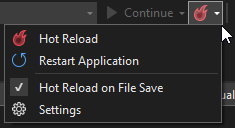
The first thing you will notice is the new drop-down style button with a new icon (yes, it’s our 3rd attempt at locking this visual down 😊). The command is renamed from “apply code changes” to “Hot Reload”.

Visual Studio 2022 New Hot Reload Button

Expanding the buttons reveals easy access to features such as restart running application(s), a toggle for Hot Reload on save, and quick access to the new settings panel.

Here are more details on each of the new features:

  • Restart Applications Easily: You can now easily restart your running application if a rude edit needs to be applied through a rebuild regardless of whether you started your app using the debugger or if you started it without the debugger (NEW for .NET 6 apps!).
  • Hot Reload on Save: In previous releases you could only apply Hot Reload changes on save in ASP.NET projects, for every other project you had to explicitly click the Hot Reload button. With recent improvements it is now possible to Hot Reload for any project type by simply pressing save. This new feature is opt-in, and once enabled will apply to all your future Visual Studio sessions unless you turn it off.
  • Easy Settings Access: In this release we’ve also added a Hot Reload settings panel to give you more control when Hot Reload is enabled/disabled. You can reach these settings in Visual Studio “Options > .NET / C++ Hot Reload” or through the Hot Reload buttons dropdown menu by clicking on Settings.

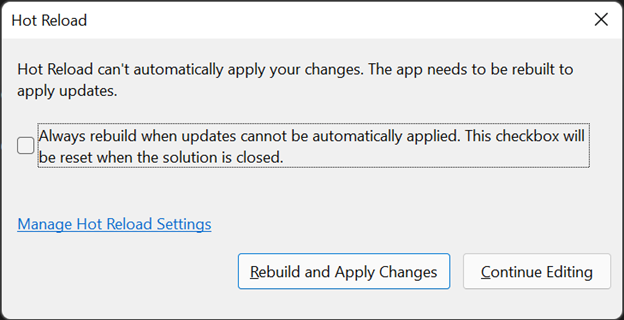
We’ve also added an improved rude edit dialog that is available when running your app without the debugger.

Visual Studio 2022 New Rude Edit Dialog for Hot Reload Scenarios

This new UI has multiple improvements such as:

  • A Visual Studio session wide option to Rebuild and Apply Changes on each Hot Reload rude edit. Once checked this applies until Visual Studio is restarted
  • A rebuild and apply your code changes command that can be accomplished with a single click, instead of multiple manual steps
  • And easy access to settings

The dialog also lets you continue editing if you don’t want to take any automated action as was previously possible.

There is one known limitation, this new dialog won’t be available in the GA release when using the debugger, but the work will be completed in a future update.

Support for .NET MAUI iOS/Android scenarios and improvements for ASP.NET developers

Expanded Hot Reload availability in mobile scenarios for .NET MAUI apps

We’ve made big progress for .NET MAUI apps beyond the initial ability to use Hot Reload when running as a WinUI desktop application. With recent updates it is possible to go beyond Windows as .NET MAUI apps can now be Hot Reloaded when running them as iOS/tvOS or Android app when using the Visual Studio 2022 debugger and targeting .NET 6. This works when your apps are in a debug configuration with the Interpreter turned on (on by default in new templates).

This feature works for both .NET MAUI and .NET MAUI Blazor hybrid apps, though there are some limitations (listed below). For those building .NET MAUI apps with XAML you can also use XAML Hot Reload alongside .NET Hot Reload, making it possible to change the apps look and feel and its code-behind in the same debug session. There are still a few edges to this experience, and we will continue to refine it, such as ensuring this pattern works well in MVVM scenarios.

As .NET MAUI is not shipping GA this November, all tooling related is also not considered GA and we are working to finish all the required work aligned with the .NET MAUI release itself.

Known issues and limitations:

  • In Android and iOS/tvOS scenarios when Mono is the runtime it is only possible to edit method bodies and make changes to those methods. In .NET 6 this will be a limitation for any platform where Mono is the runtime, and a greater number of edits are supported when using the CoreCLR runtime (example: .NET MAUI app running as a WinUI 3 app).
  • For .NET MAUI Blazor apps Hot Reload will not yet automatically refresh the view and CSS Hot Reload is not yet available. These are known issues and are being worked on for future releases.
  • When building a .NET MAUI App with XAML and using the MVVM pattern, some scenarios still won’t work perfectly. An example of this is using .NET Hot Reload (in a WinUI 3 app) to create a new property in a ViewModel, followed by using XAML Hot Reload to bind to it is not fully reliable. We’re working to enable these scenarios for the final release.

Improved support for ASP.NET scenarios

We now support additional capabilities for ASP.NET developers targeting .NET 6, improvements include:

  • CSHTML: Editing a Razor CSHTML file will now support many more types of edits.
  • Browser Refresh: Editing a razor file will now automatically refresh the changes in your web browser when debugging. This was previously only available when starting the app without the debugger.
  • CSS Hot Reload: It is now possible to change CSS files while the app is running, and changes will be applied immediately to the running app as you type.

With all these capabilities in place .NET 6, developers can now Hot Reload almost any type of .NET Code (in code-behind or Razor pages) in both ASP.NET Core and Blazor projects. This works when using both the Visual Studio debugger and when running your app without the debugger. Blazor Wasm being the one exception that only works today when launching your app without the debugger, but we will fix this in a future update as previously mentioned.

Additional Supported .NET Edits

We’ve also made general improvements to support additional types of edits, both when using Hot Reload and the Edit and Continue experience.

Specifically, it is now possible to edit code that uses any of the new C# 10 features, such as global using directives, file scoped namespaces, improved lambdas and parameter-less struct constructors.

In addition, it is also now possible to rename methods and local function parameters.

XAML end-to-end experience (preview)

With the introduction of .NET Hot Reload we’re making a series of improvements over time to enable the smoothest possible experience when using both XAML and .NET Hot Reload technologies together in this same debug session.

The following scenarios are possible if you are using Visual Studio 2022 in a Preview channel and have opted into the required setting (see below).

For WPF and WinUI 3 apps:

  • XAML code editor will now properly show newly created control types and properties created by a .NET Hot Reload operation in IntelliSense.
  • Binding to a newly created property using .NET Hot Reload will now work as expected. For WinUI 3, you can also now use x:Bind to bind to a new property.

For WPF apps:

  • Adding a newly created method for an event handler created using .NET Hot Reload will now work.

While the above scenarios work if the types are first applied using .NET Hot Reload and then XAML Hot Reload is used, there is a known limitation. For example, if you try to bind to a new property using XAML Hot Reload to a property that has not yet been created and only then use .NET Hot Reload to create it, the XAML mechanism will not see the new property. We are aware of this issue and hope to improve it in the future.

To help us test these new features, make sure you turn on the preview flag under “Options > Preview Features > XAML IntelliSense updates after .NET Hot Reload”.

While This feature won’t be ready in time for Visual Studio 2022 GA in November, we will continue to make this option available in our preview channel and we hope to see this go live in the next few update releases.

Faster Test Execution with Hot Reload (experimental)

Running tests from the Test Explorer in Visual Studio has always resulted in building the relevant test projects before test execution if changes have occurred. This is because the binaries on disk need to be up to date when picked up by the test runner (vstest.console). With the addition of Hot Reload in Visual Studio 2022, we are now able to receive the benefit of this technology for test scenarios enabling us to skip the expensive build step when supported edits are made in the editor. We achieve this by tracking the edits made in Visual Studio and executing the test runner with old binaries that are patched with the new updates, which in most cases leads to faster test execution.

This feature is still experimental, and we are working to make this broadly available (and on by default) in the future. For now, you can choose to opt-in to using this feature by going into options and enabling the following setting: Tools > Options > Test > “(Experimental) Enable Hot Reloaded Test Runs for C# and VB test projects targeting .NET 6 and higher”.

Once the option is enabled, Test Explorer will automatically use test execution with Hot Reload with .NET 6 projects. If a Hot Reload is not possible, it will fall back to the regular behavior of building and running tests.

You can learn more about this feature by reading our docs.

Update to Hot Reload support through dotnet watch

Throughout the last year we’ve been working to enable the best possible Hot Reload experience in Visual Studio 2022 and .NET 6. Part of our goal was to also explore making this feature available to customers through a variety of mechanisms such as bringing the full power of Hot Reload to as many .NET and C++ developers as possible when running through Visual Studio 2022 debugger, supporting Hot Reload when running .NET 6 apps without the debugger, and the very basic Hot Reload support we added to the .NET SDK tools through dotnet watch.

As we reflect on what was accomplished, and what is still in front of us, the backlog continues to grow. This includes many high value scenarios that will benefit the broadest number of developers, including focus areas such as .NET MAUI, Blazor, adding support more types of edits, more optimized experience when working with XAML apps, and much more.

With these considerations, we’ve decided that starting with the upcoming .NET 6 GA release, we will enable Hot Reload functionality only through Visual Studio 2022 so we can focus on providing the best experiences to the most users. We’ll also continue to pursue adding Hot Reload to Visual Studio for Mac in a future release.

Your Feedback Matters

As we’ve said in previously blog post, your feedback continues to really help us build better products and Hot Reload is no exception. We really appreciate you taking the time to try our newest feature and we hope you will report problems using the Visual Studio feedback mechanism.

Thank you!

The post Update on .NET Hot Reload progress and Visual Studio 2022 Highlights appeared first on .NET Blog.


source https://devblogs.microsoft.com/dotnet/update-on-net-hot-reload-progress-and-visual-studio-2022-highlights/

What’s new in F# 6

We’re excited to announce the availability F# 6, shipping with .NET 6 RC2 and Visual Studio 2022 RC2. It’s the next step to making it easier for you to write robust, succinct and performant code. You can get F# 6 in the following ways:

F# 6 is about making F# simpler and more performant. This applies to the language design, library, and tooling. A major goal of long-term language evolution is to remove corner-cases in the language that surprise users or are unnecessary hurdles on the path to adoption. We are very pleased to have worked with the F# community in this release to make the F# language simpler, more performant, and easier to learn.

To learn more about F#, see The .NET Conf Focus Day on F# including the F# Bonanza, Guido van Rossum Learns F# and Starting Your F# Journey.

Making F# faster and more interopable with task {…}

One of the most requested features for F# – and the most significant technical feature in this release – has been to make authoring asynchronous tasks simpler, more performant and more interoperable with other .NET languages like C#. Previously, creating .NET tasks required using async {…} to create a task and then invoking it with Async.AwaitTask. With F# 6 you can now use task {…} directly to create the task and await it. For example, consider the following F# code to create a .NET-compatible task:

let readFilesTask (path1, path2) =
   async {
        let! bytes1 = File.ReadAllBytesAsync(path1) |> Async.AwaitTask
        let! bytes2 = File.ReadAllBytesAsync(path2) |> Async.AwaitTask
        return Array.append bytes1 bytes2
   } |> Async.StartAsTask

This code can now become:

let readFilesTask (path1, path2) =
   task {
        let! bytes1 = File.ReadAllBytesAsync(path1)
        let! bytes2 = File.ReadAllBytesAsync(path2)
        return Array.append bytes1 bytes2
   }

The built-in support for task {…} is available ubiquitously in F# code – no namespaces need to be opened.

Task support has previously been available for F# 5.0 through the excellent TaskBuilder.fs and Ply libraries. These guided the design of the support in F# 6 and provided an important source of tests. The authors of these libraries have been major contributors to the design of F# 6, both directly and indirectly. Migrating code to the built-in support should be straightforward. There are however some differences: namespaces and type-inference differ slightly between the built-in support and these libraries, and some additional type annotations may be needed. These community libraries can still be used with F# 6, if explicitly referenced and the correct namespaces opened in each file.

Using task {…} is very similar to async {…}, and both are supported. Using task {…} has several advantages over async {…}:

  • The performance of task {…} is much better.
  • Debugging stepping and stack traces for task {…} is better.
  • Interoperating with .NET packages expecting or producing tasks is easier.

If you’re familiar with async {…}, there are some differences to be aware of:

  • task {…} immediately executes the task to the first asynchronous yield.
  • task {…} does not implicitly propagate a cancellation token.
  • task {…} does not perform implicit cancellation checks.
  • task {…} does not support asynchronous tailcalls. This means using return! .. recursively may result in stack overflows if there are no intervening asynchronous yields.

In general, you should consider using task {…} over async {…} in new code if interoperating with .NET libraries that uses tasks. Review code before switching to task {…} to ensure you are not relying on the above characteristics of async {…}.

The task {…} support of F# 6 is built on a foundation called “resumable code” RFC FS-1087. Resumable code is a core technical feature which can be used to build many kinds of high-performance asynchronous and yielding state machines.

In the coming months we will be working with the F# community to utilise this feature to make available two key optional packages:

  1. A fast re-implementation of F# async {…} using resumable code.
  2. A fast re-implementation of asynchronous sequences asyncSeq {…} using resumable code.

Initially these will be delivered via community packages such as FSharp.Control.AsyncSeq. In future versions they may be integrated into FSharp.Core.

Making F# simpler to learn: indexing with expr[idx]

In F# 6, we begin allowing the syntax expr[idx] for indexing syntax.

Up to and including F# 5.0, F# has used expr.[idx] as indexing syntax. This syntax was based on a similar notation used in OCaml for string indexed lookup. Allowing the use of expr[idx] is based on repeated feedback from those learning F# or seeing F# for the first time that the use of dot-notation indexing comes across as an unnecessary divergence from standard industry practice. There is no need for F# to diverge here.

This is not a breaking change – by default no warnings are emitted on the use of expr.[idx]. However, some informational messages are emitted related to this change suggesting code clarifications, and some further informational messages can be optionally activated. For example, an optional informational warning (/warnon:3566) can be activated to start reporting uses of the expr.[idx] notation. See Indexer Notation for details.

In new code, we recommend the systematic use of expr[idx] as the indexing syntax.

Making F# faster: Struct representations for partial active patterns

F# includes the active patterns feature that allows users to extend pattern matching in intuitive and powerful ways. In F# 6 we’ve augmented that feature with optional Struct representations for active patterns. This allows you to use an attribute to constrain a partial active pattern to return a value option:

[<return: Struct>]
let (|Int|_|) str =
   match System.Int32.TryParse(str) with
   | true, int -> ValueSome(int)
   | _ -> ValueNone

The use of the attribute is required. At usage sites, code doesn’t change. The net result is that allocations are reduced.

Making F# more uniform: overloaded custom operations in computation expressions

F# 6 activates the feature “overloaded custom operations in computation expressions” which has been in preview since F# 5.0. This allows for simpler DSLs in F# including for validation and web programming.

The feature was previously described in the announcement for F# 5.0 preview and implements F# RFC 1056.

Making F# more uniform: “as” patterns

In F# 6, the right hand side of an “as” pattern can now itself be a pattern. This is important when a type test has given a stronger type to an input. For example, consider the code

type Pair = Pair of int * int

let analyzeObject (input: obj) =
    match input with
    | :? (int * int) as (x, y) -> printfn $"A tuple: {x}, {y}"
    | :? Pair as Pair (x, y) -> printfn $"A DU: {x}, {y}"
    | _ -> printfn "Nope"

let input = box (1, 2)

In each pattern case the input object is type-tested. The right-hand-side of the “as” pattern is now allowed to be a further pattern which can itself match the object at the stronger type.

Making F# more uniform: Indentation syntax revisions

The F# community has contributed some key improvements to make the F# language more uniform in F# 6. The most important of these is removing a number of inconsistencies and limitations in F#’s use of indentation-aware syntax, see RFC FS-1108. This resolved 10 significant issues highlighted by the F# users since F# 4.0.

For example, in F# 5.0 the following was allowed:

let c = (
    printfn "aaaa"
    printfn "bbbb"
)

However the following was not (producing a warning)

let c = [
    1
    2
]

In F# 6, both are allowed. This makes F# simpler and easier to learn. The F# community contributor Hadrian Tang has led the way on this including remarkable and highly valuable systematic testing of the feature.

Making F# more uniform: Discards on use bindings

F# 6 allows _ to be used in a use binding, for example:

let doSomething () =
    use _ = System.IO.File.OpenText("input.txt")
    printfn "reading the file"

This feature implements F# RFC FS-1102.

Making F# more uniform: Formatting for binary numbers

F# 6 adds the %B pattern to the available format specifiers for binary number formats. Consider the following F# code:

printf "%o" 123
printf "%B" 123

This code prints the following output:

173
1111011

This feature implements F# RFC FS-1100.

Making F# faster: InlineIfLambda

In F# 6, we’ve added a new declarative feature that allows code to optionally indicate that lambda arguments should be inlined at callsites.

For example, consider the following iterate function to traverse an array:

let inline iterateTwice ([<InlineIfLambda>] action) (array: 'T[]) = 
    for j = 0 to array.Length-1 do 
        action array[j]
    for j = 0 to array.Length-1 do 
        action array[j]

If the callsite is

let arr = [| 1.. 100 |]
let mutable sum = 0
arr  |> iterateTwice (fun x -> 
    sum <- sum + x) 

then after inlining and other optimizations the code becomes:

let arr = [| 1.. 100 |]
let mutable sum = 0
for j = 0 to array.Length-1 do 
    sum <- array[i] + x
for j = 0 to array.Length-1 do 
    sum <- array[i] + x

Unlike previous versions of F#, this optimization applied regardless of the size of the lambda expression involved. This feature can also be used to implement loop unrolling and similar transformations reliably.

An opt-in warning (/warnon:3517, off by default) can be turned on to indicate places in your code where InlineIfLambda arguments are not bound to lambda expressions at callsites. In normal situations, this warning should not be enabled, however in certain kinds of high-performance programming it can be useful to ensure all code is inlined and flattened.

Making F# faster: Improved performance and debugging for list and array expressions

In F# 6, the compiled form of generative list and array expressions is now up to 4x faster (see the relevant pull request). Generative list and array expressions also have greatly improved debugging. For example:

let generateList (i: int) =
    [ "a"
      "b"
      for j in 1 .. 10 do
          "c"
          if i % 3 = 0 then 
              "d"
      "e"
    ]

This function generates lists of size 13 or 23 depending on the input and now executes more efficiently and breakpoints can be set on the individual lines

Making F# simpler and more interoperable: Implicit conversions

In F# 6 we have activated support for additional “implicit” and “type-directed” conversions in F#, as described in RFC FS-1093.

This change achieves three things.

  1. Fewer explicit upcasts are required
  2. Fewer explicit integer conversions are required
  3. First-class support for .NET-style implicit conversions is added

Additional implicit upcast conversions

In F# 5.0 and before, upcasts were needed for the return expression when implementing a function where the expressions have different subtypes on different branches, even when a type annotation was present. Consider the following F# 5.0 code (StreamReader derives from TextReader):

open System
open System.IO

let findInputSource() : TextReader = 
    if DateTime.Now.DayOfWeek = DayOfWeek.Monday then  
        // On Monday a TextReader
        Console.In
    else
        // On other days a StreamReader
        File.OpenText("path.txt") :> TextReader

Here the branches of the conditional compute a TextReader and StreamReader respectively, and the upcast was added to make both branches have type TextReader. In F# 6, these upcasts are now added automatically. This means the code can now be simpler:

let findInputSource() : TextReader = 
    if DateTime.Now.DayOfWeek = DayOfWeek.Monday then  
        // On Monday a TextReader
        Console.In
    else
        // On other days a StreamReader
        File.OpenText("path.txt")

You may optionally enable the warning /warnon:3388 to show a warning at every point an additional implicit upcast is used, as described below.

Implicit integer conversions

Type-directed conversions also allow for automatically widening 32-bit integers to 64-bit integers more often. For example, the use of 64-bit integers is now ubiquitous in machine-learning libraries. Consider a typical API shape:

type Tensor(…) =
    static member Create(sizes: seq<int64>) = Tensor(…)

In F# 5.0, integer literals for int64 must be used:

Tensor.Create([100L; 10L; 10L])

or

Tensor.Create([int64 100; int64 10; int64 10])

In F# 6, widening happens automatically for int32 to int64, int32 to nativeint and int32 to double, when both source and destination type are known during type inference, so in cases such as the above int32 literals can be used:

Tensor.Create([100; 10; 10])

Despite this change, F# still continues to use explicit widening of numeric types in most cases. For example, implicit widening does not apply to other numeric types such as int8 or int16, nor from float32 to float64, nor when either source or destination type is unknown. You may also optionally enable the warning /warnon:3389to show a warning at every point op_Implicit is used for method arguments.

NOTE: High-performance modern tensor implementations are available through TorchSharp and TensorFlow.NET.

First-class support for .NET-style implicit conversions

The addition of type-directed conversions allows .NET “op_Implicit” conversions to be applied automatically in F# code when calling methods. For example, in F# 5.0 it was necessary to use XName.op_Implicit when working with .NET APIs for XML:

open System.Xml.Linq

let purchaseOrder = XElement.Load("PurchaseOrder.xml")

let partNos = purchaseOrder.Descendants(XName.op_Implicit "Item")

In F# 6, op_Implicit conversions are applied automatically for argument expressions when they are available and the types are known for the source expression and target type:

open System.Xml.Linq

let purchaseOrder = XElement.Load("PurchaseOrder.xml")

let partNos = purchaseOrder.Descendants("Item")

You may optionally enable the warning /warnon:3390 to show a warning at every point implicit numeric widening is used, as described below.

Optional warnings for implicit conversions

When used widely, or inappropriately, type-directed and implicit conversions can interact poorly with type inference and lead to code that is harder to understand. For this reason, some mitigations are in-place to help ensure this feature is not widely abused in F# code. First, both source and destination type must be strongly known, with no ambiguity or additional type inference arising. Secondly, opt-in warnings can be activated to report any use of implicit conversions, with one warning on by default:

  • /warnon:3388 (additional implicit upcast)
  • /warnon:3389 (implicit numeric widening)
  • /warnon:3390 (op_Implicit at method arguments)
  • /warnon:3391 (op_Implicit at non-method arguments, on by default)

If your team wants to ban all uses of implicit conversions you can also use /warnaserror:3388, /warnaserror:3389, /warnaserror:3390, /warnaserror:3391.

Making F# simpler: Updating immutable collections

This release sees the addition of five new operations to the core collection functions in FSharp.Core. These are:

  • List/Array/Seq.insertAt
  • List/Array/Seq.removeAt
  • List/Array/Seq.updateAt
  • List/Array/Seq.insertManyAt
  • List/Array/Seq.removeManyAt

These all perform copy-and-update operations on the corresponding collection type or sequence. Examples of using these functions can be seen in the documentation, e.g. for List.insertAt.

As an example, consider the model, message and update logic for a simple “Todo List” application written in the Elmish style. Here the user interacts with the application, generating messages, and the update function processes these messages, producing a new model:

type Model =
    { ToDo: string list }

type Message =
    | InsertToDo of index: int * what: string
    | RemoveToDo of index: int
    | LoadedToDos of index: int * what: string list

let update (model: Model) (message: Message) =
    match message with
    | InsertToDo (index, what) -> 
        { model with ToDo = model.ToDo |> List.insertAt index what }
    | RemoveToDo index -> 
        { model with ToDo = model.ToDo |> List.removeAt index }
    | LoadedToDos (index, what) -> 
        { model with ToDo = model.ToDo |> List.insertManyAt index what }

With these new functions, the logic is clear and simple and relies only on immutable data.

Making F# simpler: Map has Keys and Values

In FSharp.Core 6.0.0.0 the Map type new supports Keys and Values properties. These do not copy the underlying collection.

Making F# simpler: Additional intrinsics for NativePtr

In FSharp.Core 6.0.0.0 we add new intrinsics to the NativePtr module:

  • NativePtr.nullPtr
  • NativePtr.isNullPtr
  • NativePtr.initBlock
  • NativePtr.clear
  • NativePtr.copy
  • NativePtr.copyBlock
  • NativePtr.ofILSigPtr
  • NativePtr.toILSigPtr

As with other functions in NativePtr these functions are inlined and their use emits warnings unless /nowarn:9 is used. The use of these functions is restricted to unmanaged types.

Making F# more uniform: Additional numeric types with unit annotations

F# supports Units of Measure, allowing annotation tags to be added to numeric types. However, in previous versions not all numeric types supported these annotations. In F# 6, the following types or type abbreviation aliases now support unit-of-measure annotations, the new additions are shown with a +:

F# alias CLR Type
float32/single++ System.Single
float/double+ System.Double
decimal System.Decimal
sbyte/int8+ System.SByte
int16 System.Int16
int/int32+ System.Int32
int64 System.Int64
byte+/uint8+ System.Byte
uint16+ System.UInt16
uint+/uint32+ System.UInt32
uint64+ System.UIn64
nativeint+ System.IntPtr
unativeint+ System.UIntPtr

For example, you can annotate an unsigned integer as follows:

[<Measure>] 
type days

let better_age = 3u<days>

This design revision was championed, designed and implemented by community member Paulmichael Blasucci.

Bringing F# forward: Reducing use of rarely used symbolic operators

In F# programming, “ref cells” can be used for heap-allocated mutable registers. While they are occasionally useful, in modern F# coding these are rarely needed as let mutable can normally be used instead. The F# core library includes two operators := and ! and two functions incr and decr specifically related to reference calls. The presence of these operators makes reference cells more central to F# programming than they need to be, requiring all F# programmers to know these operators. Further, the ! operator can be easily confused with the not operation in C# and other languages, a potentially subtle source of bugs when translating code.

As a result, in F# 6 we’ve made a decision to give soft guidance that de-normalizes the use of :=, !, incr and decr in F# 6 and beyond. Using these operators and functions will now given informational messages asking you to replace your code with explicit use of the Value property.

The rationale for this change is to reduce the number of operators the F# programmer needs to know.

For example, consider the following F# 5.0 code:

let r = ref 0

let doSomething() =
    printfn "doing something"
    r := !r + 1

First, in modern F# coding reference cells are rarely needed, as let mutable can normally be used instead:

let mutable r = 0

let doSomething() =
    printfn "doing something"
    r <- r + 1

If reference cells are used, then the in F# 6 an informational warning is emitted asking you to change the last line to r.Value <- r.Value + 1, and linking you to further guidance on the appropriate use of reference cells.

let r = ref 0

let doSomething() =
    printfn "doing something”"
    r.Value <- r.Value + 1

These messages are not warnings – they are “informational messages” shown in the IDE. This remains backwards-compatible, and is described in RFC FS-1111.

Bringing F# forward: Removing long-deprecated legacy features

F# 2.0 deprecated several F# features, giving warnings if they were used. These features been removed in F# 6.0 and will give errors, unless you explicitly use /langversion:5.0 or before. The features that now give errors are:

  • Multiple generic parameters using a postfix type name, for example (int, int) Dictionary. This becomes an error in F# 6 and the standard Dictionary<int,int> should be used instead.
  • #indent "off". This becomes an error in F# 6
  • x.(expr). This becomes an error in F# 6
  • module M = struct … end . This becomes an error in F# 6
  • Use of inputs *.ml and *.mli. This becomes an error in F# 6
  • Use of (*IF-CAML*) or (*IF-OCAML*). This becomes an error in F# 6
  • Use of land, lor, lxor, lsl, lsr or asr as infix operators. These are infix keywords in F# because they were infix keywords in OCaml and are not defined in FSharp.Core. Using these keywords will now emit a warning (not error)

These are described in RFC FS-1114

F# tooling: Pipeline debugging!

One of the most anticipated features in the F# 6 toolchain is the addition of “Pipeline debugging”. Now, the F# compiler emits debug stepping points for each position in an F# pipeline involving |>, ||> and |||> operators. At each step, the input or intermediate stage of the pipeline can be inspected in a typical debugger.

For example:
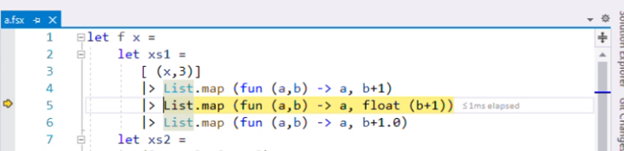
Stepping in pipeline debugging, What’s new in F# 6

Breakpoints can also be set at each point in the pipeline, for example:
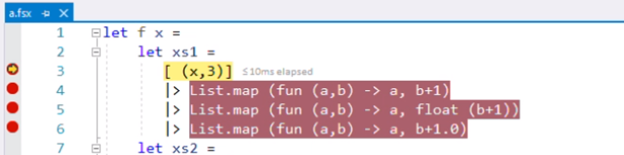
Breakpoints in pipeline debugging

Pipeline debugging activates by default when you re-compile your code with the F# 6 compiler, regardless of the language version or IDE you are using. Play with stepping and breakpoints and let us know what you think!

F# tooling: Value shadowing shown in debugger

The updated F# 6 toolchain makes another important improvement to debugging. For example, consider the code

let someFunctionUsingShadowing x =
    let yyy = "aa"
    let yyy = "aa".Length - 1
    yyy + 3 

Here the second yyy “shadows” the first. This is allowed in F# and the technique is a common one because F# defaults to immutable bindings, hence new versions of bindings often replace previous ones.

When using an F# 6 toolchain, the names associated with locals are adjusted for those portions of scopes where shadowing occurs. For example, when a breakpoint is placed on the expression yyy + 3 of the above function, the locals are displayed as follows:
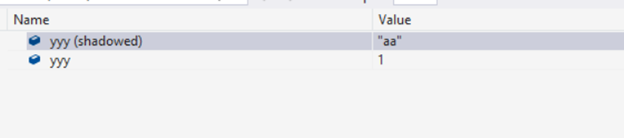
Value shadowing in debugger, What’s new in F# 6

F# tooling: Performance and Scalability

In F# 6, we have made dramatic improvements to Compiler/IDE-tooling perf/scalability improvements in both the core implementation of the language and the Visual Studio components.

  • The F# compiler now performs the parsing stage in parallel, resulting in approximately 5% performance improvement for large projects.
  • Analysis results are now performed concurrently. When working in the IDE, analysis requests are no longer serialized through a single “reactor” compilation thread. Instead, the F# Compiler Service is now concurrent. This greatly improves performance in many situations.
  • Improved performance of analysis in F# projects that contain signature files. If you are using signature files in your project you will see diagnostics and other analysis results much more quickly when a change is made to an implementation file without change to the signature file. This change was also included in the final releases of Visual Studio 2019.
  • Find-all references is now performed concurrently, in parallel across multiple projects.
  • Major performance improvements to “Close solution” and “Switch configuration”. For example, some simple use cases have reduced “Close solution” from 16 seconds to 1 second. For a demonstration of this see this tweet by contributor Will Smith.

F# tooling: In-memory cross-project referencing!

In F# 6, we made working between F# and C# projects simpler and more reliable through “In-memory cross-project referencing” from F# to C#.

This means in C# projects are now reflected immediately in a F# project without having to compile the C# project on-disk. It also means analysis results are available in uncompiled solutions.

F# tooling: .NET Core the default for scripting

If you open or execute an F# Script (.fsx) in Visual Studio, by default the script will be analysed and executed using .NET Core with 64-bit execution. This functionality was in preview in Visual Studio 2019 and is now enabled by default.

To enable .NET Framework scripting, use Tools -> Options -> F# Tools -> F# Interactive and set Use .NET Core Scripting to false and restart the F# Interactive window. This setting affects both script editing and script execution.

64-bit scripting is now also the default. To enable 32-bit execution for .NET Framework scripting, also set 64-bit F# Interactive to false. There is no 32-bit option for .NET Core scripting.

F# tooling: F# scripts now respect global.json

If you execute a script using dotnet fsi in a directory containing a global.json with a .NET SDK setting, then the listed version of the .NET SDK will be used to execute and for editing the the script. This feature has been in preview in the later versions of .NET 5.

For example, assume is a script is in a directory with the following global.json specifying a .NET SDK version policy:

{
  "sdk": {
    "version": "5.0.200",
    "rollForward": "minor"
  }
}

This is a powerful feature that lets you “lock down” the SDK used to compile, analyse and execute your scripts.

  • If you now execute the script using dotnet fsi, from this directory, the SDK version will be respected. If the SDK is not found, you may need to install it on your development machine.
  • Visual Studio and other IDEs will respect this setting when you are editing script.
  • When you start or reset the F# Interactive evaluation window in Visual Studio, the SDK choice is delayed until you first use “Send to Interactive” (Alt-Enter) from the script. At this point, the SDK chosen will the one used for editing and executing the script.

On Linux and other UNIX systems you can combine a global.json with a shebang with a language version for direct execution of the script. A simple shebang for script.fsx is:

#!/usr/bin/env -S dotnet fsi

printfn "Hello, world"

The script can be executed directly with script.fsx. You can combine this with a specific, non-default language version like this:

#!/usr/bin/env -S dotnet fsi --langversion:5.0

Note that this setting will be ignored by editing tools, which will analyse the script assuming latest language version.

F# tooling: .NET Interactive in Visual Studio Code and Visual Studio!

.NET Interactive Notebooks allow you to use notebook-style programming with F# and C#. Many improvements have been made in recent releases including excellent support in Visual Studio Code.

Also just announced is a Notebook Editor extension for Visual Studio 2022.

Making F# simpler to learn: Code Examples!

In October, the F# community has worked on an initiative to add code examples for all public entry points to the F# Core Library. 800 code examples have now been contributed! For example:

  • All functions in the List, Array, Seq and Map modules now have code examples.
  • Functions and methods in advanced modules such as Quotations now have examples.

You can contribute to this initiative via this GitHub issue.

System.Text.Json support for common F# types

Starting with .NET 6 System.Text.Json will have built-in support for common F# types. An example is shown below.

Image json from f#

User-defined discriminated unions are not yet supported in this way. Thank you to Eirik Tsarpalis for contributing this to .NET.

General Improvements in .NET 6

F# 6 is built on .NET 6, and F# programmers benefit both directly and indirectly from a host of new features and improvements in the runtime. Some of these are listed below, summarized from the announcements for .NET 6 Release Candidate 1 and previous release announcements.

  • Source build, a scenario and infrastructure being developed with Red Hat that is intended to satisfy packaging rules of commonly used Linux distributions, such as Debian and Fedora. Also, source build is intended to enable .NET Core contributors to build a .NET Core SDK with coordinated changes in multiple repositories. The technology is intended to solve common challenges that developers encounter when trying to build the whole .NET Core SDK from source.
  • Profile-guided optimization, which is based on the assumption that code executed as part of a startup often is uniform and that higher level performance can be delivered by leveraging it. PGO can compile startup code at higher quality, reduce binary size, and rearrange application binaries so code used at startup is co-located near the start of the file.
  • Dynamic PGO, a mirror image of PGO, integrated with the RyuJIT .NET just-in-time compiler. Performance is improved.
  • Crossgen2, to generate and optimize code via ahead-of-time compilation, is now enabled by default when publishing ReadyToRun images.
  • Intel Control Enforcement Technology (CET), available in some new Intel and AMD processors to protect against common types of attacks involving control-flow hijacking.
  • HTTP/3, previewed in .NET 6, solves functional and performance challenges with previous versions of HTTP.
  • W^X, a security mitigation to block attack paths by disallowing memory pages to be writable and executable at the same time.

Other improvements in .NET 6 include:

  • Interface casting performance has been improved by 16 percent to 38 percent.
  • Code generation has been improved in RyuJIT via multiple changes, to make the process more efficient or resulting code run faster.
  • Single-file bundles now support compression.
  • Single-file application publishing improvements including improved analysis to allow for custom warnings.
  • Enhanced date, time, and time zone support.
  • Significantly improved FileStream performance on Windows.
  • OpenSSL 3 support has been added for cryptography on Linux.
  • OpenTelemetry Metrics API support has been added. OpenTelemetry, which has been supported in recent .NET versions, promotes observability.
  • WebSocket compression for libraries reduces the amount of data transmitted over a network.
  • Package validation tools enable NuGet library developers to validate that packages are consistent and well-formed.
  • TLS support for DirectoryServices.Protocols.
  • Native memory allocation APIs.

General Improvements in Visual Studio

The release of F# 6 coincides with the release of Visual Studio 2022 on Windows. F# programmers using this IDE experience will benefit from many improvements in this release:

  • Visual Studio 2022 on Windows is now a 64-bit application. This means you can open, edit, run, and debug even the biggest and most complex solutions without running out of memory.
  • Find in Files is faster. Find in Files is now as much as 3x faster when searching large solutions such as Orchard Core.
  • Multi-repo support with Git in the IDE. If you’ve worked with projects hosted on different Git repositories, you might have used external tools or multiple instances of Visual Studio to connect to them. With Visual Studio 2022, you can work with a single solution that has projects in multiple repositories and contribute to them all from a single instance of Visual Studio.
  • Personalization improvements. For example, Visual Studio 2022 offers you the ability to sync with your Windows theme – if you’ve enabled the “night light” feature there, Visual Studio uses it, too.

What’s next

Now that F# 6 is released, we’re moving our focus to a few areas:

  1. Simplifying the F# learning experience
  2. Continuing to modernize the F# language service implementation
  3. Planning for the next F# version

Cheers, and happy F# coding!

Thanks and Acknowledgments!

F# is developed as a collaboration between the .NET Foundation, the F# Software Foundation, their members and other contributors including Microsoft. The F# community is involved at all stages of innovation, design, implementation and delivery and we’re proud to be a contributing part of this community.

Many people have contributed directly and indirectly to F# 6, including all who have contributed to the F# Language Design Process through fsharp/fslang-suggestions and fsharp/fslang-design repositories. Robert Peele developed TaskBuilder.fs and Nino Floris developed Ply.

Will Smith, Kevin Ransom, Vlad Zarytovskii, Phillip Carter, Don Syme, Brett V. Forsgren contributed directly at Microsoft under the guidance of Jon Sequeira and Tim Heuer.

Eugene Auduchinok made 41 PRs to the F# core implementation, including significant improvements to error recovery. Florian Verdonck made 24 PRs, including improved source trees for the Fantomas source code formatter. Hadrian Tang made 22 PRs, including several of the language features and simplifications outlined in this blog post. GitHub user kerams made 13 pull requests, including support for SkipLocalsInit and performance improvements. Scott Hutchinson made 9 PRs, Goswin Rothenthal made 7 PRs, Ryan Coy made 6 PRs, Victor Baybekov made 5 PRs, including performance improvements to Map and Set in FSharp.Core. Some of these improvements were shipped in later versions of FSharp.Core 5.0.x.

Other direct contributors to the dotnet/fsharp repository in the F# 6.0 time period include forki, smoothdevelopers, cristianosuzuki77, ErikSchierboom, jonfortescue, teo-tsirpanis, MaxWilson, mmitche, DedSec256, uxsoft, Swoorup, En3Tho, 0x6a62, uweigand, MecuStefan, JYCabello, Yatao Li, amieres, chillitom, Daniel-Svensson, Krzysztof-Cieslak, thinkbeforecoding, abelbraaksma and ShalokShalom.

Many other people are contributing to the rollout of F# 6 and .NET 6 in Fable, Ionide, Bolero, FSharp.Data, Giraffe, Saturn, SAFE Stack, WebSharper, FsCheck, DiffSharp, Fantomas and other community-delivered technologies.

Contributor Showcase

In this and future announcements we will highlight some of the individuals who contribute to F#. This text is written in the contributors’ own words:

I’m Nino Floris, co-founder of Crowded and contributor to Npgsql and other projects. At Crowded we endeavor to create a friendly community platform, written in F# with a focus on fast apis and principled flexibility. I am interested in statically typed programming languages that bring adaptable, performant, and usable programming experiences to more places. Small open source communities with big impact hold a special place in my heart – when I’m not busy with work you may see me contributing to Npgsql, (web) frameworks, or sharing my enthusiasm for programming by helping people in the community.

Contributor photo

I’m Hadrian Tang, a 19-year-old student at Hong Kong University of Science and Technology studying Information Systems for the second year. I started programming in 2014 by picking up a book on VB.NET at the school library. I moved to C#, then started looking into F# after reading a comment by Charles Roddie in 2018. I was reluctant to adopt F#, but the simple syntax and interoperability ultimately won me over. However, like every language, F# has much to improve, which is why I’m the author of 17% of currently open issues at the F# suggestions repo. Last summer, I took a shot at some of the easy features that ultimately made it to F# 6. I use F# for mobile development using and for my next project plan to use Fable and web interfaces to improve interoperability with JavaScript’s huge array of libraries, teaming up with [WhiteBlackGoose] (https://github.com/WhiteBlackGoose).

Much thanks to Don Syme for creating such an amazing language with simple syntax and great interoperability, and to the F# Discord for a great place to help each other: I could get help from the community with any problems that I faced. Moreover, GitHub and .NET also give a great foundation for all F# work. I love how F# is agile: starting PRs to implement unapproved features can lead to approval. I look forward to the future of F#, especially with the theme of making F# simple! And much thanks to the F# community as a whole for libraries, tooling and support!

Hadrian Tang photo

The post What’s new in F# 6 appeared first on .NET Blog.


source https://devblogs.microsoft.com/dotnet/whats-new-in-fsharp-6/

Share this post

Search This Blog

What's New

The "AI is going to replace devs" hype is over – 22-year dev veteran Jason Lengstorf [Podcast #201]

Image
Curriculum for the course The "AI is going to replace devs" hype is over – 22-year dev veteran Jason Lengstorf [Podcast #201] Today Quincy Larson interviews Jason Lengstorf. He's a college dropout who taught himself programming while building websites for his emo band. 22 years later he's worked as a developer at IBM, Netlify, run his own dev consultancy, and he now runs CodeTV making reality TV shows for developers. We talk about: - How many CEOs over-estimated the impact of AI coding tools and laid off too many devs, whom they're now trying to rehire - Why the developer job market has already rebounded a bit, but will never be the same - Tips for how to land roles in the post-LLM résumé spam job search era - How devs are working to rebuild the fabric of the community through in-person community events Support for this podcast is provided by a grant from AlgoMonster. AlgoMonster is a platform that teaches data structure and algorithm patterns in a structure...

Labels

Programming Video Tutorials Coursera Video Tutorials Plurasight Programming Tutorials Udemy Tutorial C# Microsoft .Net Dot Net Udemy Tutorial, Plurasight Programming Tutorials, Coursera Video Tutorials, Programming Video Tutorials Asp.Net Core Asp.Net Programming AWS Azure GCP How To WordPress Migration C sharp AWS Project Git Commands FREE AWS Tutorial OldNewThings Git Tutorial Azure vs AWS vs GCP New in .Net javascript AI Google I/O 2025 Wordpress jquery Generative Video Git Git Squash Google Flow AI PHP SQL Veo 3 squash commit CSS Cloud Services React Tutorial With Live Project Source Code git rebase CPR Nummer Dropdown Reset Javascript Figma Figma Beginner Tutorial Geolocation Non-Programmer Content Python Free Course Think Simply Awesome Tutorial UI UX Live Project UI/UX Full Course Wireframing dotnet core runtime error html API Gateway AWS EKS vs Azure AKS All in one WP stuck C++ C++ Coroutines CPR Denmark ChatGPT Cloud Database Cloud DevOps Cloud Security Cloud Storage Contact Form 7 Dropdown Unselect Javascript E commerce Free AWS Terraform Project Training Git Commit Google Drive Files Google Drive Tips Http Error 500.30 Http Error 500.31 Interview Questions Learn Courutines C++ Microservices for Live Streaming PII Denmark Pub Sub SQL Server SSIS Terraform Course Free Terraform Tutorial Free USA E commerce strategies UpdraftPlus UpdraftPlus Manual Restore Website Optimization Strategies dropdown javascript select drop down javascript smarttube apk error 403 smarttube next 403 Error 413 Error 503 504 524 AI & ML AI Assistants AI Course CS50 AI in daily life AWS API Gateway AWS EBS AWS EC2 vs Azure VMs vs GCP Compute Engine AWS EFS AWS IAM AWS Lamda AWS RDS vs Azure SQL AWS Redshift AWS S3 AZ-104 AZ-104 Free Course AZ-104 Full Course AZ-104 Pass the exam Abstract Class C# Abstract Method Ajax Calender Control Ajax Control Toolkit All In One Extension Compatibility All In One WP Freeze All In One WP Migration All in one WP All-in-One WP Migration Android 15 Android TV Applying Theme html Asp.net core runtime Error Audio Auto Complete Azure AD Azure APIM Azure Administrator Certification Azure Blob Storage Azure Data Lake Azure Files Azure Function Azure Managed Disk Azure Synapse Base Class Child Class Best Grocery Price Big Data BigBasket vs Grofers Bing Homepage Quiz Blogger Import Blogger Post Import Blogger XML Import Bluetooth Connectivity Browser Detail Building Real-Time Web Applications Bulk Insert CI/CD CPR Address Update CPR Generator CPR Generator Denmark CS50 AI Course CS50 AI Python Course CS50 Artificial Intelligence Full Course CVR Centrale Virksomhedsregister Change Workspace TFS ChatGPT Essay Guide ChatGPT Usage ChatGPT vs Humans Cloud API Management Cloud CDN Cloud Computing Cloud Data Warehouse Cloud Event Streaming Cloud IAM Cloud Messaging Queue Cloud Monitoring and Logging Cloud Networking CloudFront Cloudflare Cloudwatch Compute Services Connect a Bluetooth Device to my PC site:microsoft.com Containers ControlService FAILED 1062 Corona Lockdown MP CosmosDB Covid19 Covid19 Bhopal Covid19 Home Delivery MP Covid19 Indore Covid19 Susner Covid19 Ujjain Cypress Javascript Cypress Javascript framework Cypress Javascript testing Cypress Javascript tutorial Cypress Javascript vs typescript DNS Danish CVR Data Analytics Data Analytics Course Free Data Engineering Data Structure Full Course Data Visualization Database Database Diagram Visualizer Davek Na Dodano Vrednost Dbdiagram export seeder Deep Learning Course Denmark Numbers Det Centrale Personregister Det Centrale Virksomhedsregister DevOps Device Compatibility Dictionary Dictionary in C# Digital Economy Disaster Recovery for Web Applications Disaster-Proof Infrastructure Dmart Frenchise Dmart Home Delibery Dmart Mumbai Address Dmart Pickup Points Doodle Jump Drive Images On Blog Drive Images On Website Driver Problems DropDown Dropbox Dropdown jquery DynamoDB ETL ETL Package Ecommerce Store using AWS & React Embed Drive Images Escape Sequences in c#.Net Event Hub Explicit Join Extract Facebook App Fake CVR Denmark Fake DDV Slovenia Fake VAT Number Fake Virk Number Faker Feature Toggle Find CPR Information Find a Word on Website Firestore Flappy Bird Game Form Selectors using jQuery Free React Portfolio Template FreeCodeCamp Frontend Best Practices for Millions of Users Full Text Index View G Drive Hosting GAN certification course GCP Cloud Data Lake GCP Filestore GCP Functions GCP IAM GCP Persistent Disk Gemini Git Checkout Google Adsense Setting Google Beam Google BigQuery Google Conversion Tracking Google Docs Advanced Tutorial Google Drive Clone Google Drive Clone Bot Google Drive Clone HTML CSS Google Drive Clone PHP Google Drive Clone React Google Drive Clone Tutorial Google Drive Clone VueJS Google Drive File Sharing Google Drive Images Google Drive Sharing Permissions Grocery Price Compare Online Grocery in Corona Grocery in Covid19 Grofers vs DMart vs Big basket HAXM installation HTML Storage HTML to PDF Javascript HTML2Canvas HTML5 HTML5 Append Data HTML5 Audio HTML5 Data Storage HTML5 Storage HTML5 Video Harvard University AI Course Header Sent Height Jquery High Availability in Live Streaming Platforms High-Concurrency Frontend Design High-Concurrency Web Applications How to Search for a Word on Mac Html2Canvas Black Background issue Http Error 413 Http Error 500.35 IIS INNER Join Image Gallery Blogger Image Gallery Blogger Picasa Image Gallery Blogger Template Image Gallery Blogger Template Free Implicit Join Indexing in SQL Instagram Clone React Instagram Clone Script Install NodeJS Ubuntu Internet Infrastructure Interview IoT IoT Core IoT Hub JS Game Tutorial Java Feature Toggle Javascript game tutorial JioCinema Case Study Keep Me Login Key Management Kinesis Learn Scrappy with a live project List Live Streaming Data Delivery Live Streaming Performance Optimization Load Load Balancer Looping Dictionary MTech First Semester Syllabus MTech Syllabus MVC Mac Mac Finder Shortcut Media Controller Media Group Attribute Microservices Architecture for Scalability Missing MySQL Extension Mobile Optimization Multiple Audio Sync Multiple Video Sync Mumbai Dmart List MySQL MySQL ERD Generator Next.js Beginner Tutorial Ngnix NodeJS NodeJS Ubuntu Commands Numpy OOPS Concepts OOPS in C# Object Oriented Programming Object Storage Outer Join PHP Installation Error PHP WordPress Installation Error Pandas Personligt identifikations nummer Pipedrive Pipedrive Quickbooks Integration Portfolio Website using React Project Astra PyTorch Quickbooks Quote Generator RGPV Syllabus Download Random SSN Generator ReCaptcha Dumbass React Feature Toggle Real-Time Video Processing Architecture Real-Time Video Processing Backend RegExp Regular Expression Reinstall Bluetooth Drivers Remember Me Remove NodeJS Ubuntu Renew DHCP Lease Reset IP Address Linux Reset IP Address Mac Reset IP Address Windows Reset Remote Connection Reset Remote Connection Failure Resize Textarea Restore Errors Restore Failed UpdraftPlus Route 53 SOS Phone SQL Indexed Tables SQL Joins SQL Seed generator SQS SSIS Package SSIS Tutorial SSN Generator for Paypal SSN Number SSN Number Generator SSN Validator Safari 8 Safari Video Delay SageMaker Scalable Backend for High Concurrency Scalable Cloud Infrastructure for Live Streaming Scalable Frontend Architectures Scalable Live Streaming Architecture Scrapy course for beginners Search A word Search for a Word in Google Docs Secret Management Serverless Service Bus Slovenian VAT Generator SmartTube Software Architect Interview Questions Software Architect Mock Interview Sparse Checkout Spotlight Mac Shortcut Stored Procedure Subtree Merge T-Mobile IMEI Check TFS TMobile IMEI check unlock Team Foundation Server Terraform Associate Certification Training Free Text Search Text color Textarea Resize Jquery Theme Top WordPress Plugins Transform Trim javascript Troubleshooting TypeScript Beginner Tutorial Ubuntu Unleash Feature Toggle Update Computer Name UpdraftPlus 500 UpdraftPlus Backup Restore UpdraftPlus Error 500 UpdraftPlus Error 504 UpdraftPlus Error 524 UpdraftPlus HTTP Error UpdraftPlus New Domain UpdraftPlus Restore Not Working UpdraftPlus Troubleshooting Upstream Reset Error Use Google Drive Images VAT Number Generator Verizon imei check Verizon imei check paid off Verizon imei check unlock Verizon imei check\ Version Control Vertex AI Video View Indexing SQL Views in SQL Virksomhedsregister Virtual friends Visual Studio 2013 WHERE Clause WHPX expo Web Security Web scraping full course with project Web3 What is Feature Toggle WordPress Backup Troubleshooting WordPress Backup UpdraftPlus WordPress Database Backup WordPress Error 503 WordPress Installation Error WordPress Migration UpdraftPlus Wordpress Restore Workspaces Commands Your ip has been banned Zero Click angle between two points bing homepage quiz answers bing homepage quiz answers today bing homepage quiz not working bing homepage quiz reddit bing homepage quiz today byod Verizon imei check chatgpt essay example chatgpt essay writer chatgpt essay writing check tmobile imei contact form 7 captcha contact form 7 captcha plugin contact form 7 recaptcha v3 cpr-nummer engelsk cpr-nummer liste cpr-nummer register cpr-nummer tjek dbdiagram dom load in javascript dotnet core hosting bundle dotnet failed to load dotnet runtime error get url in php how to search for a word on a page how to search for a word on a page windows ipconfig release is cypress javascript istio transport failure jQuery AutoComplete jQuery Input Selector jQuery Menu jQuery Options joins in mySql jquery selector jquery selectors jsPDF jsPDF images missing key key-value keypress event in jQuery kubernetes upstream error localStorage metro by t-mobile imei check nemid cpr-nummer react native expo setup react native on Windows react native setup recaptcha v3 contact form 7 recaptcha wordpress contact form 7 reset connection failure resize control jQuery response code 403 smarttube round number in javascript select sessionStorage smarttube 403 エラー smarttube apk smarttube beta smarttube download smarttube reddit smarttube unknown source error 403 smartube sos iphone top right sos on iphone 13 sos only iphone substr substr in javascript tmobile imei tmobile imei check paid off tmobile imei number total by Verizon imei check trim trim jquery turn off sos iphone turn off sos on iphone 11 unknown source error 403 unknown source error response code 403 smarttube upstream connect error url in php view hidden files mac finder zuegQmMdy8M ошибка 403 smarttube
  • ()
  • ()
Show more
an "open and free" initiative. Powered by Blogger.