Lanyon A Simple Blogger template

Free tutorials, courses, generative tools, and projects built with Javascript, PHP, Python, ML, AI,.Net, C#, Microsoft, Youtube, Github Code Download and more.

October 2020

Archive for October 2020

Unified Blazor UI in the Mobile Blazor Bindings Preview 5

I’m excited to announce that today we are releasing the Mobile Blazor Bindings Preview 5 update that adds support for sharing UI between web apps and mobile/desktop apps. You can now use a Razor Class Library (RCL) to build your UI and app logic once and use it in a Blazor Web app and in a Mobile Blazor Bindings app. This release also includes many other improvements, such as support for Shell with Blazor @page routing, SkiaSharp for rich graphics, gesture recognizers, and a whole lot more!

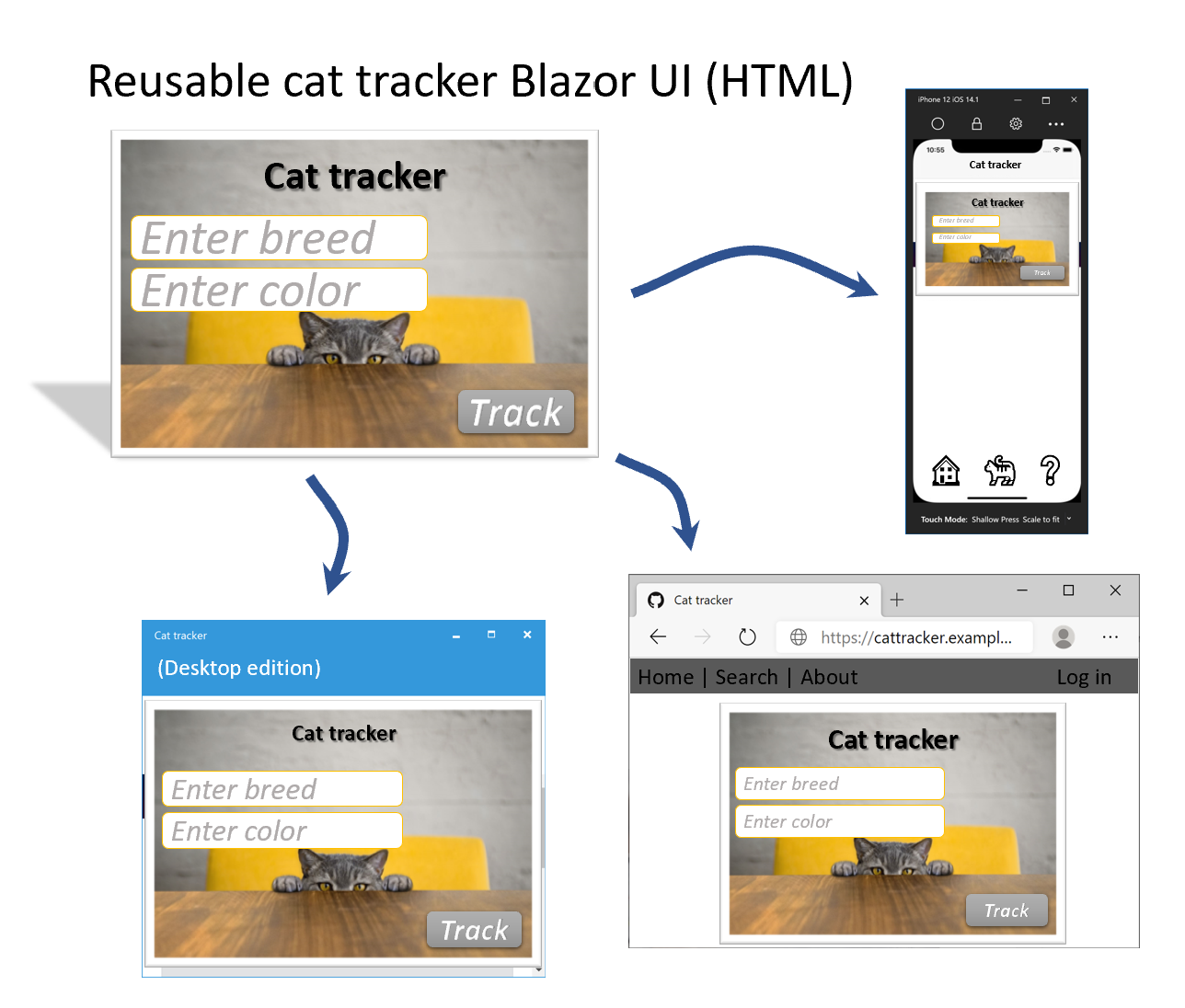
You can build one UI using Blazor Web and host it in a Blazor Server or Blazor Web Assembly app and also in a Mobile Blazor Bindings hybrid app to target Android, iOS, macOS, and Windows:

Image cat tracker options

These are the major new features in the 0.5 Preview 5 release:

  • Build your UI in a Razor Class Library (RCL) and share the same UI between web app and native app, including static assets such as CSS and images (community contribution from Jan-Willem Spuij)
  • Support for Shell with Routing, including the Razor @page directive (community contribution from Lachlan Gordon
  • Support for SkiaSharp graphics (community contribution from Lachlan Gordon
  • Gesture recognizers (tap, swipe, etc.)
  • Dual-screen device support
  • Added FontImageSource, DatePicker, TimePicker
  • Simplified Grid layout syntax
  • Update to Xamarin.Forms 4.8
  • Nightly package feed
  • OSS docs on GitHub
  • And several bug fixes and other small improvements
  • The full list of closed issues is here: https://github.com/xamarin/MobileBlazorBindings/milestone/5?closed=1

Get started

To get started building a Blazor Hybrid app with Experimental Mobile Blazor Bindings preview 5, install the .NET Core 3.1 SDK, have Visual Studio with the Mobile development with .NET (Xamarin.Forms) and ASP.NET and web development workloads installed, and then run the following command:

dotnet new -i Microsoft.MobileBlazorBindings.Templates::0.5.50-preview

And then create your first project by running this command:

dotnet new blazorhybrid -o MyHybridApp

Note: For additional information on required software, please check the Getting Started article.

Now open it in Visual Studio and run it on Android, iOS, Windows, or macOS. That’s it! You can find additional docs and tutorials on https://docs.microsoft.com/mobile-blazor-bindings/. We have a new tutorial for building a Razor Class Library and including it in a Blazor Server app as well as targeting Android, iOS, macOS, and Windows platforms.

Upgrade an existing project

To update an existing Mobile Blazor Bindings project please refer to the Migrate Mobile Blazor Bindings From Preview 4 to Preview 5 topic for full details.

Razor Class Library support

Razor Class Libraries are a feature of Razor that enable you to package part of your application’s UI and logic into a reusable library. This library can then be reused in multiple web applications. Now in Mobile Blazor Bindings you can use the same library in a Blazor Hybrid application as part of a mobile or desktop app. The web content is hosted in a Web View, just like any hybrid app content, and it can interact with any native parts of the application, and the reverse is true as well. Previous versions included limited support for RCLs, and this version adds improved support for them, particularly support for serving static assets such as CSS and images, as well as support for JSInterop for interop between JavaScript and .NET code.

Shell navigation

To build a great native experience for your app you can use the Shell control that comes from Xamarin.Forms. Starting with Preview 5 you can author native Blazor pages with the @page "/search/{query}" syntax and integrate them with the Shell’s navigation (such as the Back button) and navigate to them using the new NavigationManager.NavigateToAsync($"/search/{query}") API. Pages can use the navigation manager by injecting it from the DI container as in @inject ShellNavigationManager NavigationManager.

SkiaSharp graphics

SkiaSharp is a popular cross-platform graphics library based on Google’s Skia graphics library. In Preview 5 you can directly use SkiaSharp’s Canvas APIs to render rich high-performance graphics directly in your Mobile Blazor Bindings app.

Here’s what a simple canvas might look like:

<ContentView>
    <StackLayout Padding="20">
        <SKCanvasView OnPaintSurface="PaintSurface"/>
    </StackLayout>
</ContentView>

@code
{
    void PaintSurface(SKPaintSurfaceEventArgs e)
    {
        var canvas = e.Surface.Canvas;
        canvas.Clear(SKColors.Green);
        var paint = new SKPaint { Color = SKColors.SkyBlue, };
        canvas.DrawLine(0, 0, 200, 200, paint);
    }
}

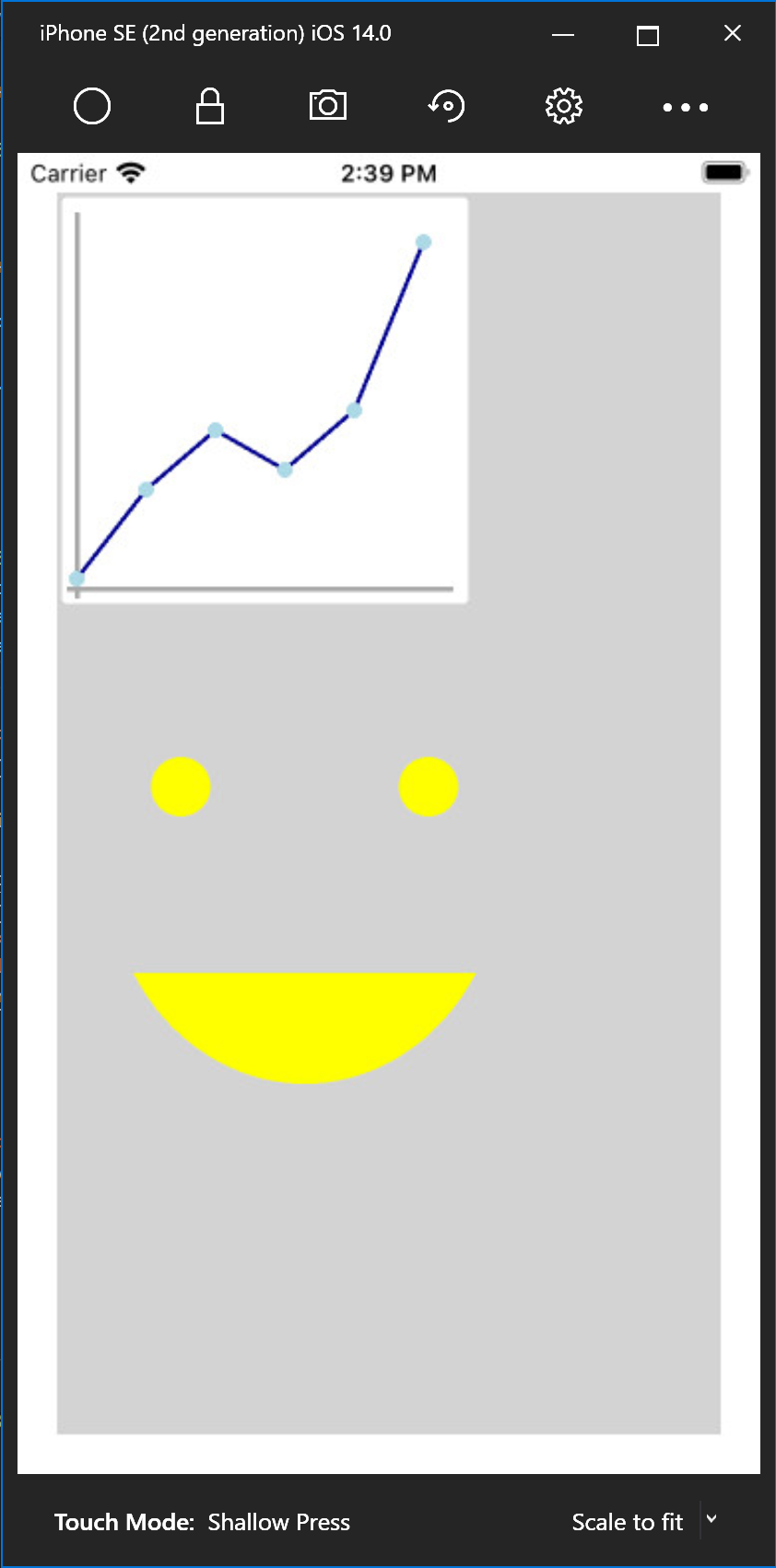
And here’s what a more complex canvas might render as:

SkiaSharp rendering a graph in Mobile Blazor Bindings on iOS

More information

Thank you to contributors

This release had several major contributions from community contributors:

  • Jan-Willem Spuij added support for Razor Class Libraries with static assets. He stayed up late (his time) on calls with me several times and I appreciate his hard work!
  • Lachlan Gordon added support for Shell navigation and SkiaSharp. His patience in playing time-zone ping-pong (Australia vs. USA) is most appreciated and resulted in high quality contributions!

Thanks you to Jan-Willem, Lachlan, and everyone else who contributed to this release!

What’s next? Let us know what you want!

This project relies on your feedback to help shape the future of Blazor for native and hybrid scenarios. Please share your thoughts on this blog post or at the GitHub repo so we can keep the discussion going.

The post Unified Blazor UI in the Mobile Blazor Bindings Preview 5 appeared first on ASP.NET Blog.


.NET Framework October 2020 Cumulative Update Preview Update for Windows 10 2004 and Windows Server, version 2004

Yesterday, we are releasing the October 2020 Cumulative Update Preview Updates for .NET Framework.

Quality and Reliability

This release contains the following quality and reliability improvements.

SQL
  • Addressed an issue in System.Data.SqlClient where querying string columns would fail if the database had a Kazakh collation.
WPF1
  • Addressed a regression from a previous update, arising when two HostVisual elements disconnect at the same time.
  • Addressed a crash and/or hang when typing into a TextBox in a WPF app, when the OS feature “use text cursor indicator” is enabled.

1 Windows Presentation Foundation (WPF)

Getting the Update

The Cumulative Update Preview is available via Windows Update and Microsoft Update Catalog.

Microsoft Update Catalog

You can get the update via the Microsoft Update Catalog. For Windows 10, NET Framework 4.8 updates are available via Windows Update and Microsoft Update Catalog. Updates for other versions of .NET Framework are part of the Windows 10 Monthly Cumulative Update.

**Note**: Customers that rely on Windows Update will automatically receive the .NET Framework version-specific updates. Advanced system administrators can also take use of the below direct Microsoft Update Catalog download links to .NET Framework-specific updates. Before applying these updates, please ensure that you carefully review the .NET Framework version applicability, to ensure that you only install updates on systems where they apply.

The following table is for Windows 10 and Windows Server 2016+ versions.


Product Version Cumulative Update
Windows 10 2004 and Windows Server, version 2004
.NET Framework 3.5, 4.8 Catalog 4580419


Previous Cumulative Updates

The last few .NET Framework updates are listed below for your convenience:

The post .NET Framework October 2020 Cumulative Update Preview Update for Windows 10 2004 and Windows Server, version 2004 appeared first on .NET Blog.


source https://devblogs.microsoft.com/dotnet/net-framework-october-2020-cumulative-update-preview-update-for-windows-10-2004-and-windows-server-version-2004/

Microsoft Excel Tutorial for Beginners - Full Course


Curriculum for the course Microsoft Excel Tutorial for Beginners - Full Course

Lean how to use Microsoft Excel from the beginning by creating 6 real-world projects. Most of the content applies to Google Sheets as well. You will learn how to - enter data, - navigate through a spreadsheet, - create formulas to solve problems, - create charts and graphs, - understand relative vs absolute references, - import and export data, - implement VLOOKUP, - use pivot tables, - split and concatenate text, - and more. ✏️ Course developed by Shad Sluiter. Check out his YouTube channel: https://www.youtube.com/user/shadsluiter ⭐️ Course Contents ⭐️ ⌨️ (0:00:00) Intro ⌨️ (0:04:14) Payroll ⌨️ (0:39:35) Gradebook ⌨️ (0:57:22) Decision Factors ⌨️ (1:04:40) Sales Database ⌨️ (1:23:13) Car Inventory ⌨️ (1:59:29) Problem Solving Templates ⭐️ Special thanks to our Champion supporters! ⭐️ 🏆 Loc Do 🏆 Joseph C 🏆 DeezMaster -- Learn to code for free and get a developer job: https://www.freecodecamp.org Read hundreds of articles on programming: https://freecodecamp.org/news And subscribe for new videos on technology every day: https://youtube.com/subscription_center?add_user=freecodecamp

Watch Online Full Course: Microsoft Excel Tutorial for Beginners - Full Course


Click Here to watch on Youtube: Microsoft Excel Tutorial for Beginners - Full Course


This video is first published on youtube via freecodecamp. If Video does not appear here, you can watch this on Youtube always.


Udemy Microsoft Excel Tutorial for Beginners - Full Course courses free download, Plurasight Microsoft Excel Tutorial for Beginners - Full Course courses free download, Linda Microsoft Excel Tutorial for Beginners - Full Course courses free download, Coursera Microsoft Excel Tutorial for Beginners - Full Course course download free, Brad Hussey udemy course free, free programming full course download, full course with project files, Download full project free, College major project download, CS major project idea, EC major project idea, clone projects download free

gRPC performance improvements in .NET 5

gRPC is a modern open source remote procedure call framework. There are many exciting features in gRPC: real-time streaming, client-to-server code generation, and great cross-platform support to name a few. The most exciting to me, and consistently mentioned by developers who are interested in gRPC, is performance.

Last year Microsoft contributed a new implementation of gRPC for .NET to the CNCF. Built on top of Kestrel and HttpClient, gRPC for .NET makes gRPC a first-class member of the .NET ecosystem.

In our first gRPC for .NET release, we focused on gRPC’s core features, compatibility, and stability. In .NET 5, we made gRPC really fast.

gRPC and .NET 5 are fast

In a community run benchmark of different gRPC server implementations, .NET gets the highest requests per second after Rust, and is just ahead of C++ and Go.

gRPC performance comparison

This result builds on top of the work done in .NET 5. Our benchmarks show .NET 5 server performance is 60% faster than .NET Core 3.1. .NET 5 client performance is 230% faster than .NET Core 3.1.

Stephen Toub discusses dotnet/runtime changes in his Performance Improvements in .NET 5 blog post. Check it out to read about improvements in HttpClient and HTTP/2.

In the rest of this blog post I’ll talk about the improvements we made to make gRPC fast in ASP.NET Core.

HTTP/2 allocations in Kestrel

gRPC uses HTTP/2 as its underlying protocol. A fast HTTP/2 implementation is the most important factor when it comes to performance. Our gRPC server builds on top of Kestrel, a HTTP server written in C# that is designed with performance in mind. Kestrel is a top contender in the TechEmpower benchmarks, and gRPC benefits from a lot of the performance improvements in Kestrel automatically. However, there are many HTTP/2 specific optimizations that were made in .NET 5.

Reducing allocations is a good place to start. Fewer allocations per HTTP/2 request means less time doing garbage collection (GC). And CPU time “wasted” in GC is CPU time not spent serving HTTP/2 requests.

.NET Core 3.1 memory graph

The performance profiler above is measuring allocations over 100,000 gRPC requests. The live object graph’s sawtooth shaped pattern indicates memory building up, then being garbage collected. About 3.9KB is being allocated per request. Lets try to get that number down!

dotnet/aspnetcore#18601 adds pooling of streams in a HTTP/2 connection. This one change almost cuts allocations per request in half. It enables reuse of internal types like Http2Stream, and publicly accessible types like HttpContext and HttpRequest, across multiple requests.

Once streams are pooled a range of optimizations become available:

There are many smaller allocation savings. dotnet/aspnetcore#19783 removes allocations in Kestrel’s HTTP/2 flow control. A resettable ManualResetValueTaskSourceCore<T> type replaces allocating a new object each time flow control is triggered. dotnet/aspnetcore#19273 replaces an array allocation with stackalloc when validating the HTTP request path. dotnet/aspnetcore#19277 and dotnet/aspnetcore#19325 eliminate some unintended allocations related to logging. dotnet/aspnetcore#22557 avoids allocating a Task<T> if a task is already complete. And finally dotnet/aspnetcore#19732 saves a string allocation by special casing content-length of 0. Because every allocation matters.

.NET 5 memory

Per-request memory in .NET 5 is now just 330 B, a decrease of 92%. The sawtooth pattern has also disappeared. Reduced allocations means garbage collection didn’t run at all while the server processed 100,000 gRPC calls.

Reading HTTP headers in Kestrel

A hotpath in HTTP/2 is reading and writing HTTP headers. A HTTP/2 connection supports concurrent requests over a TCP socket, a feature called multiplexing. Multiplexing allows HTTP/2 to make efficient use of connections, but only the headers for one request on a connection can be processed at a time. HTTP/2’s HPack header compression is stateful and depends on order. Processing HTTP/2 headers is a bottleneck so has to be as fast as possible.

dotnet/aspnetcore#23083 optimizes the performance of HPackDecoder. The decoder is a state machine that reads incoming HTTP/2 HEADER frames. The approach here is good, the state machine allows Kestrel to decode frames as they arrive, but the decoder was checking state after parsing each byte. Another problem is literal values, the header names and values, were copied multiple times. Optimizations in this PR include:

  • Tighten parsing loops. For example, if we’ve just parsed a header name then the value must come afterwards. There is no need to check the state machine to figure out the next state.
  • Skip literal parsing all together. Literals in HPack have a length prefix. If we know the next 100 bytes are a literal then there is no need to inspect each byte. Mark the literal’s location and resuming parsing at its end.
  • Avoid copying literal bytes. Previously literal bytes were always copied to an intermediary array before passed to Kestrel. Most of the time this isn’t necessary and instead we can just slice the original buffer and pass a ReadOnlySpan<byte> to Kestrel.

Together these changes significantly decrease the time it takes to parse headers. Header size is almost no longer a factor. The decoder marks the start and end position of a value and then slices that range.

private HPackDecoder _decoder = CreateDecoder();
private byte[] _smallHeader = new byte[] { /* HPack bytes */ };
private byte[] _largeHeader = new byte[] { /* HPack bytes */ };
private IHttpHeadersHandler _noOpHandler = new NoOpHeadersHandler();

[Benchmark]
public void SmallDecode() =>
    _decoder.Decode(_smallHeader, endHeaders: true, handler: _noOpHandler);

[Benchmark]
public void LargeDecode() =>
    _decoder.Decode(_largeHeader, endHeaders: true, handler: _noOpHandler);
Method Runtime Mean Ratio Allocated
SmallDecode .NET Core 3.1 111.20 ns 1.00 0 B
SmallDecode .NET 5.0 71.90 ns 0.65 0 B
LargeDecode .NET Core 3.1 49,083.00 ns 1.00 0 B
LargeDecode .NET 5.0 98.68 ns 0.002 0 B

Once headers have been decoded, Kestrel needs to validate and process them. For example, special HTTP/2 headers like :path and :method need to be set onto HttpRequest.Path and HttpRequest.Method, and other headers need to be converted to strings and added to the HttpRequest.Headers collection.

Kestrel has the concept of known request headers. Known headers are a selection of commonly occuring request headers that have been optimized for fast setting and getting. dotnet/aspnetcore#24730 adds an even faster path for setting HPack static table headers to the known headers. The HPack static table gives 61 common header names and values a number ID that can be sent instead of the full name. A header with a static table ID can use the optimized path to bypass some validation and quickly be set in the collection based on its ID. dotnet/aspnetcore#24945 adds extra optimization for static table IDs with a name and value.

Adding HPack response compression

Prior to .NET 5, Kestrel supported reading HPack compressed headers in requests, but it didn’t compress response headers. The obvious advantage of response header compression is less network usage, but there are performance benefits as well. It’s faster to write a couple of bits for a compressed header than it is to encode and write the header’s full name and value as bytes.

dotnet/aspnetcore#19521 adds initial HPack static compression. Static compression is pretty simple: if the header is in the HPack static table then write the ID to identify the header instead of the longer name.

Dynamic HPack header compression is more complicated, but also provides bigger gains. Response header names and values are tracked in a dynamic table and are each assigned an ID. As a response’s headers are written, the server checks to see if the header name and value are in the table. If there is a match then the ID is written. If there isn’t then the full header is written, and it is added to the table for the next response. There is a maximum size of the dynamic table, so adding a header to it may evict other headers with a first in, first out order.

dotnet/aspnetcore#20058 adds dynamic HPack header compression. To quickly search for headers the dynamic table groups header entries using a basic hash table. To track order and evict the oldest headers, entries maintain a linked list. To avoid allocations, removed entries are pooled and reused.

Wireshark HTTP/2 response

Using Wireshark, we can see the impact of header compression on response size for this example gRPC call. .NET Core 3.x writes 77 B, while .NET 5 is only 12 B.

Protobuf message serialization

gRPC for .NET uses the Google.Protobuf package as the default serializer for messages. Protobuf is an efficient binary serialization format. Google.Protobuf is designed for performance, using code generation instead of reflection to serialize .NET objects. There are some modern .NET APIs and features that can be added to it to reduce allocations and improve efficiency.

The biggest improvement to Google.Protobuf is support for modern .NET IO types: Span<T>, ReadOnlySequence<T> and IBufferWriter<T>. These types allow gRPC messages to be serialized directly using buffers exposed by Kestrel. This saves Google.Protobuf allocating an intermediary array when serializing and deserializing Protobuf content.

Support for Protobuf buffer serialization was a multi-year effort between Microsoft and Google engineers. Changes were spread across multiple repositories.

protocolbuffers/protobuf#7351 and protocolbuffers/protobuf#7576 add support for buffer serialization to Google.Protobuf. This is by far the biggest and most complicated change. Three attempts were made to add this feature before the right balance between performance, backwards compatibility and code reuse was found. Protobuf reading and writing uses many performance oriented features and APIs added to C# and .NET Core:

  • Span<T> and C# ref struct types enables fast and safe access to memory. Span<T> represents a contiguous region of arbitrary memory. Using span lets us serialize to managed .NET arrays, stack allocated arrays, or unmanaged memory, without using pointers. Span<T> and .NET protects us against buffer overflow.
  • stackalloc is used to create stack-based arrays. stackalloc is a useful tool to avoid allocations when a small buffer is required.
  • Low-level methods such as MemoryMarshal.GetReference(), Unsafe.ReadUnaligned() and Unsafe.WriteUnaligned() convert directly between primitive types and bytes.
  • BinaryPrimitives has helper methods for efficiently converting between .NET primitive types and bytes. For example, BinaryPrimitives.ReadUInt64LittleEndian reads little endian bytes and returns an unsigned 64 bit number. Methods provided by BinaryPrimitive are heavily optimized and use vectorization.

A great thing about modern C# and .NET is it is possible to write fast, efficient, low-level libraries without sacrificing memory safety. When it comes to performance, .NET lets you have your cake and eat it too!

private TestMessage _testMessage = CreateMessage();
private ReadOnlySequence<byte> _testData = CreateData();
private IBufferWriter<byte> _bufferWriter = CreateWriter();

[Benchmark]
public IMessage ToByteArray() =>
    _testMessage.ToByteArray();

[Benchmark]
public IMessage ToBufferWriter() =>
    _testMessage.WriteTo(_bufferWriter);

[Benchmark]
public IMessage FromByteArray() =>
    TestMessage.Parser.ParseFrom(CreateBytes());

[Benchmark]
public IMessage FromSequence() =>
    TestMessage.Parser.ParseFrom(_testData);
Method Runtime Mean Ratio Allocated
ToByteArray .NET 5.0 1,133.82 ns 1.00 184 B
ToBufferWriter .NET 5.0 589.05 ns 0.51 64 B
FromByteArray .NET 5.0 409.88 ns 1.00 1960 B
FromSequence .NET 5.0 381.03 ns 0.92 1776 B

Adding support for buffer serialization to Google.Protobuf is just the first step. More work is required for gRPC for .NET to take advantage of the new capability:

  • grpc/grpc#18865 and grpc/grpc#19792 adds ReadOnlySequence<byte> and IBufferWriter<byte> APIs to the gRPC serialization abstraction layer in Grpc.Core.Api.
  • grpc/grpc#23485 updates gRPC code generation to glue the changes in Google.Protobuf to Grpc.Core.Api.
  • grpc/grpc-dotnet#376 and grpc/grpc-dotnet#629 updates gRPC for .NET to use the new serialization abstractions in Grpc.Core.Api. This code is the integration between Kestrel and gRPC. Because Kestrel’s IO is built on top of System.IO.Pipelines, we can use its buffers during serialization.

The end result is gRPC for .NET serializes Protobuf messages directly to Kestrel’s request and response buffers. Intermediary array allocations and byte copies have been eliminated from gRPC message serialization.

Wrapping Up

Performance is a feature of .NET and gRPC, and as cloud apps scale it is more important than ever. I think all developers can agree it is fun to make fast apps, but performance has real world impact. Lower latency and higher throughput means fewer servers. It is an opportunity to save money, reduce power use and build greener apps.

.NET Core 3.1 vs .NET 5 results

As is obvious from this tour, a lot of changes have gone into gRPC, Protobuf and .NET aimed at improving performance. Our benchmarks show a 60% improvement in gRPC server RPS and a 230% improvement in gRPC client RPS.

.NET 5 RC2 is available now, and the official .NET 5 release is in November. To try out the performance improvements and to get started using gRPC with .NET, the best place to start is the Create a gRPC client and server in ASP.NET Core tutorial.

We look forward to hearing about apps built with gRPC and .NET, and to your future contributions in the dotnet and grpc repos!

The post gRPC performance improvements in .NET 5 appeared first on ASP.NET Blog.


Help Us Plan EF Core 6.0

Entity Framework Core 5.0 will soon be released in conjunction with .NET 5. The release is a major milestone in the long history of Entity Framework that began before version 1.0 was shipped with .NET Framework 3.5 Service Pack 1 in 2008. EF Core 5.0 is cross-platform and supports all of the most popular relational databases. It also provides a consistent API to interface with the popular NoSQL Azure Cosmos DB database. EF Core 5.0 includes scores of new features ranging from “many-to-many” and “table-per-type” to an updated migrations experience. The team is currently focused on bug fixes, updates to documentation, and planning for the next release.

.NET bot builder

The team is ready to start building the next release, but we need your help!

The Entity Framework 2020 Survey

To better understand how you work with EF Core and which features are top priority for you, the team developed this short Entity Framework survey. It will take you less than 15 minutes. Our team deeply values your feedback and sincerely hopes many of you will complete the survey. It will be open for a few weeks and we encourage you to share it with colleagues who also work with data in .NET. This is a key opportunity to help shape the next release of EF Core. We will prioritize our focus based on the responses we receive. So make sure you tell us what you want!

Here’s the link for your reference:

» Take the Survey

Thank you,

The Entity Framework Team:

@ajcvickers, @AndriySvyryd, @bricelambs, @JeremyLikness, @ShayRojansky, and @smitpatel

The post Help Us Plan EF Core 6.0 appeared first on .NET Blog.


source https://devblogs.microsoft.com/dotnet/help-us-plan-ef-core-6-0/

Announcing Version 1.0 of .NET for Apache Spark

Today, we announce the release of version 1.0 of .NET for Apache® Spark™, an open source package that brings .NET development to the Apache® Spark™ platform. This release is possible due to the combined efforts of Microsoft and the open source community. Version 1.0 includes support for .NET applications targeting .NET Standard 2.0 or later. Access to the Apache® Spark™ DataFrame APIs (versions 2.3, 2.4 and 3.0) and the ability to write Spark SQL and create user-defined functions (UDFs) are also included in the release.

The .NET Bot

The following code snippet is an example of using Spark to produce a word count from a document (browse the full sample here):

var docs = spark.Read().Option("header", true).Csv("documents.csv");
var filCol = Functions.Col("file");
var words = docs
    .Select(
        fileCol,
        // "a b c" => ["a", "b", "c"]
        Functions.Split(
            Functions.Col("words"), " ")
        .Alias("wordList"))
    // flatten into one row per word
    .Select(
        fileCol,
        // 1: ["a", "b", "c"] => 1: "a", 2: "b", 3: "c"
        Functions.Explode(
            Functions.Col("wordList"))
        .Alias("word"))
    .GroupBy(fileCol, Functions.Lower(Functions.Col("word")))
    .Count();

Background

.NET for Apache® Spark™ launched two years ago to address increasing demand from the .NET community for an easier way to build big data applications. A recent survey confirmed the biggest motivation to use the package is to take advantage of existing .NET development skills and resources, including the enormous .NET ecosystem of existing libraries and frameworks. The team is committed to the continuous evolution of the product to integrate the latest features and keep the API current with the latest Spark versions. For more about the history of the project and key contributors, read the full announcement.

Get Started

There are several options to get started. First, read the full .NET for Apache Spark 1.0 announcement. Then you can:

The post Announcing Version 1.0 of .NET for Apache Spark appeared first on .NET Blog.


source https://devblogs.microsoft.com/dotnet/announcing-version-1-0-of-net-for-apache-spark/

Use PHP to Create an MVC Framework - Full Course


Curriculum for the course Use PHP to Create an MVC Framework - Full Course

Learn how to use PHP to build an MVC framework from scratch. You will get an understanding of how frameworks are made. The framework you build is not production-ready. During this project we will learn many things: - How to work with file system - How to work with databases - How to use Abstraction in real projects - How to implement custom routing - How to install third party packages using composer - How to create reusable composer package - and many other important things ✏️ This course was developed by Zura Sekhniashvili (The Codeholic). Check out his YouTube channel: https://www.youtube.com/channel/UC_UMEcP_kF0z4E6KbxCpV1w 💻 Code: https://github.com/thecodeholic/php-mvc-framework ⭐️ Course Contents ⭐️ ⌨️ (00:00:00) Introduction ⌨️ (00:01:29) Show features ⌨️ (00:03:57) Demo of the Framework ⌨️ (00:07:40) Create Application and Router ⌨️ (00:14:17) Enable autoloading using composer ⌨️ (00:19:20) Implement Routing ⌨️ (00:32:31) Create project structure ⌨️ (00:36:03) Implement views & layouts ⌨️ (01:00:54) Implement Controllers ⌨️ (01:12:49) Sanitize $_POST data ⌨️ (01:18:19) Start Registration ⌨️ (01:24:54) Implement second layout ⌨️ (01:29:56) Implement Models ⌨️ (01:41:18) Implement Validation using models ⌨️ (02:00:21) Implement form Widget ⌨️ (02:21:01) Migrations & Connection to Database ⌨️ (02:29:53) .env file & Application Config ⌨️ (02:38:59) Implement Migrations ⌨️ (03:04:21) Implement ActiveRecord & Finish Registration ⌨️ (03:23:56) Restrict registration with the same email ⌨️ (03:32:49) Implement Session Flash messages ⌨️ (03:49:44) Implement Input labels ⌨️ (03:59:43) Implement Login ⌨️ (04:29:26) Hide Login/Register buttons When user is authorized ⌨️ (04:35:15) Create protected routes ⌨️ (04:57:45) Create View component & implement page titles ⌨️ (05:06:55) Improve form widget with abstraction ⌨️ (05:20:55) Make core installable composer package ⌨️ (05:47:18) Create second website to use the same core ⌨️ (05:52:18) Add new feature to core and release new version ⭐️ Special thanks to our Champion supporters! ⭐️ 🏆 Loc Do 🏆 Joseph C 🏆 DeezMaster -- Learn to code for free and get a developer job: https://www.freecodecamp.org Read hundreds of articles on programming: https://freecodecamp.org/news And subscribe for new videos on technology every day: https://youtube.com/subscription_center?add_user=freecodecamp

Watch Online Full Course: Use PHP to Create an MVC Framework - Full Course


Click Here to watch on Youtube: Use PHP to Create an MVC Framework - Full Course


This video is first published on youtube via freecodecamp. If Video does not appear here, you can watch this on Youtube always.


Udemy Use PHP to Create an MVC Framework - Full Course courses free download, Plurasight Use PHP to Create an MVC Framework - Full Course courses free download, Linda Use PHP to Create an MVC Framework - Full Course courses free download, Coursera Use PHP to Create an MVC Framework - Full Course course download free, Brad Hussey udemy course free, free programming full course download, full course with project files, Download full project free, College major project download, CS major project idea, EC major project idea, clone projects download free

.NET Framework October 2020 Cumulative Update Preview Update

Yesterday, we are releasing the October 2020 Cumulative Update Preview Updates for .NET Framework.

Quality and Reliability

This release contains the following quality and reliability improvements.

SQL
  • Addressed an issue in System.Data.SqlClient where querying string columns would fail if the database had a Kazakh collation.
WPF1
  • Addressed a regression from a previous update, arising when two HostVisual elements disconnect at the same time.
  • Addressed a crash and/or hang when typing into a TextBox in a WPF app, when the OS feature “use text cursor indicator” is enabled.

1 Windows Presentation Foundation (WPF)

Getting the Update

The Cumulative Update Preview is available via Windows Update and Microsoft Update Catalog.

Microsoft Update Catalog

You can get the update via the Microsoft Update Catalog. For Windows 10, NET Framework 4.8 updates are available via Windows Update and Microsoft Update Catalog. Updates for other versions of .NET Framework are part of the Windows 10 Monthly Cumulative Update.

**Note**: Customers that rely on Windows Update will automatically receive the .NET Framework version-specific updates. Advanced system administrators can also take use of the below direct Microsoft Update Catalog download links to .NET Framework-specific updates. Before applying these updates, please ensure that you carefully review the .NET Framework version applicability, to ensure that you only install updates on systems where they apply.

The following table is for Windows 10 and Windows Server 2016+ versions.

Product Version Cumulative Update
Windows 10 1909 and Windows Server, version 1909
.NET Framework 3.5, 4.8 Catalog 4580980
Windows 10 1903 and Windows Server, version 1903
.NET Framework 3.5, 4.8 Catalog 4580980
Windows 10 1809 (October 2018 Update) and Windows Server 2019 4581000
.NET Framework 3.5, 4.7.2 Catalog 4580422
.NET Framework 3.5, 4.8 Catalog 4580979


Previous Cumulative Updates

The last few .NET Framework updates are listed below for your convenience:

The post .NET Framework October 2020 Cumulative Update Preview Update appeared first on .NET Blog.


source https://devblogs.microsoft.com/dotnet/net-framework-october-2020-cumulative-update-preview-update/

Docker and Kubernetes - Full Course for Beginners


Curriculum for the course Docker and Kubernetes - Full Course for Beginners

Learn the fundamentals of Docker and Kubernetes in this complete hand-on course. First, you will learn about creating docker images, running docker containers, docker volumes, container registry and docker architecture. Next, you will learn about Kubernetes architecture, Kubernetes pods, services, config maps all the way to Kubernetes deployments. You will learn the differences between Docker and Kubernetes, allowing you to start using these two technologies with confidence. ✏️ Course from Amigoscode and Techworld with Nana. 🔗 Subscribe to the Amigoscode YouTube channel: http://bit.ly/2HpF5V8 🔗 Subscribe to the Techworld with Nana YouTube channel: https://www.youtube.com/channel/UCdngmbVKX1Tgre699-XLlUA ⭐️ Course Contents ⭐️ 🌟 Introduction to Docker 🌟 ⌨️ (0:00) Introduction ⌨️ (2:34) Course Overview ⌨️ (5:03) What is Docker ⌨️ (9:34) Installing Docker ⌨️ (12:56) Verify Installation 🌟 Images, Containers, and Ports 🌟 ⌨️ (15:36) Images & Containers ⌨️ (17:06) Pulling NGINX Image ⌨️ (21:12) Running Containers ⌨️ (25:48) Exposing Ports ⌨️ (30:01) Exposing Multiple Ports ⌨️ (31:38) Managing Containers ⌨️ (39:37) Naming Containers 🌟 Volumes 🌟 ⌨️ (45:38) Volumes ⌨️ (49:47) Volumes Between Host and Container ⌨️ (57:53) Customize Website ⌨️ (1:00:48) Volumes Between Containers 🌟 Building Images 🌟 ⌨️ (1:04:03) Dockerfile ⌨️ (1:06:10) Creating Dockerfile ⌨️ (1:11:55) Docker Build 🌟 Project: Build an Image for an API 🌟 ⌨️ (1:19:16) Node JS and Express JS ⌨️ (1:25:50) Dockerfile for our API ⌨️ (1:31:57) Running Containers for our API 🌟 Caching and Layers 🌟 ⌨️ (1:35:02) .dockerignore ⌨️ (1:40:17) Caching and Layers ⌨️ (1:45:32) Caching and Layers Part 2 🌟 Reducing Image Size 🌟 ⌨️ (1:51:39) Alpine ⌨️ (1:54:30) Pulling Alpine Images ⌨️ (2:00:02) Using Alpine 🌟 Tags and Versioning 🌟 ⌨️ (2:06:28) Tags and Versions ⌨️ (2:09:31) Using Tags with Versions ⌨️ (2:13:35) Running Containers and Tags ⌨️ (2:17:23) Tagging Override ⌨️ (2:20:22) Tagging Own Images ⌨️ (2:25:06) Running Containers with Different Tags 🌟 Image Registries 🌟 ⌨️ (2:29:58) Docker Registry ⌨️ (2:32:58) Create Docker Hub Repo ⌨️ (2:35:31) Pushing Images to Docker Hub ⌨️ (2:41:32) Pulling Own Images 🌟 Debugging Containers 🌟 ⌨️ (2:46:06) Docker Inspect ⌨️ (2:49:30) Docker Logs ⌨️ (2:53:51) Docker Exec 🌟 Introduction to Kubernetes 🌟 ⌨️ (2:57:30) Kubernetes ⌨️ (2:58:35) Course Overview ⌨️ (2:59:03) What is Kubernetes 🌟 Kubernetes Architecture & Components 🌟 ⌨️ (3:02:28) Kubernetes Architecture ⌨️ (3:07:01) Pod, Service & Ingress ⌨️ (3:12:51) Config Map and Secret ⌨️ (3:16:05) Volumes ⌨️ (3:18:06) Deployments and Stateful Sets ⌨️ (3:23:25) Components Summary 🌟 Developing Locally 🌟 ⌨️ (3:24:23) Minikube and kubectl ⌨️ (3:28:06) Installing Minikube and kubectl ⌨️ (3:34:06) Create Deployment ⌨️ (3:37:17) Debugging Pods ⌨️ (3:40:21) kubectl apply -f ⌨️ (3:44:48) kubectl commands summary 🌟 Project: MongoDB and Mongo Express 🌟 ⌨️ (3:45:42) Deploying MongoDB and Mongo Express ⌨️ (3:48:00) MongoDB Pod ⌨️ (3:52:01) Secret ⌨️ (3:58:16) MongoDB Internal Service ⌨️ (4:03:08) Deployment Service and Config Map ⌨️ (4:09:56) Mongo Express External Service ⌨️ (4:16:03) Congrats! You made it to the end 🎉 🔗 Visit Amigoscode.com for more courses | http://bit.ly/2JgGW0w 🔗 Follow Amigoscode on Instagram | http://bit.ly/2TSkA9w 🔗 Join Amigoscode Closed Facebook Group | http://bit.ly/2FbuIkx ⭐️ Special thanks to our Champion supporters! ⭐️ 🏆 Loc Do 🏆 Joseph C 🏆 DeezMaster -- Learn to code for free and get a developer job: https://www.freecodecamp.org Read hundreds of articles on programming: https://freecodecamp.org/news And subscribe for new videos on technology every day: https://youtube.com/subscription_center?add_user=freecodecamp

Watch Online Full Course: Docker and Kubernetes - Full Course for Beginners


Click Here to watch on Youtube: Docker and Kubernetes - Full Course for Beginners


This video is first published on youtube via freecodecamp. If Video does not appear here, you can watch this on Youtube always.


Udemy Docker and Kubernetes - Full Course for Beginners courses free download, Plurasight Docker and Kubernetes - Full Course for Beginners courses free download, Linda Docker and Kubernetes - Full Course for Beginners courses free download, Coursera Docker and Kubernetes - Full Course for Beginners course download free, Brad Hussey udemy course free, free programming full course download, full course with project files, Download full project free, College major project download, CS major project idea, EC major project idea, clone projects download free

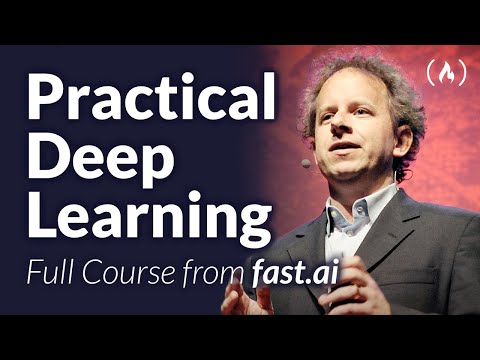
Practical Deep Learning for Coders - Full Course from fast.ai and Jeremy Howard


Curriculum for the course Practical Deep Learning for Coders - Full Course from fast.ai and Jeremy Howard

Practical Deep Learning for Coders is a course from fast.ai designed to give you a complete introduction to deep learning. This course was created to make deep learning accessible to as many people as possible. The only prerequisite for this course is that you know how to code (a year of experience is enough), preferably in Python, and that you have at least followed a high school math course. This course was developed by Jeremy Howard and Sylvain Gugger. Jeremy has been using and teaching machine learning for around 30 years. He is the former president of Kaggle, the world's largest machine learning community. Sylvain Gugger is a researcher who has written 10 math textbooks. 🔗 Course website with questionnaires, set-up guide, and more: https://course.fast.ai/ Lessons 7 and 8 are in a second video: https://youtu.be/HL7LOfyf6bc ⭐️ Course Contents ⭐️ (See next section for book & code.) ⌨️ (0:00:00) Lesson 1 - Your first modules ⌨️ (1:22:55) Lesson 2 - Evidence and p values ⌨️ (2:53:59) Lesson 3 - Production and Deployment ⌨️ (5:00:20) Lesson 4 - Stochastic Gradient Descent (SGD) from scratch ⌨️ (7:01:56) Lesson 5 - Data ethics ⌨️ (9:09:46) Lesson 6 - Collaborative filtering ⌨️ (https://youtu.be/HL7LOfyf6bc) Lesson 7 - Tabular data ⌨️ (https://youtu.be/HL7LOfyf6bc) Lesson 8 - Natural language processing ⭐️ Book chapters and code on Google Colab ⭐️ 🔗 Full book (or use links below to go directly to a chapter on Google Colab): https://github.com/fastai/fastbook NB: Chapter 2 contains widgets, which unfortunately are not supported by Colab. Also, in some places we use a file upload button, which is also not supported by Colab. For those sections, either skip them, or use a different platform such as Gradient (Colab is the only platform which doesn't support widgets). 💻 Intro to Jupyter: https://colab.research.google.com/github/fastai/fastbook/blob/master/app_jupyter.ipynb 💻 Chapter 1, Intro: https://colab.research.google.com/github/fastai/fastbook/blob/master/01_intro.ipynb 💻 Chapter 2, Production: https://colab.research.google.com/github/fastai/fastbook/blob/master/02_production.ipynb 💻 Chapter 3, Ethics: https://colab.research.google.com/github/fastai/fastbook/blob/master/03_ethics.ipynb 💻 Chapter 4, MNIST Basics: https://colab.research.google.com/github/fastai/fastbook/blob/master/04_mnist_basics.ipynb 💻 Chapter 5, Pet Breeds: https://colab.research.google.com/github/fastai/fastbook/blob/master/05_pet_breeds.ipynb 💻 Chapter 6, Multi-Category: https://colab.research.google.com/github/fastai/fastbook/blob/master/06_multicat.ipynb 💻 Chapter 7, Sizing and TTA: https://colab.research.google.com/github/fastai/fastbook/blob/master/07_sizing_and_tta.ipynb 💻 Chapter 8, Collab: https://colab.research.google.com/github/fastai/fastbook/blob/master/08_collab.ipynb 💻 Chapter 9, Tabular: https://colab.research.google.com/github/fastai/fastbook/blob/master/09_tabular.ipynb 💻 Chapter 10, NLP: https://colab.research.google.com/github/fastai/fastbook/blob/master/10_nlp.ipynb 💻 Chapter 11, Mid-Level API: https://colab.research.google.com/github/fastai/fastbook/blob/master/11_midlevel_data.ipynb 💻 Chapter 12, NLP Deep-Dive: https://colab.research.google.com/github/fastai/fastbook/blob/master/12_nlp_dive.ipynb 💻 Chapter 13, Convolutions: https://colab.research.google.com/github/fastai/fastbook/blob/master/13_convolutions.ipynb 💻 Chapter 14, Resnet: https://colab.research.google.com/github/fastai/fastbook/blob/master/14_resnet.ipynb 💻 Chapter 15, Arch Details: https://colab.research.google.com/github/fastai/fastbook/blob/master/15_arch_details.ipynb 💻 Chapter 16, Optimizers and Callbacks: https://colab.research.google.com/github/fastai/fastbook/blob/master/16_accel_sgd.ipynb 💻 Chapter 17, Foundations: https://colab.research.google.com/github/fastai/fastbook/blob/master/17_foundations.ipynb 💻 Chapter 18, GradCAM: https://colab.research.google.com/github/fastai/fastbook/blob/master/18_CAM.ipynb 💻 Chapter 19, Learner: https://colab.research.google.com/github/fastai/fastbook/blob/master/19_learner.ipynb 💻 Chapter 20, conclusion: https://colab.research.google.com/github/fastai/fastbook/blob/master/20_conclusion.ipynb -- Learn to code for free and get a developer job: https://www.freecodecamp.org Read hundreds of articles on programming: https://freecodecamp.org/news And subscribe for new videos on technology every day: https://youtube.com/subscription_center?add_user=freecodecamp

Watch Online Full Course: Practical Deep Learning for Coders - Full Course from fast.ai and Jeremy Howard


Click Here to watch on Youtube: Practical Deep Learning for Coders - Full Course from fast.ai and Jeremy Howard


This video is first published on youtube via freecodecamp. If Video does not appear here, you can watch this on Youtube always.


Udemy Practical Deep Learning for Coders - Full Course from fast.ai and Jeremy Howard courses free download, Plurasight Practical Deep Learning for Coders - Full Course from fast.ai and Jeremy Howard courses free download, Linda Practical Deep Learning for Coders - Full Course from fast.ai and Jeremy Howard courses free download, Coursera Practical Deep Learning for Coders - Full Course from fast.ai and Jeremy Howard course download free, Brad Hussey udemy course free, free programming full course download, full course with project files, Download full project free, College major project download, CS major project idea, EC major project idea, clone projects download free

Tkinter Calculator - Python Basics with Sam


Curriculum for the course Tkinter Calculator - Python Basics with Sam

Learn the basics of Python live from Sam Focht every Tuesday. This is part of a series that will cover the entire Python Programming language. Check out Sam's YouTube channel: https://www.youtube.com/python_basics Python Basics with Sam playlist: https://www.youtube.com/playlist?list=PLWKjhJtqVAbkmRvnFmOd4KhDdlK1oIq23 -- Learn to code for free and get a developer job: https://www.freecodecamp.org Read hundreds of articles on programming: https://freecodecamp.org/news And subscribe for new videos on technology every day: https://youtube.com/subscription_center?add_user=freecodecamp

Watch Online Full Course: Tkinter Calculator - Python Basics with Sam


Click Here to watch on Youtube: Tkinter Calculator - Python Basics with Sam


This video is first published on youtube via freecodecamp. If Video does not appear here, you can watch this on Youtube always.


Udemy Tkinter Calculator - Python Basics with Sam courses free download, Plurasight Tkinter Calculator - Python Basics with Sam courses free download, Linda Tkinter Calculator - Python Basics with Sam courses free download, Coursera Tkinter Calculator - Python Basics with Sam course download free, Brad Hussey udemy course free, free programming full course download, full course with project files, Download full project free, College major project download, CS major project idea, EC major project idea, clone projects download free

Choose a .NET Game Engine

Developing games is multi-disciplined compared to developing business apps and services. Games need design skills spanning UI, audio, gameplay, and art direction. It also requires engineering skills for graphics, gameplay, audio, cloud services, and develops. Sometimes you need to get low level and play around with hardware registries in assembly to optimize performance for a specific device. Do you need to build all those layers yourself when making a game, or is there a better way? Of course, there is a better way. The .NET ecosystem offers many choices for folks like you who want to make games, but do not want to build everything from scratch. In my previous post, I showcased the diverse .NET game development landscape. In this post I will showcase some of the .NET game engines out there, and will help you choose which game engine is right for you.

a game controller with a laptop with a game engine in the background

Game Engines

Developers used to build their games from scratch each time. Now, developers have abstracted a lot of reusable code in their games and created a set of APIs and tools that they can reuse whenever they start a new game. These Game Engines contain abstractions of graphics, input, media API. They also might contain design tools and assets managers for visual and audio assets. You can think about them as an IDE but for more than just code. Some game companies started releasing their engines commercially.

With the popularity of C# more game engines started using .NET. The Mono runtime, now part of .NET 5, was a great choice because it was able to run C# code on many platforms including Android, iOS, PC, Mac, and Linux. Mono also supported dedicated game consoles like Xbox, PlayStation, and Nintendo platforms. Now with .NET including Mono with .NET 5, we are seeing some game engines getting ready to upgrade.

logos of some popular .NET game engines

Engines built with .NET

MonoGame

MonoGame can be described as more of a framework to build game engines with. It might have started as a multi-platform version of XNA, but it has advanced beyond that scope. MonoGame offers comprehensive APIs for game development and an asset management tool. MonoGame just got updates to version 3.8 where it uses .NET Core 3.1 and NuGet, with a plan to upgrade to .NET 5. MonoGame is so flexible other game engines use it as a base, for example FlatRedBall. Many indie developers use MonoGame for all their cross-platform game development.

Stride

Stride (formally Xenko) is another pure C# and .NET engine that was developed by Silicon Studios. It’s a complete integrated engine with a graphical editor. Stride is now open-source and royalty free. Different parts of the engine can be used independently thanks to its modular design. Stride also uses .NET Core 3.1 in their latest 4.0 release. I really like the part in their documentation that focuses on folks who have used Unity before.

WaveEngine

Another Engine that is purely .NET is WaveEngine. WaveEngine is free with many of its components open-sourced. Their latest 3.0 preview released just upgraded to .NET Core 3.1. It offers exciting features like running 3D scenes in a browser using .NET WebAssembly (Mono WASM), Azure remote rendering, and support for HoloLens 2. WaveEngine has many mixed reality features, like spatial audio, ready to use out of the box.

NeoAxis

NeoAxis is an engine that was pointed out to me after I published my previous blog post about using .NET for game development. It’s also completely written with .NET, open-source, and royalty free. It supports a full set of features, in including the addition of Android support in the latest release.


Engines embedding .NET

Unity

Unity, developed in C++, was one of the earlier commercial engines to use .NET to provide C# scripting and multi-platform targeting. Unity is an integrated engine with a programming API interface as well as visual editing tools for graphics, audio, profiling, and debugging. Unity quickly became one of the most used game engine for all real-time graphics applications like games, VR, and simulations. There is a big ecosystem supporting Unity, from an asset store for plugins and starter packs, to game services like Microsoft Azure PlayFab. Unity is a commercial engine, but its free to use until certain revenue thresholds. It’s also free to use for some educational and personal uses.

Godot

Godot is a royalty free, multi-platform, open-source engine developed using C++. It’s a fully integrated game development engine. It also uses .NET to deliver C# scripting. Lately, Godot has been gaining popularity and its community is growing rapidly. It has also gained support and grants from both Microsoft and Epic games.

CryEngine

The famous CryEngine also uses .NET. The engine was built in C++, but it uses the .NET to enable C# scripting. It’s a powerful game engine with a great history powering AAA games. You only pay royalties when you exceed a revenue threshold.


Which engine is right for you?

The most important point when choosing a game engine is how to get support. For beginners, asking peers, or folks online for help is an essential part of learning and remaining motivated. For professionals, enterprise level support is essential to mitigate technical risks. By far, Unity has one of the biggest and most active communities. It also offers paid high-quality enterprise support. In addition, Unity also has one of the biggest ecosystems of services and plugins supporting the engine. Godot has also been gaining more popularity amongst hobbyists and its momentum has been accelerating as well.

Another thing to consider are your own skills, and how well an engine will support you. If you come from a .NET background and want the latest C# features, maybe a pure .NET engine like Stride, WaveEngine, or even MonoGame would suit you best. You can use all the familiar tools with them, like NuGet and the CLI.

An engine with active development gives you security that bugs will get fixed and new platforms and features will be added. Commercial engines might be better for you if that is a concern.

An important consideration when choosing an engine is the price. All the game engines mentioned above are free to start with. Some have royalties attached to them once you reach a revenue threshold. Some of the engines are completely free and royalty free. You choose where the loot goes depending on your financial plans.

Game design can dictate which engine you should use too. One engine might be more suitable than others for certain types of games. For example, using a fully integrated commercial engine to make a text-based adventure might be overkill.


We’d love to hear from you

You have a .NET game development related project, plugin, library, or game you want to blog about on the .NET blog? Is there a .NET game development topic that you want me to write about?

The post Choose a .NET Game Engine appeared first on .NET Blog.


source https://devblogs.microsoft.com/dotnet/choose-a-net-game-engine/

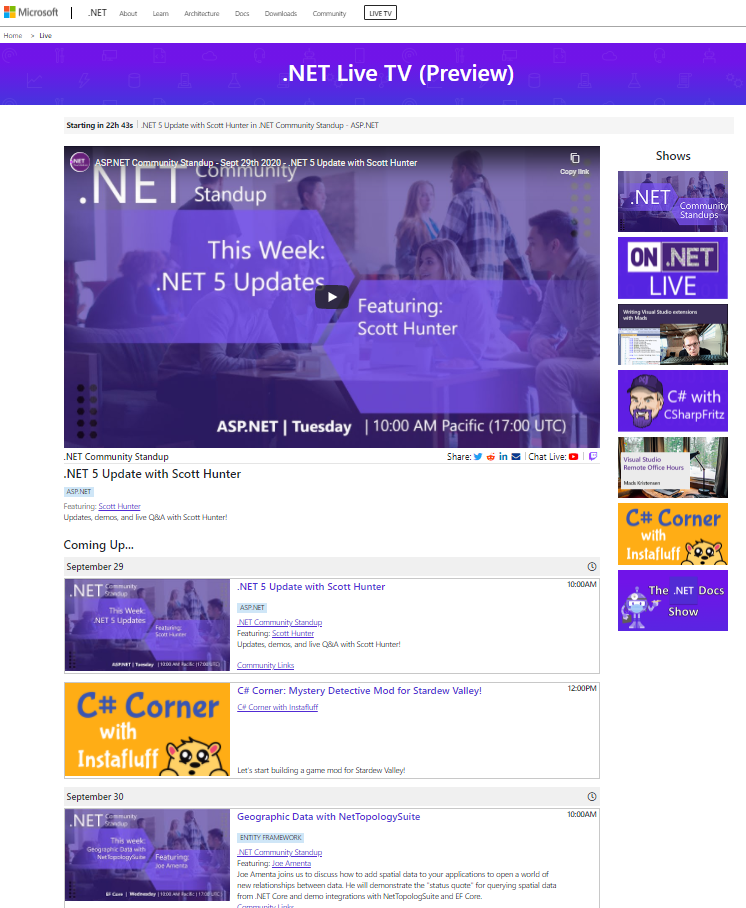
Introducing .NET Live TV – Daily Developer Live Streams

Today, we are launching .NET Live TV, your one stop shop for all .NET and Visual Studio live streams across Twitch and YouTube. We are always looking for new ways to bring great content to the developer community and innovate in ways to interact with you in real-time. Live streaming gives us the opportunity to deliver more content where everyone can ask questions and interact with the product teams.

.NET Live Website

We started our journey several years ago with the .NET Community Standup series. It’s a weekly “behind the scenes” live stream that shows you what goes into building the runtimes, languages, frameworks, and tools we all love. As it grew, so did our dreams of delivering even more awesome .NET live stream content.

.NET Live TV takes things to a whole new level with the introduction of new shows and a new website. It is a single place to bookmark so you can stay up to date with live streams across several Twitch and YouTube channels and with a single click can join in the conversation.

Here are some of the new shows that recently launched that you could look forward to:

Expanded .NET Community Standups

What started as the ASP.NET Community Standup has grown into 7 unique shows throughout the month! Here is a quick guide to the schedule of the shows that all start at 10:00 AM Pacific:

  • Tuesday: ASP.NET hosted by Jon Galloway with a monthly Blazor focus hosted by Safia Abdalla kicking off Nov 17!
  • Wednesday: Rotating – Entity Framework hosted by Jeremy Likness & Machine Learning hosted by Bri Achtman
  • 1st Thursday: Xamarin hosted by Maddy Leger
  • 2nd Thursday: Languages & Runtime hosted by Immo Landwerth
  • 3rd Thursday: .NET Tooling hosted by Kendra Havens
  • 4th Thursday: .NET Desktop hosted by Olia Gavrysh

Packed Week of .NET Shows!

DayTime (PT) Show Description
Monday 6:00 AM C# with CSharpFritz Join Jeff Fritz (csharpfritz) in this start from the beginning series to learn C# in this talk-show format that answers viewers questions and provides interactive samples with every episode.
Monday 9:00 AM The .NET Docs Show Join David Pine, Scott Addie, Cam Soper, and more from the Developer Relations team at Microsoft each week as they highlight the amazing community members in the .NET community.
Monday 11:00 AM Visual Studio Remote Office Hours A weekly show dedicated to the topic of working from home. Mads Kristensen from the Visual Studio team invites guests onto the show for conversations about anything and everything related to Visual Studio and working from home.
Tuesday 10:00 AM .NET Community Standup Join members from the ASP.NET teams for our community standup covering great community contributions for ASP.NET, ASP.NET Core, and more.
Tuesday 12:00 PM C# Corner with Instafluff Join Instafluff (Raphael) each week live on Twitch as he works on fun C# game related projects from his C# corner.
Wednesday 10:00 AM .NET Community Standup Join the Entity Framework and the Machine learning teams for their community standups covering great community contributions.
Thursday 10:00 AM .NET Community Standup Join the Xamarin, Languages & Runtime, .NET Tooling, and .NET Desktop teams covering great community contributions for each subject.
Thursday 2:00 PM On .NET Live Join Cecil Phillip as he hosts and interviews amazing .NET contributors from the .NET teams and the community.
Friday 2:00 PM Visual Studio Extensions with Mads Join Mads Kristensen from the Visual Studio team each week as he builds extensions for Visual Studio live!

More to come!

Be sure to bookmark live.dot.net as we are living streaming 5 days a week and adding even more shows soon! If you are looking for even more great developer video content be sure to check out Microsoft Learn TV where in addition to some of the shows from .NET Live TV you will find 24 hour a day streaming content of all topics.

The post Introducing .NET Live TV – Daily Developer Live Streams appeared first on .NET Blog.


source https://devblogs.microsoft.com/dotnet/dotnet-live-tv/

Docker and Kubernetes - Full Course for Beginners


Curriculum for the course Docker and Kubernetes - Full Course for Beginners

Learn the fundamentals of Docker and Kubernetes in this complete hand-on course. First, you will learn about creating docker images, running docker containers, docker volumes, container registry and docker architecture. Next, you will learn about Kubernetes architecture, Kubernetes pods, services, config maps all the way to Kubernetes deployments. You will learn the differences between Docker and Kubernetes, allowing you to start using these two technologies with confidence. ✏️ Course from Amigoscode and Techworld with Nana. 🔗 Subscribe to the Amigoscode YouTube channel: http://bit.ly/2HpF5V8 🔗 Subscribe to the Techworld with Nana YouTube channel: https://www.youtube.com/channel/UCdngmbVKX1Tgre699-XLlUA ⭐️ Course Contents ⭐️ 🌟 Introduction to Docker 🌟 ⌨️ (0:00) Introduction ⌨️ (2:34) Course Overview ⌨️ (5:03) What is Docker ⌨️ (9:34) Installing Docker ⌨️ (12:56) Verify Installation 🌟 Images, Containers, and Ports 🌟 ⌨️ (15:36) Images & Containers ⌨️ (17:06) Pulling NGINX Image ⌨️ (21:12) Running Containers ⌨️ (25:48) Exposing Ports ⌨️ (30:01) Exposing Multiple Ports ⌨️ (31:38) Managing Containers ⌨️ (39:37) Naming Containers 🌟 Volumes 🌟 ⌨️ (45:38) Volumes ⌨️ (49:47) Volumes Between Host and Container ⌨️ (57:53) Customize Website ⌨️ (1:00:48) Volumes Between Containers 🌟 Building Images 🌟 ⌨️ (1:04:03) Dockerfile ⌨️ (1:06:10) Creating Dockerfile ⌨️ (1:11:55) Docker Build 🌟 Project: Build an Image for an API 🌟 ⌨️ (1:19:16) Node JS and Express JS ⌨️ (1:25:50) Dockerfile for our API ⌨️ (1:31:57) Running Containers for our API 🌟 Caching and Layers 🌟 ⌨️ (1:35:02) .dockerignore ⌨️ (1:40:17) Caching and Layers ⌨️ (1:45:32) Caching and Layers Part 2 🌟 Reducing Image Size 🌟 ⌨️ (1:51:39) Alpine ⌨️ (1:54:30) Pulling Alpine Images ⌨️ (2:00:02) Using Alpine 🌟 Tags and Versioning 🌟 ⌨️ (2:06:28) Tags and Versions ⌨️ (2:09:31) Using Tags with Versions ⌨️ (2:13:35) Running Containers and Tags ⌨️ (2:17:23) Tagging Override ⌨️ (2:20:22) Tagging Own Images ⌨️ (2:25:06) Running Containers with Different Tags 🌟 Image Registries 🌟 ⌨️ (2:29:58) Docker Registry ⌨️ (2:32:58) Create Docker Hub Repo ⌨️ (2:35:31) Pushing Images to Docker Hub ⌨️ (2:41:32) Pulling Own Images 🌟 Debugging Containers 🌟 ⌨️ (2:46:06) Docker Inspect ⌨️ (2:49:30) Docker Logs ⌨️ (2:53:51) Docker Exec 🌟 Introduction to Kubernetes 🌟 ⌨️ (2:57:30) Kubernetes ⌨️ (2:58:35) Course Overview ⌨️ (2:59:03) What is Kubernetes 🌟 Kubernetes Architecture & Components 🌟 ⌨️ (3:02:28) Kubernetes Architecture ⌨️ (3:07:01) Pod, Service & Ingress ⌨️ (3:12:51) Config Map and Secret ⌨️ (3:16:05) Volumes ⌨️ (3:18:06) Deployments and Stateful Sets ⌨️ (3:23:25) Components Summary 🌟 Developing Locally 🌟 ⌨️ (3:24:23) Minikube and kubectl ⌨️ (3:28:06) Installing Minikube and kubectl ⌨️ (3:34:06) Create Deployment ⌨️ (3:37:17) Debugging Pods ⌨️ (3:40:21) kubectl apply -f ⌨️ (3:44:48) kubectl commands summary 🌟 Project: MongoDB and Mongo Express 🌟 ⌨️ (3:45:42) Deploying MongoDB and Mongo Express ⌨️ (3:48:00) MongoDB Pod ⌨️ (3:52:01) Secret ⌨️ (3:58:16) MongoDB Internal Service ⌨️ (4:03:08) Deployment Service and Config Map ⌨️ (4:09:56) Mongo Express External Service ⌨️ (4:16:03) Congrats! You made it to the end 🎉 🔗 Visit Amigoscode.com for more courses | http://bit.ly/2JgGW0w 🔗 Follow Amigoscode on Instagram | http://bit.ly/2TSkA9w 🔗 Join Amigoscode Closed Facebook Group | http://bit.ly/2FbuIkx ⭐️ Special thanks to our Champion supporters! ⭐️ 🏆 Loc Do 🏆 Joseph C 🏆 DeezMaster -- Learn to code for free and get a developer job: https://www.freecodecamp.org Read hundreds of articles on programming: https://freecodecamp.org/news And subscribe for new videos on technology every day: https://youtube.com/subscription_center?add_user=freecodecamp

Watch Online Full Course: Docker and Kubernetes - Full Course for Beginners


Click Here to watch on Youtube: Docker and Kubernetes - Full Course for Beginners


This video is first published on youtube via freecodecamp. If Video does not appear here, you can watch this on Youtube always.


Udemy Docker and Kubernetes - Full Course for Beginners courses free download, Plurasight Docker and Kubernetes - Full Course for Beginners courses free download, Linda Docker and Kubernetes - Full Course for Beginners courses free download, Coursera Docker and Kubernetes - Full Course for Beginners course download free, Brad Hussey udemy course free, free programming full course download, full course with project files, Download full project free, College major project download, CS major project idea, EC major project idea, clone projects download free

Reviewing Your Website Designs Live - with Gary Simon


Curriculum for the course Reviewing Your Website Designs Live - with Gary Simon

Gary Simon reviews viewer's website designs live. Submit a design for Gary to review by tweeting it with the hashtag #LiveUIUXReview. Gary runs the DesignCourse YouTube channel: https://www.youtube.com/channel/UCVyRiMvfUNMA1UPlDPzG5Ow -- Learn to code for free and get a developer job: https://www.freecodecamp.org Read hundreds of articles on programming: https://freecodecamp.org/news And subscribe for new videos on technology every day: https://youtube.com/subscription_center?add_user=freecodecamp

Watch Online Full Course: Reviewing Your Website Designs Live - with Gary Simon


Click Here to watch on Youtube: Reviewing Your Website Designs Live - with Gary Simon


This video is first published on youtube via freecodecamp. If Video does not appear here, you can watch this on Youtube always.


Udemy Reviewing Your Website Designs Live - with Gary Simon courses free download, Plurasight Reviewing Your Website Designs Live - with Gary Simon courses free download, Linda Reviewing Your Website Designs Live - with Gary Simon courses free download, Coursera Reviewing Your Website Designs Live - with Gary Simon course download free, Brad Hussey udemy course free, free programming full course download, full course with project files, Download full project free, College major project download, CS major project idea, EC major project idea, clone projects download free

0React / GraphQL Course - Build a social media app (MERNG Stack)


Curriculum for the course 0React / GraphQL Course - Build a social media app (MERNG Stack)

Learn how to create a social media app using MongoDB, Express, Node, React, GraphQL, and Node (the MERNG stack). You will learn how to implement a GraphQL server that using Node and Express to communicate to a MongoDB Database and fetch and persist data to a social media app back-end. ⌨️ Source Code: https://github.com/hidjou/classsed-graphql-mern-apollo ✏️ This course was created by Classsed. Check out their channel: https://www.youtube.com/c/classsed ⭐️ Course Contents ⭐️ ⌨️ (0:00:00) Intro & app demo ⌨️ (0:02:47) GraphQL explained + tech used ⌨️ (0:07:56) Server demonstration ⌨️ (0:13:21) Setting Up Database & Server ⌨️ (0:39:43) Register & Login Users ⌨️ (1:12:50) Authentication middleware & Create/Delete posts ⌨️ (1:35:02) Finishing up the server ⌨️ (2:07:58) Client start & Apollo setup ⌨️ (2:17:45) Semantic UI & Routes ⌨️ (2:34:08) Displaying posts ⌨️ (2:51:56) Login & Register pages ⌨️ (3:19:31) Authentication Context ⌨️ (3:46:57) Adding posts ⌨️ (4:07:51) Like Button ⌨️ (4:27:13) Single post page ⌨️ (4:55:52) Displaying, Adding & Deleting Comments ⌨️ (5:15:27) Info Popups ⌨️ (5:26:06) Deployment to Heroku & Netlify -- Learn to code for free and get a developer job: https://www.freecodecamp.org Read hundreds of articles on programming: https://freecodecamp.org/news And subscribe for new videos on technology every day: https://youtube.com/subscription_center?add_user=freecodecamp

Watch Online Full Course: 0React / GraphQL Course - Build a social media app (MERNG Stack)


Click Here to watch on Youtube: 0React / GraphQL Course - Build a social media app (MERNG Stack)


This video is first published on youtube via freecodecamp. If Video does not appear here, you can watch this on Youtube always.


Udemy 0React / GraphQL Course - Build a social media app (MERNG Stack) courses free download, Plurasight 0React / GraphQL Course - Build a social media app (MERNG Stack) courses free download, Linda 0React / GraphQL Course - Build a social media app (MERNG Stack) courses free download, Coursera 0React / GraphQL Course - Build a social media app (MERNG Stack) course download free, Brad Hussey udemy course free, free programming full course download, full course with project files, Download full project free, College major project download, CS major project idea, EC major project idea, clone projects download free

.NET Framework October 2020 Security and Quality Rollup Updates

Today, we are releasing the October 2020 Security and Quality Rollup Updates for .NET Framework.

Security

CVE-2020-16937– .NET Framework Information Disclosure Vulnerability

An information disclosure vulnerability exists when the .NET Framework improperly handles objects in memory. An attacker who successfully exploited the vulnerability could disclose contents of an affected system’s memory. To exploit the vulnerability, an authenticated attacker would need to run a specially crafted application. The update addresses the vulnerability by correcting how the .NET Framework handles objects in memory.

To learn more about the vulnerabilities, go to the following Common Vulnerabilities and Exposures (CVE).

Quality and Reliability

This release contains the following quality and reliability improvements.

ASP.NET
  • Disabled resuse of AppPathModifier in ASP.Net control output.
  • HttpCookie objects in the ASP.Net request context will be created with configured defaults for cookie flags instead of .NET-style primitive defaults to match the behavior of `new HttpCookie(name)`.
CLR1
  • Added a CLR config variable Thread_AssignCpuGroups (1 by default) that can be set to 0 to disable automatic CPU group assignment done by the CLR for new threads created by Thread.Start() and thread pool threads, such that an app may do its own thread-spreading.
  • Addressed a rare data corruption that can occur when using new API’s such as Unsafe.ByteOffset which are often used with the new Span types. The corruption could occur when a GC operation is performed while a thread is calling Unsafe.ByteOffset from inside of a loop.
SQL
  • Addressed a failure that sometimes occured when a user connects to one Azure SQL database, performed an enclave based operation, and then connected to another database under the same server that has the same Attestation URL and performed an enclave operation on the second server.
Windows Forms
  • Addressed a regression introduced in .NET Framework 4.8, where Control.AccessibleName, Control.AccessibleRole, and Control.AccessibleDescription properties stopped working for the following controls:Label, GroupBox, ToolStrip, ToolStripItems, StatusStrip, StatusStripItems, PropertyGrid, ProgressBar, ComboBox, MenuStrip, MenuItems, DataGridView.
  • Addressed a regression in accessible name for combo box items for data bound combo boxes. .NET Framework 4.8 started using type name instead of the value of the DisplayMember property as an accessible name, this improvement uses the DisplayMember again.
WCF2
  • Addressed an issue with WCF services sometimes failing to start when starting multiple services concurrently.

1 Common Language Runtime (CLR) 2 Windows Communication Foundation (WCF)

Getting the Update

The Security and Quality Rollup is available via Windows Update, Windows Server Update Services, and Microsoft Update Catalog. The Security Only Update is available via Windows Server Update Services and Microsoft Update Catalog.

Microsoft Update Catalog

You can get the update via the Microsoft Update Catalog. For Windows 10, NET Framework 4.8 updates are available via Windows Update, Windows Server Update Services, Microsoft Update Catalog. Updates for other versions of .NET Framework are part of the Windows 10 Monthly Cumulative Update.

**Note**: Customers that rely on Windows Update and Windows Server Update Services will automatically receive the .NET Framework version-specific updates. Advanced system administrators can also take use of the below direct Microsoft Update Catalog download links to .NET Framework-specific updates. Before applying these updates, please ensure that you carefully review the .NET Framework version applicability, to ensure that you only install updates on systems where they apply.

The following table is for Windows 10 and Windows Server 2016+ versions.

Product Version Cumulative Update
Windows 10 Version Next and Windows Server, Version Next
.NET Framework 3.5, 4.8 Catalog 4578967
Windows 10, version 20H2 and Windows Server, version 20H2
.NET Framework 3.5, 4.8 Catalog 4578968
Windows 10 2004 and Windows Server, version 2004
.NET Framework 3.5, 4.8 Catalog 4578968
Windows 10 1909 and Windows Server, version 1909
.NET Framework 3.5, 4.8 Catalog 4578974
Windows 10 1903 and Windows Server, version 1903
.NET Framework 3.5, 4.8 Catalog 4578974
Windows 10 1809 (October 2018 Update) and Windows Server 2019 4579976
.NET Framework 3.5, 4.7.2 Catalog 4578966
.NET Framework 3.5, 4.8 Catalog 4578973
Windows 10 1803 (April 2018 Update)
.NET Framework 3.5, 4.7.2 Catalog 4580330
.NET Framework 4.8 Catalog 4578972
Windows 10 1709 (Fall Creators Update)
.NET Framework 3.5, 4.7.1, 4.7.2 Catalog 4580328
.NET Framework 4.8 Catalog 4578971
Windows 10 1703 (Creators Update)
.NET Framework 3.5, 4.7, 4.7.1, 4.7.2 Catalog 4580370
.NET Framework 4.8 Catalog 4578970
Windows 10 1607 (Anniversary Update) and Windows Server 2016
.NET Framework 3.5, 4.6.2, 4.7, 4.7.1, 4.7.2 Catalog 4580346
.NET Framework 4.8 Catalog 4578969
Windows 10 1507
.NET Framework 3.5, 4.6, 4.6.1, 4.6.2 Catalog 4580327

The following table is for earlier Windows and Windows Server versions.

Product Version Security and Quality Rollup Security Only Update
Windows 8.1, Windows RT 8.1 and Windows Server 2012 R2 4579979 4580469
.NET Framework 3.5 Catalog 4578953 Catalog 4578981
.NET Framework 4.5.2 Catalog 4578956 Catalog 4578984
.NET Framework 4.6, 4.6.1, 4.6.2, 4.7, 4.7.1, 4.7.2 Catalog 4578962 Catalog 4578986
.NET Framework 4.8 Catalog 4578976 Catalog 4578989
Windows Server 2012 4579978 4580468
.NET Framework 3.5 Catalog 4578950 Catalog 4578978
.NET Framework 4.5.2 Catalog 4578954 Catalog 4578982
.NET Framework 4.6, 4.6.1, 4.6.2, 4.7, 4.7.1, 4.7.2 Catalog 4578961 Catalog 4578985
.NET Framework 4.8 Catalog 4578975 Catalog 4578988
Windows 7 SP1 and Windows Server 2008 R2 SP1 4579977 4580467
.NET Framework 3.5.1 Catalog 4578952 Catalog 4578980
.NET Framework 4.5.2 Catalog 4578955 Catalog 4578983
.NET Framework 4.6, 4.6.1, 4.6.2, 4.7, 4.7.1, 4.7.2 Catalog 4578963 Catalog 4578987
.NET Framework 4.8 Catalog 4578977 Catalog 4578990
Windows Server 2008 4579980 4580470
.NET Framework 2.0, 3.0 Catalog 4578951 Catalog 4578979
.NET Framework 4.5.2 Catalog 4578955 Catalog 4578983
.NET Framework 4.6 Catalog 4578963 Catalog 4578987


Previous Monthly Rollups

The last few .NET Framework Monthly updates are listed below for your convenience:

The post .NET Framework October 2020 Security and Quality Rollup Updates appeared first on .NET Blog.


source https://devblogs.microsoft.com/dotnet/net-framework-october-2020-security-and-quality-rollup-updates/

Share this post

Search This Blog

What's New

The "AI is going to replace devs" hype is over – 22-year dev veteran Jason Lengstorf [Podcast #201]

Image
Curriculum for the course The "AI is going to replace devs" hype is over – 22-year dev veteran Jason Lengstorf [Podcast #201] Today Quincy Larson interviews Jason Lengstorf. He's a college dropout who taught himself programming while building websites for his emo band. 22 years later he's worked as a developer at IBM, Netlify, run his own dev consultancy, and he now runs CodeTV making reality TV shows for developers. We talk about: - How many CEOs over-estimated the impact of AI coding tools and laid off too many devs, whom they're now trying to rehire - Why the developer job market has already rebounded a bit, but will never be the same - Tips for how to land roles in the post-LLM résumé spam job search era - How devs are working to rebuild the fabric of the community through in-person community events Support for this podcast is provided by a grant from AlgoMonster. AlgoMonster is a platform that teaches data structure and algorithm patterns in a structure...

Labels

Programming Video Tutorials Coursera Video Tutorials Plurasight Programming Tutorials Udemy Tutorial C# Microsoft .Net Dot Net Udemy Tutorial, Plurasight Programming Tutorials, Coursera Video Tutorials, Programming Video Tutorials Asp.Net Core Asp.Net Programming AWS Azure GCP How To WordPress Migration C sharp AWS Project Git Commands FREE AWS Tutorial OldNewThings Git Tutorial Azure vs AWS vs GCP New in .Net javascript AI Google I/O 2025 Wordpress jquery Generative Video Git Git Squash Google Flow AI PHP SQL Veo 3 squash commit CSS Cloud Services React Tutorial With Live Project Source Code git rebase CPR Nummer Dropdown Reset Javascript Figma Figma Beginner Tutorial Geolocation Non-Programmer Content Python Free Course Think Simply Awesome Tutorial UI UX Live Project UI/UX Full Course Wireframing dotnet core runtime error html API Gateway AWS EKS vs Azure AKS All in one WP stuck C++ C++ Coroutines CPR Denmark ChatGPT Cloud Database Cloud DevOps Cloud Security Cloud Storage Contact Form 7 Dropdown Unselect Javascript E commerce Free AWS Terraform Project Training Git Commit Google Drive Files Google Drive Tips Http Error 500.30 Http Error 500.31 Interview Questions Learn Courutines C++ Microservices for Live Streaming PII Denmark Pub Sub SQL Server SSIS Terraform Course Free Terraform Tutorial Free USA E commerce strategies UpdraftPlus UpdraftPlus Manual Restore Website Optimization Strategies dropdown javascript select drop down javascript smarttube apk error 403 smarttube next 403 Error 413 Error 503 504 524 AI & ML AI Assistants AI Course CS50 AI in daily life AWS API Gateway AWS EBS AWS EC2 vs Azure VMs vs GCP Compute Engine AWS EFS AWS IAM AWS Lamda AWS RDS vs Azure SQL AWS Redshift AWS S3 AZ-104 AZ-104 Free Course AZ-104 Full Course AZ-104 Pass the exam Abstract Class C# Abstract Method Ajax Calender Control Ajax Control Toolkit All In One Extension Compatibility All In One WP Freeze All In One WP Migration All in one WP All-in-One WP Migration Android 15 Android TV Applying Theme html Asp.net core runtime Error Audio Auto Complete Azure AD Azure APIM Azure Administrator Certification Azure Blob Storage Azure Data Lake Azure Files Azure Function Azure Managed Disk Azure Synapse Base Class Child Class Best Grocery Price Big Data BigBasket vs Grofers Bing Homepage Quiz Blogger Import Blogger Post Import Blogger XML Import Bluetooth Connectivity Browser Detail Building Real-Time Web Applications Bulk Insert CI/CD CPR Address Update CPR Generator CPR Generator Denmark CS50 AI Course CS50 AI Python Course CS50 Artificial Intelligence Full Course CVR Centrale Virksomhedsregister Change Workspace TFS ChatGPT Essay Guide ChatGPT Usage ChatGPT vs Humans Cloud API Management Cloud CDN Cloud Computing Cloud Data Warehouse Cloud Event Streaming Cloud IAM Cloud Messaging Queue Cloud Monitoring and Logging Cloud Networking CloudFront Cloudflare Cloudwatch Compute Services Connect a Bluetooth Device to my PC site:microsoft.com Containers ControlService FAILED 1062 Corona Lockdown MP CosmosDB Covid19 Covid19 Bhopal Covid19 Home Delivery MP Covid19 Indore Covid19 Susner Covid19 Ujjain Cypress Javascript Cypress Javascript framework Cypress Javascript testing Cypress Javascript tutorial Cypress Javascript vs typescript DNS Danish CVR Data Analytics Data Analytics Course Free Data Engineering Data Structure Full Course Data Visualization Database Database Diagram Visualizer Davek Na Dodano Vrednost Dbdiagram export seeder Deep Learning Course Denmark Numbers Det Centrale Personregister Det Centrale Virksomhedsregister DevOps Device Compatibility Dictionary Dictionary in C# Digital Economy Disaster Recovery for Web Applications Disaster-Proof Infrastructure Dmart Frenchise Dmart Home Delibery Dmart Mumbai Address Dmart Pickup Points Doodle Jump Drive Images On Blog Drive Images On Website Driver Problems DropDown Dropbox Dropdown jquery DynamoDB ETL ETL Package Ecommerce Store using AWS & React Embed Drive Images Escape Sequences in c#.Net Event Hub Explicit Join Extract Facebook App Fake CVR Denmark Fake DDV Slovenia Fake VAT Number Fake Virk Number Faker Feature Toggle Find CPR Information Find a Word on Website Firestore Flappy Bird Game Form Selectors using jQuery Free React Portfolio Template FreeCodeCamp Frontend Best Practices for Millions of Users Full Text Index View G Drive Hosting GAN certification course GCP Cloud Data Lake GCP Filestore GCP Functions GCP IAM GCP Persistent Disk Gemini Git Checkout Google Adsense Setting Google Beam Google BigQuery Google Conversion Tracking Google Docs Advanced Tutorial Google Drive Clone Google Drive Clone Bot Google Drive Clone HTML CSS Google Drive Clone PHP Google Drive Clone React Google Drive Clone Tutorial Google Drive Clone VueJS Google Drive File Sharing Google Drive Images Google Drive Sharing Permissions Grocery Price Compare Online Grocery in Corona Grocery in Covid19 Grofers vs DMart vs Big basket HAXM installation HTML Storage HTML to PDF Javascript HTML2Canvas HTML5 HTML5 Append Data HTML5 Audio HTML5 Data Storage HTML5 Storage HTML5 Video Harvard University AI Course Header Sent Height Jquery High Availability in Live Streaming Platforms High-Concurrency Frontend Design High-Concurrency Web Applications How to Search for a Word on Mac Html2Canvas Black Background issue Http Error 413 Http Error 500.35 IIS INNER Join Image Gallery Blogger Image Gallery Blogger Picasa Image Gallery Blogger Template Image Gallery Blogger Template Free Implicit Join Indexing in SQL Instagram Clone React Instagram Clone Script Install NodeJS Ubuntu Internet Infrastructure Interview IoT IoT Core IoT Hub JS Game Tutorial Java Feature Toggle Javascript game tutorial JioCinema Case Study Keep Me Login Key Management Kinesis Learn Scrappy with a live project List Live Streaming Data Delivery Live Streaming Performance Optimization Load Load Balancer Looping Dictionary MTech First Semester Syllabus MTech Syllabus MVC Mac Mac Finder Shortcut Media Controller Media Group Attribute Microservices Architecture for Scalability Missing MySQL Extension Mobile Optimization Multiple Audio Sync Multiple Video Sync Mumbai Dmart List MySQL MySQL ERD Generator Next.js Beginner Tutorial Ngnix NodeJS NodeJS Ubuntu Commands Numpy OOPS Concepts OOPS in C# Object Oriented Programming Object Storage Outer Join PHP Installation Error PHP WordPress Installation Error Pandas Personligt identifikations nummer Pipedrive Pipedrive Quickbooks Integration Portfolio Website using React Project Astra PyTorch Quickbooks Quote Generator RGPV Syllabus Download Random SSN Generator ReCaptcha Dumbass React Feature Toggle Real-Time Video Processing Architecture Real-Time Video Processing Backend RegExp Regular Expression Reinstall Bluetooth Drivers Remember Me Remove NodeJS Ubuntu Renew DHCP Lease Reset IP Address Linux Reset IP Address Mac Reset IP Address Windows Reset Remote Connection Reset Remote Connection Failure Resize Textarea Restore Errors Restore Failed UpdraftPlus Route 53 SOS Phone SQL Indexed Tables SQL Joins SQL Seed generator SQS SSIS Package SSIS Tutorial SSN Generator for Paypal SSN Number SSN Number Generator SSN Validator Safari 8 Safari Video Delay SageMaker Scalable Backend for High Concurrency Scalable Cloud Infrastructure for Live Streaming Scalable Frontend Architectures Scalable Live Streaming Architecture Scrapy course for beginners Search A word Search for a Word in Google Docs Secret Management Serverless Service Bus Slovenian VAT Generator SmartTube Software Architect Interview Questions Software Architect Mock Interview Sparse Checkout Spotlight Mac Shortcut Stored Procedure Subtree Merge T-Mobile IMEI Check TFS TMobile IMEI check unlock Team Foundation Server Terraform Associate Certification Training Free Text Search Text color Textarea Resize Jquery Theme Top WordPress Plugins Transform Trim javascript Troubleshooting TypeScript Beginner Tutorial Ubuntu Unleash Feature Toggle Update Computer Name UpdraftPlus 500 UpdraftPlus Backup Restore UpdraftPlus Error 500 UpdraftPlus Error 504 UpdraftPlus Error 524 UpdraftPlus HTTP Error UpdraftPlus New Domain UpdraftPlus Restore Not Working UpdraftPlus Troubleshooting Upstream Reset Error Use Google Drive Images VAT Number Generator Verizon imei check Verizon imei check paid off Verizon imei check unlock Verizon imei check\ Version Control Vertex AI Video View Indexing SQL Views in SQL Virksomhedsregister Virtual friends Visual Studio 2013 WHERE Clause WHPX expo Web Security Web scraping full course with project Web3 What is Feature Toggle WordPress Backup Troubleshooting WordPress Backup UpdraftPlus WordPress Database Backup WordPress Error 503 WordPress Installation Error WordPress Migration UpdraftPlus Wordpress Restore Workspaces Commands Your ip has been banned Zero Click angle between two points bing homepage quiz answers bing homepage quiz answers today bing homepage quiz not working bing homepage quiz reddit bing homepage quiz today byod Verizon imei check chatgpt essay example chatgpt essay writer chatgpt essay writing check tmobile imei contact form 7 captcha contact form 7 captcha plugin contact form 7 recaptcha v3 cpr-nummer engelsk cpr-nummer liste cpr-nummer register cpr-nummer tjek dbdiagram dom load in javascript dotnet core hosting bundle dotnet failed to load dotnet runtime error get url in php how to search for a word on a page how to search for a word on a page windows ipconfig release is cypress javascript istio transport failure jQuery AutoComplete jQuery Input Selector jQuery Menu jQuery Options joins in mySql jquery selector jquery selectors jsPDF jsPDF images missing key key-value keypress event in jQuery kubernetes upstream error localStorage metro by t-mobile imei check nemid cpr-nummer react native expo setup react native on Windows react native setup recaptcha v3 contact form 7 recaptcha wordpress contact form 7 reset connection failure resize control jQuery response code 403 smarttube round number in javascript select sessionStorage smarttube 403 エラー smarttube apk smarttube beta smarttube download smarttube reddit smarttube unknown source error 403 smartube sos iphone top right sos on iphone 13 sos only iphone substr substr in javascript tmobile imei tmobile imei check paid off tmobile imei number total by Verizon imei check trim trim jquery turn off sos iphone turn off sos on iphone 11 unknown source error 403 unknown source error response code 403 smarttube upstream connect error url in php view hidden files mac finder zuegQmMdy8M ошибка 403 smarttube
  • ()
  • ()
Show more
an "open and free" initiative. Powered by Blogger.