Lanyon A Simple Blogger template

Free tutorials, courses, generative tools, and projects built with Javascript, PHP, Python, ML, AI,.Net, C#, Microsoft, Youtube, Github Code Download and more.

September 2021

Archive for September 2021

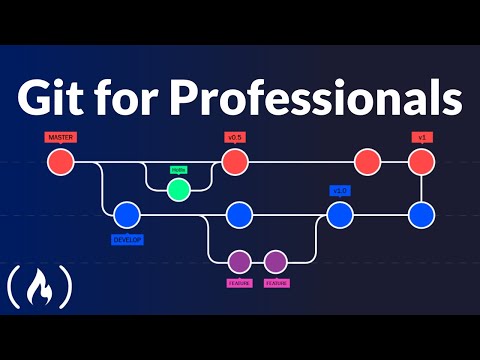
Git for Professionals Tutorial - Tools & Concepts for Mastering Version Control with Git


Curriculum for the course Git for Professionals Tutorial - Tools & Concepts for Mastering Version Control with Git

Git has the power to make you a better software developer. But you'll have to go beyond the basic "commit, push, pull" to use it effectively! In this course, we'll look at some of the more advanced concepts and tools to make you more productive and confident with Git. This course focuses on using Git with the command line. ✏️ This course was created by Tobias Günther from Tower. You can download Tower's Git desktop UI here: https://www.git-tower.com ⭐️ Course Contents ⭐️ ⌨️ (00:00) Introduction ⌨️ (00:52) Hosted by Tower ⌨️ (01:27) The perfect commit ⌨️ (08:07) Branching strategies ⌨️ (17:16) Pull requests ⌨️ (24:07) Merge conflicts ⌨️ (33:48) Merge vs. rebase ⌨️ (40:05) The Advanced Git Kit: https://www.git-tower.com/learn/git/advanced-git-kit/ 🎉 Thanks to our Champion and Sponsor supporters: 👾 Wong Voon jinq 👾 hexploitation 👾 Katia Moran 👾 BlckPhantom 👾 Nick Raker 👾 Otis Morgan 👾 DeezMaster 👾 Treehouse 👾 AppWrite -- Learn to code for free and get a developer job: https://www.freecodecamp.org Read hundreds of articles on programming: https://freecodecamp.org/news And subscribe for new videos on technology every day: https://youtube.com/subscription_center?add_user=freecodecamp

Watch Online Full Course: Git for Professionals Tutorial - Tools & Concepts for Mastering Version Control with Git


Click Here to watch on Youtube: Git for Professionals Tutorial - Tools & Concepts for Mastering Version Control with Git


This video is first published on youtube via freecodecamp. If Video does not appear here, you can watch this on Youtube always.


Udemy Git for Professionals Tutorial - Tools & Concepts for Mastering Version Control with Git courses free download, Plurasight Git for Professionals Tutorial - Tools & Concepts for Mastering Version Control with Git courses free download, Linda Git for Professionals Tutorial - Tools & Concepts for Mastering Version Control with Git courses free download, Coursera Git for Professionals Tutorial - Tools & Concepts for Mastering Version Control with Git course download free, Brad Hussey udemy course free, free programming full course download, full course with project files, Download full project free, College major project download, CS major project idea, EC major project idea, clone projects download free

Custom deployment layout for Blazor WebAssembly apps

Some environments block the download and execution of DLLs from the network to prevent the potential spread of malware, which can also block downloading Blazor WebAssembly apps. To enable Blazor WebAssembly in these environments, we introduced in .NET 6 new extensibility points that allows developers to customize the published files and packaging of Blazor WebAssembly apps. These customizations can then be packaged as a reusable NuGet package.

There are two main features that make this possible:

  • JavaScript initializers that allow customizing the Blazor boot process.
  • MSBuild extensibility to transform the list of publish files and define Blazor publish extensions.

JavaScript initializers

JavaScript initializers are JavaScript modules loaded during the Blazor boot process. These modules can export two functions that get called at specific points early in the lifecycle of the host app:

  • beforeStart: Invoked by Blazor before the app is started.
  • afterStarted: Invoked by Blazor after the .NET runtime has started.

In Blazor WebAssembly apps, beforeStarts receives two pieces of data:

  • Blazor WebAssembly options that can be changed to provide a custom resource loader.
  • An extensions object that contains a collection of extensions defined for the app. Each of these extensions is an JavaScript object that contains a list of files relevant to that extension.

Blazor publish extensions

Blazor publish extensions are files that can be defined as part of the publish process and that provide an alternative representation for the set of files needed to run the published app.

For example, in this post we’ll create a Blazor publish extension that produces a multipart bundle with all the app DLLs packed into a single file so they can be downloaded together. We hope this sample will serve as a starting point for people to come up with their own strategies and custom loading processes.

Customizing the Blazor WebAssembly loading process via a NuGet package

In this example, we’re going to pack all the Blazor app resources into a bundle file as a multipart file bundle and load it on the browser via a custom JavaScript initializer. For an app consuming this package, they only need to make sure that the bundle file is being served. Everything else is handled transparently.

There are four things that we need to customize how a published Blazor app loads:

  • An MSBuild task to transform the publish files.
  • A package with MSBuild targets that hooks into the Blazor publishing process, transforms the output, and defines one or more Blazor publish extension files (in this case, a single bundle).
  • A JavaScript initializer to update the Blazor WebAssembly resource loader callback so that it loads the bundle and provides the app with the individual files.
  • A small helper on the host server app to ensure we serve the bundle.

Writing an MSBuild task to customize the list of published files and define new extensions

An MSBuild task is a public C# class that can be imported as part of an MSBuild compilation and that can interact with the build.

Before we write our C# class, we need to do the following:

  • We need to create a new class library project.
  • Change the target framework to netstandard2.0
  • Reference the MSBuild packages

After that, the csproj file should look something like this:

<Project Sdk="Microsoft.NET.Sdk">

  <PropertyGroup>
    <TargetFramework>netstandard2.0</TargetFramework>
    <LangVersion>8.0</LangVersion>
  </PropertyGroup>

  <ItemGroup>
    <PackageReference Include="Microsoft.Build.Framework" Version="16.10.0" />
    <PackageReference Include="Microsoft.Build.Utilities.Core" Version="16.10.0" />
  </ItemGroup>

</Project>

Now that our project is created, we can create our MSBuild task. To do so, we create a public class extending Microsoft.Build.Utilities.Task (not System.Threading.Tasks.Task) and declare three properties:

  • PublishBlazorBootStaticWebAsset: The list of files to publish for the Blazor app
  • BundlePath: The path where we need to write the bundle.
  • Extension: The new publish extensions to include in the build.

A sketch of the code can be seen below.

namespace Microsoft.AspNetCore.Components.WebAssembly.MultipartBundle.Tasks
{
    public class BundleBlazorAssets : Task
    {
        [Required]
        public ITaskItem[] PublishBlazorBootStaticWebAsset { get; set; }

        [Required]
        public string BundlePath { get; set; }

        [Output]
        public ITaskItem[] Extension { get; set; }

        public override bool Execute()
        {
          ...
        }
    }
}

The remaining piece is to implement the Execute method, where we take the files and create the bundle. There are three types of files we are going to deal with:

  • JavaScript files (dotnet.js)
  • WASM files (dotnet.wasm)
  • App DLLs.

We are going to create a multipart/form-data bundle and add each file to the bundle with their respective descriptions via the content disposition header and the content type header. The code can be seen below:

var bundle = new MultipartFormDataContent("--0a7e8441d64b4bf89086b85e59523b7d");
foreach (var asset in PublishBlazorBootStaticWebAsset)
{
    var name = Path.GetFileName(asset.GetMetadata("RelativePath"));
    var fileContents = File.OpenRead(asset.ItemSpec);
    var content = new StreamContent(fileContents);
    var disposition = new ContentDispositionHeaderValue("form-data");
    disposition.Name = name;
    disposition.FileName = name;
    content.Headers.ContentDisposition = disposition;
    var contentType = Path.GetExtension(name) switch
    {
        ".js" => "text/javascript",
        ".wasm" => "application/wasm",
        _ => "application/octet-stream"
    };
    content.Headers.ContentType = MediaTypeHeaderValue.Parse(contentType);
    bundle.Add(content);
}

Now that we’ve created our bundle, we need to write it to a file:

using (var output = File.Open(BundlePath, FileMode.OpenOrCreate))
{
    output.SetLength(0);
    bundle.CopyToAsync(output).ConfigureAwait(false).GetAwaiter().GetResult();
    output.Flush(true);
}

Finally, we need to let the build know about our extension. We do so by creating an extension item and adding it to the Extension property. Each extension item contains three pieces of data:

  • The path to the extension file
  • The URL path relative to the root of the Blazor WebAssembly app.
  • The name of the extension, which groups the files produced by a given extension. We’ll use this to refer to the extension later.

In our extension we define the item as follows:

var bundleItem = new TaskItem(BundlePath);
bundleItem.SetMetadata("RelativePath", "app.bundle");
bundleItem.SetMetadata("ExtensionName", "multipart");

Extension = new ITaskItem[] { bundleItem };

return true;

With that, we’ve authored an MSBuild task for customizing the Blazor publish output. Blazor will take care of gathering the extensions and making sure that they get copied to the right place in the publish output folder and will apply the same optimizations (compression) it applies to other files.

For clarity, here is the full class in one snippet:

using System.IO;
using System.Net.Http;
using System.Net.Http.Headers;
using Microsoft.Build.Framework;
using Microsoft.Build.Utilities;

namespace Microsoft.AspNetCore.Components.WebAssembly.MultipartBundle.Tasks
{
    public class BundleBlazorAssets : Task
    {
        [Required]
        public ITaskItem[] PublishBlazorBootStaticWebAsset { get; set; }

        [Required]
        public string BundlePath { get; set; }

        [Output]
        public ITaskItem[] Extension { get; set; }

        public override bool Execute()
        {
            var bundle = new MultipartFormDataContent("--0a7e8441d64b4bf89086b85e59523b7d");
            foreach (var asset in PublishBlazorBootStaticWebAsset)
            {
                var name = Path.GetFileName(asset.GetMetadata("RelativePath"));
                var fileContents = File.OpenRead(asset.ItemSpec);
                var content = new StreamContent(fileContents);
                var disposition = new ContentDispositionHeaderValue("form-data");
                disposition.Name = name;
                disposition.FileName = name;
                content.Headers.ContentDisposition = disposition;
                var contentType = Path.GetExtension(name) switch
                {
                    ".js" => "text/javascript",
                    ".wasm" => "application/wasm",
                    _ => "application/octet-stream"
                };
                content.Headers.ContentType = MediaTypeHeaderValue.Parse(contentType);
                bundle.Add(content);
            }

            using (var output = File.Open(BundlePath, FileMode.OpenOrCreate))
            {
                output.SetLength(0);
                bundle.CopyToAsync(output).ConfigureAwait(false).GetAwaiter().GetResult();
                output.Flush(true);
            }

            var bundleItem = new TaskItem(BundlePath);
            bundleItem.SetMetadata("RelativePath", "app.bundle");
            bundleItem.SetMetadata("ExtensionName", "multipart");

            Extension = new ITaskItem[] { bundleItem };

            return true;
        }
    }
}

Now that we have an MSBuild task capable of transforming the publish output, we need a bit of plumbing code to hook it to the MSBuild pipeline.

Authoring a NuGet package for automatically transforming the publish output

A good way to create a reusable solution is to generate a NuGet package with MSBuild targets that are automatically included when the package is referenced. For that, the steps are:

  • Create a new Razor class library project.
  • Create a targets file following the NuGet conventions to automatically import it in consuming projects.
  • Collect the output from the class library containing the MSBuild task and make sure it gets packed in the right location.
  • Make sure all the required files are packed in the right location.
  • Add the necessary MSBuild code to attach to the Blazor pipeline and invoke our task to generate the bundle.

First we create a Razor class library and remove all the content from it.

<Project Sdk="Microsoft.NET.Sdk.Razor">

  <PropertyGroup>
    <TargetFramework>net6.0</TargetFramework>
  </PropertyGroup>

</Project>

Next we create a file build\net6.0\<<PackageId>>.targets where <<PackageId>> is the name of our package. We’ll fill in the contents later.

After that, we need to make sure we collect all the DLLs required for the MSBuild task. We can do so by creating a custom target in the package project file. In our target we invoke MSBuild over the project with our task and capture the output in the _TasksProjectOutputs item group as follows:

<Target Name="GetTasksOutputDlls" BeforeTargets="CoreCompile">
  <MSBuild Projects="$(PathToTasksFolder)" Targets="Publish;PublishItemsOutputGroup" Properties="Configuration=Release">
    <Output TaskParameter="TargetOutputs" ItemName="_TasksProjectOutputs" />
  </MSBuild>
</Target>

The next step is to make sure that our content is included in the package. To include the targets file we use the following snippet:

<ItemGroup>
  <None Update="build\**" Pack="true" PackagePath="%(Identity)" />
</ItemGroup>

This tells NuGet to pack the file and place it on the same path in the package.

We add the task DLLs as content after we’ve invoked the MSBuild task inside the tasks subfolder.

<Target Name="GetTasksOutputDlls" BeforeTargets="CoreCompile">
  ...
  <ItemGroup>
    <Content Include="@(_TasksProjectOutputs)" Condition="'%(_TasksProjectOutputs.Extension)' == '.dll'" Pack="true" PackagePath="tasks\%(_TasksProjectOutputs.TargetPath)" KeepMetadata="Pack;PackagePath" />
  </ItemGroup>
</Target>

Finally, we need to setup some properties to keep NuGet happy, since this doesn’t include a library DLL like most packages do (we are only using it as a mechanism to deliver our targets and content).

The finished project file is displayed below:

<Project Sdk="Microsoft.NET.Sdk.Razor">

  <PropertyGroup>
    <!-- Suppress the warning about the assemblies we are putting in the task folder. -->
    <NoWarn>NU5100</NoWarn>
    <TargetFramework>net6.0</TargetFramework>
    <IncludeBuildOutput>false</IncludeBuildOutput>
  </PropertyGroup>

  <ItemGroup>
    <None Update="build\**" Pack="true" PackagePath="%(Identity)" />
    <Content Include="_._" Pack="true" PackagePath="lib\net6.0\_._" />
  </ItemGroup>

  <Target Name="GetTasksOutputDlls" BeforeTargets="CoreCompile">
    <MSBuild Projects="..\Microsoft.AspNetCore.Components.WebAssembly.MultipartBundle.Tasks\Microsoft.AspNetCore.Components.WebAssembly.MultipartBundle.Tasks.csproj" Targets="Publish;PublishItemsOutputGroup" Properties="Configuration=Release">
      <Output TaskParameter="TargetOutputs" ItemName="_TasksProjectOutputs" />
    </MSBuild>
    <ItemGroup>
      <Content Include="@(_TasksProjectOutputs)" Condition="'%(_TasksProjectOutputs.Extension)' == '.dll'" Pack="true" PackagePath="tasks\%(_TasksProjectOutputs.TargetPath)" KeepMetadata="Pack;PackagePath" />
    </ItemGroup>
  </Target>

</Project>

All that remains now is to add a .targets file to wire up our task to the build pipeline. In this file we need to do the following:

  • Import our task into the build process.
  • Attach a custom target to the Blazor WebAssembly build pipeline.
  • Invoke our task in the target to produce the results.

We start by defining an empty project on the file

<Project>
</Project>

Next, we import our task. Note that the path to the DLL is relative to where this file will be in the package:

<UsingTask 
  TaskName="Microsoft.AspNetCore.Components.WebAssembly.MultipartBundle.Tasks.BundleBlazorAssets" 
  AssemblyFile="$(MSBuildThisProjectFileDirectory)..\..\tasks\Microsoft.AspNetCore.Components.WebAssembly.MultipartBundle.Tasks.dll" />

We define a target that invokes our bundling task:

<Target Name="_BundleBlazorDlls">
  <BundleBlazorAssets
    PublishBlazorBootStaticWebAsset="@(PublishBlazorBootStaticWebAsset)"
    BundlePath="$(IntermediateOutputPath)bundle.multipart"
  >
    <Output TaskParameter="Extension" ItemName="BlazorPublishExtension"/>
  </BundleBlazorAssets>
</Target>

The list of published files is provided by the Blazor WebAssembly pipeline in the PublishBlazorBootStaticWebAsset item group.

We define the bundle path using the IntermediateOutputPath (typically inside the obj folder). The bundle will later get copied automatically to the right location in the publish output folder.

Finally, we capture the Extension property on the task output and add it to BlazorPublishExtension to tell Blazor about the extension.

We can now attach our custom target to the Blazor WebAssembly pipeline:

<PropertyGroup>
  <ComputeBlazorExtensionsDependsOn>$(ComputeBlazorExtensionsDependsOn);_BundleBlazorDlls</ComputeBlazorExtensionsDependsOn>
</PropertyGroup>

With this, we have a package that when referenced will generate a bundle of the Blazor files during publish. However, we haven’t yet seen how to automatically bootstrap a Blazor WebAssembly app from that bundle instead of using the DLLs. We’ll tackle that next.

Automatically bootstrap Blazor from the bundle

This is where we will leverage JavaScript initializers. We’ll use a JavaScript initializer to change the Blazor boot resource loader and use our bundle instead.

To create a JavaScript initializer, add a JavaScript file with the name <<PackageId>>.lib.module.js to the wwwroot folder of the package project. Once we’ve done that, we can export two functions to handle the loading.

export async function beforeStart(wasmOptions, extensions) {
  ...
}

export async function afterStarted(blazor) {
  ...
}

The approach that we’re going to follow is:

  • Detect if our extension is available.
  • Download the bundle
  • Parse the contents and create a map of resources using object URLs.
  • Update the wasmOptions.loadBootResource with our own function that resolves the resources using object URLs.
  • After the app has started, revoke the object URLs to release memory.

Most of the steps happen inside beforeStart, with only the last happening in afterStarted.

To detect if our extension is available, we check the extensions argument:

if (!extensions || !extensions.multipart) {
    return;
}

Remember that multipart bit that we added in the extension definition inside the Task? It shows up here.

Next we’re going to download the bundle and parse its contents into a resources map. The resources map is defined locally at the top of the file.

try {
    const integrity = extensions.multipart['app.bundle'];
    const bundleResponse = await fetch('app.bundle', { integrity: integrity, cache: 'no-cache' });
    const bundleFromData = await bundleResponse.formData();
    for (let value of bundleFromData.values()) {
        resources.set(value, URL.createObjectURL(value));
    }
} catch (error) {
    console.log(error);
}

After that, we customize the options to use our custom boot resource loader. We do this after we’ve created the object URLs:

wasmOptions.loadBootResource = function (type, name, defaultUri, integrity) {
    return resources.get(name) ?? null;
}

Finally, we release all the object URLs after the app has started within the afterStarted function:

for (const [_, url] of resources) {
    URL.revokeObjectURL(url);
}

Here is all the code for handling the loading in one snippet:

const resources = new Map();

export async function beforeStart(wasmOptions, extensions) {
    // Simple way of detecting we are in web assembly
    if (!extensions || !extensions.multipart) {
        return;
    }

    try {
        const integrity = extensions.multipart['app.bundle'];
        const bundleResponse = await fetch('app.bundle', { integrity: integrity, cache: 'no-cache' });
        const bundleFromData = await bundleResponse.formData();
        for (let value of bundleFromData.values()) {
            resources.set(value, URL.createObjectURL(value));
        }
        wasmOptions.loadBootResource = function (type, name, defaultUri, integrity) {
            return resources.get(name) ?? null;
        }
    } catch (error) {
        console.log(error);
    }
}

export async function afterStarted(blazor) {
    for (const [_, url] of resources) {
        URL.revokeObjectURL(url);
    }
}

Serving the bundle from the host server app

We have our app.bundle file (and app.bundle.gz and app.bundle.br, since we transparently apply the same optimizations to the extensions that we do for the app files) but ASP.NET Core doesn’t know how to serve it (and won’t do so by default for security reasons) so we need a small helper to make that happen. Thankfully, we can do this in a few lines of code using minimal APIs.

Add an endpoint for serving app.bundle in Program.cs:

app.MapGet("app.bundle", (HttpContext context) =>
{
    string? contentEncoding = null;
    var contentType = "multipart/form-data; boundary=\"--0a7e8441d64b4bf89086b85e59523b7d\"";
    var fileName = "app.bundle";

    if (context.Request.Headers.AcceptEncoding.Contains("br"))
    {
        contentEncoding = "br";
        fileName += ".br";
    }
    else if (context.Request.Headers.AcceptEncoding.Contains("gzip"))
      {
        contentEncoding = "gzip";
        fileName += ".gz";
      }

    if (contentEncoding != null)
      {
         context.Response.Headers.ContentEncoding = contentEncoding;
      }
    return Results.File(
        app.Environment.WebRootFileProvider.GetFileInfo(fileName).CreateReadStream(),
        contentType);
});

Notice the content type matches the one we defined in the build task. The endpoint checks for the content encodings accepted by the browser and serves the most optimal file.

And that’s a wrap! We can now reference our NuGet package from an app, add a small helper to our server host and completely change how the Blazor WebAssembly app loads.

image

You can find the full code for this sample on GitHub and the experimental Microsoft.AspNetCore.Components.WebAssembly.MultipartBundle package is available to try out on NuGet. We’d love to know how well this approach works for you. Leave us a comment on the GitHub with your thoughts.

Thanks!

The post Custom deployment layout for Blazor WebAssembly apps appeared first on ASP.NET Blog.


HTML & CSS Project Tutorial - Build a Recipes Website


Curriculum for the course HTML & CSS Project Tutorial - Build a Recipes Website

In this HTML and CSS project tutorial, you will improve your HTML and CSS skills by building a recipes website. 💻 Code: https://github.com/john-smilga/html-css-simply-recipes ✏️ Course from John Smilga of Coding Addict. Check out his channel: https://www.youtube.com/channel/UCMZFwxv5l-XtKi693qMJptA 🎥 Starter Project video referenced in tutorial: https://www.youtube.com/watch?v=UDdyGNlQK5w 🎉 Thanks to our Champion and Sponsor supporters: 👾 Wong Voon jinq 👾 hexploitation 👾 Katia Moran 👾 BlckPhantom 👾 Nick Raker 👾 Otis Morgan 👾 DeezMaster 👾 Treehouse 👾 AppWrite -- Learn to code for free and get a developer job: https://www.freecodecamp.org Read hundreds of articles on programming: https://freecodecamp.org/news And subscribe for new videos on technology every day: https://youtube.com/subscription_center?add_user=freecodecamp

Watch Online Full Course: HTML & CSS Project Tutorial - Build a Recipes Website


Click Here to watch on Youtube: HTML & CSS Project Tutorial - Build a Recipes Website


This video is first published on youtube via freecodecamp. If Video does not appear here, you can watch this on Youtube always.


Udemy HTML & CSS Project Tutorial - Build a Recipes Website courses free download, Plurasight HTML & CSS Project Tutorial - Build a Recipes Website courses free download, Linda HTML & CSS Project Tutorial - Build a Recipes Website courses free download, Coursera HTML & CSS Project Tutorial - Build a Recipes Website course download free, Brad Hussey udemy course free, free programming full course download, full course with project files, Download full project free, College major project download, CS major project idea, EC major project idea, clone projects download free

Natural Language Processing with spaCy & Python - Course for Beginners


Curriculum for the course Natural Language Processing with spaCy & Python - Course for Beginners

In this spaCy tutorial, you will learn all about natural language processing and how to apply it to real-world problems using the Python spaCy library. 💻 Course website with code: http://spacy.pythonhumanities.com/ ✏️ Course developed by Dr. William Mattingly. Check out his channel: https://www.youtube.com/pythontutorialsfordigitalhumanities ⭐️ Course Contents ⭐️ ⌨️ (0:00:00) Course Introduction ⌨️ (0:03:56) Intro to NLP ⌨️ (0:11:53) How to Install spaCy ⌨️ (0:17:33) SpaCy Containers ⌨️ (0:21:36) Linguistic Annotations ⌨️ (0:45:03) Named Entity Recognition ⌨️ (0:50:08) Word Vectors ⌨️ (1:05:22) Pipelines ⌨️ (1:16:44) EntityRuler ⌨️ (1:35:44) Matcher ⌨️ (2:09:38) Custom Components ⌨️ (2:16:46) RegEx (Basics) ⌨️ (2:19:59) RegEx (Multi-Word Tokens) ⌨️ (2:38:23) Applied SpaCy Financial NER 🎉 Thanks to our Champion and Sponsor supporters: 👾 Wong Voon jinq 👾 hexploitation 👾 Katia Moran 👾 BlckPhantom 👾 Nick Raker 👾 Otis Morgan 👾 DeezMaster 👾 Treehouse 👾 AppWrite -- Learn to code for free and get a developer job: https://www.freecodecamp.org Read hundreds of articles on programming: https://freecodecamp.org/news And subscribe for new videos on technology every day: https://youtube.com/subscription_center?add_user=freecodecamp

Watch Online Full Course: Natural Language Processing with spaCy & Python - Course for Beginners


Click Here to watch on Youtube: Natural Language Processing with spaCy & Python - Course for Beginners


This video is first published on youtube via freecodecamp. If Video does not appear here, you can watch this on Youtube always.


Udemy Natural Language Processing with spaCy & Python - Course for Beginners courses free download, Plurasight Natural Language Processing with spaCy & Python - Course for Beginners courses free download, Linda Natural Language Processing with spaCy & Python - Course for Beginners courses free download, Coursera Natural Language Processing with spaCy & Python - Course for Beginners course download free, Brad Hussey udemy course free, free programming full course download, full course with project files, Download full project free, College major project download, CS major project idea, EC major project idea, clone projects download free

R Shiny for Data Science Tutorial – Build Interactive Data-Driven Web Apps


Curriculum for the course R Shiny for Data Science Tutorial – Build Interactive Data-Driven Web Apps

Learn how to build interactive data-driven web apps in R using the Shiny package. ✏️ Course developed by Chanin Nantasenamat (aka Data Professor). Check out his YouTube channel for more bioinformatics and data science tutorials: https://www.youtube.com/dataprofessor ⭐️ Code ⭐️ 💻 Apps 1-5: https://github.com/dataprofessor/rshiny_freecodecamp 💻 Deploy Shiny App: https://github.com/dataprofessor/iris-r-heroku 🔗 Medium blog posts for more data science tutorials https://data-professor.medium.com/ 🔗 For updates connect via Newsletter: http://newsletter.dataprofessor.org/ 🔗 Twitter: https://twitter.com/thedataprof/ ⭐️ Course Contents ⭐️ ⌨️ (0:00:00) Introduction ⌨️ (0:01:13) Introduction to Shiny ⌨️ (0:08:24) App 1 – Print User Input ⌨️ (0:21:12) App 2 – Display Histogram ⌨️ (0:32:07) App 3 – Machine Learning (Weather Dataset) ⌨️ (0:47:51) App 4 – Machine Learning (Iris Dataset) ⌨️ (1:05:03) App 5 – BMI Calculator ⌨️ (1:19:18) Deploy Shiny Apps to Heroku 🎉 Thanks to our Champion and Sponsor supporters: 👾 Wong Voon jinq 👾 hexploitation 👾 Katia Moran 👾 BlckPhantom 👾 Nick Raker 👾 Otis Morgan 👾 DeezMaster 👾 Treehouse 👾 AppWrite -- Learn to code for free and get a developer job: https://www.freecodecamp.org Read hundreds of articles on programming: https://freecodecamp.org/news And subscribe for new videos on technology every day: https://youtube.com/subscription_center?add_user=freecodecamp

Watch Online Full Course: R Shiny for Data Science Tutorial – Build Interactive Data-Driven Web Apps


Click Here to watch on Youtube: R Shiny for Data Science Tutorial – Build Interactive Data-Driven Web Apps


This video is first published on youtube via freecodecamp. If Video does not appear here, you can watch this on Youtube always.


Udemy R Shiny for Data Science Tutorial – Build Interactive Data-Driven Web Apps courses free download, Plurasight R Shiny for Data Science Tutorial – Build Interactive Data-Driven Web Apps courses free download, Linda R Shiny for Data Science Tutorial – Build Interactive Data-Driven Web Apps courses free download, Coursera R Shiny for Data Science Tutorial – Build Interactive Data-Driven Web Apps course download free, Brad Hussey udemy course free, free programming full course download, full course with project files, Download full project free, College major project download, CS major project idea, EC major project idea, clone projects download free

Automating With Python - Tutorial


Curriculum for the course Automating With Python - Tutorial

Learn how to use Python automation to perform common tasks. In this full course you will learn how to build the following automation projects: - Hacker News Headlines Emailer - TED Talk Downloader - Table Extractor from PDF - Automated Bulk Resume Parser - Image Type Converter - Building an Automated News Summarizer 💻 Code: https://github.com/amrrs/build_tools_to_automate_python ✏️ Course from 1littlecoder. Check out his channel: https://www.youtube.com/c/1littlecoder ⭐️ Course Contents ⭐️ ⌨️ (0:00:00) Introduction ⌨️ (0:00:29) Hacker News Headlines Emailer - Tutorial 1 ⌨️ (0:01:13) Introduction to Web Scraping ⌨️ (0:03:08) Setting up the Environment ⌨️ (0:06:30) Project Script ⌨️ (0:11:00) Website Structure of Hacker News FrontPage ⌨️ (0:21:00) Sending Email from Python ⌨️ (0:35:15) Building the Headlines Email Module ⌨️ (0:39:07) TED Talk Downloader - Tutorial 2 ⌨️ (0:39:49) Installation and Introduction to requests package ⌨️ (0:41:25) Installation and Introduction to BeautifulSoup ⌨️ (0:43:25) Building the basic script to download the video ⌨️ (0:49:37) Generalising the Script to get Arguments ⌨️ (0:53:49) Table Extractor from PDF - Tutorial 3 ⌨️ (0:54:44) Basics of PDF Format ⌨️ (0:57:05) Installing required Python Modules ⌨️ (1:02:16) Extracting Table from PDF ⌨️ (1:06:51) Quick Introduction to Jupyter Notebook ⌨️ (1:08:29) PDF Extraction on Jupyter Notebook ⌨️ (1:15:29) Pandas and Write Table as CSV Excel ⌨️ (1:21:02) Automated Bulk Resume Parser - Tutorial 4 ⌨️ (1:22:15) Different Formats of Resumes and marking relevant Information ⌨️ (1:25:50) Project Architecture and Brief Overview of the required packages and installations ⌨️ (1:34:48) Basics of Regular Expression in Python ⌨️ (1:41:38) Basic Overview of Spacy Functions ⌨️ (1:49:55) Extracting Relevant Information from the Resumes ⌨️ (2:16:46) Completing the script to make it a one-click CLI ⌨️ (2:28:09) Image Type Converter - Tutorial 5 ⌨️ (2:29:09) Different type of Image Formats ⌨️ (2:31:33) What is an Image type convertor ⌨️ (2:33:04) Introduction to Image Manipulation in Python ⌨️ (2:34:51) Building an Image type converting Script ⌨️ (2:40:03) Converting the script into a CLI Tool ⌨️ (2:44:27) Building an Automated News Summarizer - Tutorial 6 ⌨️ (2:46:27) What is Text Summarization ⌨️ (2:47:46) Installing Gensim and other Python Modules ⌨️ (2:52:43) Extracting the required News Source ⌨️ (2:59:38) Building the News Summarizer ⌨️ (3:07:14) Scheduling the News Summarizer ⌨️ (3:10:25) Thank you 🎉 Thanks to our Champion and Sponsor supporters: 👾 Wong Voon jinq 👾 hexploitation 👾 Katia Moran 👾 BlckPhantom 👾 Nick Raker 👾 Otis Morgan 👾 DeezMaster 👾 Treehouse 👾 AppWrite -- Learn to code for free and get a developer job: https://www.freecodecamp.org Read hundreds of articles on programming: https://freecodecamp.org/news And subscribe for new videos on technology every day: https://youtube.com/subscription_center?add_user=freecodecamp

Watch Online Full Course: Automating With Python - Tutorial


Click Here to watch on Youtube: Automating With Python - Tutorial


This video is first published on youtube via freecodecamp. If Video does not appear here, you can watch this on Youtube always.


Udemy Automating With Python - Tutorial courses free download, Plurasight Automating With Python - Tutorial courses free download, Linda Automating With Python - Tutorial courses free download, Coursera Automating With Python - Tutorial course download free, Brad Hussey udemy course free, free programming full course download, full course with project files, Download full project free, College major project download, CS major project idea, EC major project idea, clone projects download free

Django For Everybody - Full University Course


Curriculum for the course Django For Everybody - Full University Course

This Django tutorial aims to teach everyone the Python Django web development framework. 🔗 Course Website: https://www.dj4e.com/ 💻 Sample Code: https://github.com/csev/dj4e-samples/ ✏️ This course was created by Dr. Charles Severance (a.k.a. Dr. Chuck). He is a Professor at the University of Michigan School of Information, where he teaches various technology-oriented courses including programming, database design, and Web development. ⭐️ Course Contents ⭐️ 00:00:00 Why Teach Django? 00:07:04 Web Applications and the Request/Response Cycle 00:13:07 Exploring the HyperText Transfer Protocol 00:29:35 Using Sockets to Make Network Connections in Python 00:36:08 Building a Simple Web Browser in Python 00:44:47 Building a Simple HTTP Server in Python 01:00:53 Understanding Browser Developer Mode 01:10:35 The Structure of a Django Application 01:17:39 Installing Django on PythonAnywhere 01:34:32 HTML - HyperText Markup Language (Part 1) 01:40:25 HTML - HyperText Markup Language (Part 2) 01:54:17 Code Walk Through HTML 02:08:14 CSS - Cascading Style Sheets - (Part 1) 02:21:00 CSS - Cascading Style Sheets - (Part 2) 02:36:02 CSS - Cascading Style Sheets - (Part 3) 02:49:41 CSS - Sample Code Walkthrough (Part 1) 03:03:05 CSS - Sample Code Walkthrough (Part 2) 03:28:53 Using GitHub With Django and PythonAnywhere 03:35:48 Using ngrok to Submit Assignments to DJ4E 03:41:53 How Databases Work 04:00:49 Introduction to Structured Query Language (SQL) 04:12:33 Demonstration: Basic SQL 04:19:09 Introduction to Django Models 04:39:06 Data Model Migration in Django 04:47:00 Demonstration: Django Single Table Models 04:58:08 Resetting your Django database on PythonAnywhere 05:03:54 Django Models - Many-To-One Relationships - Music Database 05:18:03 Model View Controller in Django 05:25:09 URL Routing in Django 05:32:08 Django Views 05:38:27 Inside Django Views and HTML Escaping in Django 05:54:02 Using Templates in Django 06:04:07 The Django Template Language (DTL) 06:15:05 Inheritance in Django Templates 06:21:11 Reversing Django Views and URLs 06:34:02 Understanding Django Generic Views 06:50:29 Forms, GET, POST, and HTTP 06:58:48 Building HTML Forms 07:16:28 Forms and Cross Site Request Forgery (CSRF) 07:16:28 CSRF Support in Django 07:25:43 The POST Refresh Pattern 07:29:09 Cookies in Browsers and Django 07:38:51 Using Sessions in Django 07:51:24 One-to-Many Models Overview 07:57:16 Removing Replication in One-to-Many Models 08:05:51 Storing Primary and Foreign Keys in a Database 08:08:37 Representing One-To-Many Models in Django 08:18:33 Using the Django Shell to Explore One-to-Many Models 08:26:17 Loading One-to-Many Data using a Django Batch Script 08:38:32 Creating and Managing Users in Django 08:42:17 Login and Logout URLs in Django 08:49:40 Using Django Login in Views 08:59:55 Using Django Forms Capabilities 09:13:20 Walkthrough of the DJ4E Autos Sample - Generic Django Edit Forms 09:49:30 Data Validation with Django Forms 09:58:42 Exploring the DIY Hello World Django Application on Localhost 10:22:24 Exploring the DIY Hello World Django Application on PythonAnywhere 10:36:38 Virtual Hosting of Django Applications 10:36:38 Owned Rows in Django - Overview 10:42:39 Owned Rows in Django - Generic Views Review 10:52:56 Owned Rows in Django - owner.py 11:05:58 Walking through the DJ4E My Articles (myarts) Sample Code 11:18:26 Walking through the DJ4E Bootstrap Menu (menu) Sample Code 11:48:37 Walking through the DJ4E Crispy Forms (crispy) Sample Code 12:02:57 Many-to-Many Overview 12:08:31 A Simple Many-To-Many Example in Django 12:21:05 Many-To-Many Data Models for Courses and Membership 12:29:42 Building a Django Batch Script to Load Data from CSV 12:46:31 JavaScript - Overview and History 12:56:29 JavaScript - In the Browser 13:10:31 JavaScript - The Language 13:34:28 JavaScript Functions and Arrays 13:34:28 JavaScript Conditional and Loops 13:41:05 JavaScript Object Oriented Concepts 13:45:25 JavaScript Object Oriented Classes 13:58:37 Walking through the DJ4E Pictures (pics) Sample Code 14:31:41 Walking through the DJ4E Forums (forums) Sample Code 14:57:07 jQuery and the Document Object Model 15:09:44 Using jQuery 15:38:16 Walking through the DJ4E jQuery DOM sample code 15:49:29 Walking through the DJ4E jQuery setup sample code 15:57:42 Walking through the DJ4E jQuery events sample code 16:05:59 Walking through the DJ4E jQuery DOM modification 16:10:26 JSON/AJAX Overview 16:24:40 Walking through the DJ4E JSON Sample Code 16:30:41 Building an AJAX Chat with Django 16:40:34 Walking through the DJ4E JSON (chat) Sample Code 16:58:26 Walking through the DJ4E Favicon Sample Code 17:02:36 Walking through the DJ4E Social Login Code 17:11:23 Walking through the DJ4E Favorites (favs) Sample Code 17:41:41 Walking through the DJ4E Search (well) Sample Code 18:03:10 Behind the Scenes: Welcome to Django for Everybody - Why Django? This course is licensed under CC BY.

Watch Online Full Course: Django For Everybody - Full University Course


Click Here to watch on Youtube: Django For Everybody - Full University Course


This video is first published on youtube via freecodecamp. If Video does not appear here, you can watch this on Youtube always.


Udemy Django For Everybody - Full University Course courses free download, Plurasight Django For Everybody - Full University Course courses free download, Linda Django For Everybody - Full University Course courses free download, Coursera Django For Everybody - Full University Course course download free, Brad Hussey udemy course free, free programming full course download, full course with project files, Download full project free, College major project download, CS major project idea, EC major project idea, clone projects download free

ASP.NET Core updates in .NET 6 Release Candidate 1

.NET 6 Release Candidate 1 (RC1) is now available and includes many great new improvements to ASP.NET Core.

Here’s what’s new in this preview release:

  • Render Blazor components from JavaScript
  • Blazor custom elements
  • Manipulate the query string from Blazor
  • .NET to JavaScript streaming
  • PageX and PageY in MouseEventArgs
  • Blazor templates updated to set page titles
  • Disabled long-polling transport for Blazor Server
  • Collocate JavaScript files with pages, views, and components
  • JavaScript initializers
  • Customize Blazor WebAssembly packaging
  • Template improvements
  • Minimal API updates
  • Support for Latin1 encoded request headers in HttpSysServer
  • Emit KestrelServerOptions via EventSource event
  • Add timestamps and PID to ASP.NET Core Module logs
  • New DiagnosticSource event for rejected HTTP requests
  • Create a ConnectionContext from an Accept Socket
  • Streamlined HTTP/3 setup
  • Upgrade to Duende Identity Server

Get started

To get started with ASP.NET Core in .NET 6 RC1, install the .NET 6 SDK.

If you’re on Windows using Visual Studio, install the latest preview of Visual Studio 2022. Support for .NET 6 in Visual Studio for Mac is coming soon, and is currently available as a private preview.

To get setup with .NET MAUI & Blazor for cross-platform native apps, see the latest instructions in the .NET MAUI getting started guide. Please also read this important update on .NET MAUI.

To install the .NET WebAssembly build tools, run the following command from an elevated command prompt:

dotnet workload install wasm-tools

Alternative, use the Visual Studio Installer to enable the “.NET WebAssembly build tools” optional component in the “ASP.NET and web development” workload.

Upgrade an existing project

To upgrade an existing ASP.NET Core app from .NET 6 Preview 7 to .NET 6 RC1:

  • Update all Microsoft.AspNetCore.* package references to 6.0.0-rc.1.*.
  • Update all Microsoft.Extensions.* package references to 6.0.0-rc.1.*.

To upgrade a .NET MAUI Blazor app from .NET 6 Preview 7 to .NET 6 RC1 we recommend starting from a new .NET MAUI Blazor project created with the .NET 6 RC1 SDK and then copying code over from your original project.

See the full list of breaking changes in ASP.NET Core for .NET 6.

Render Blazor components from JavaScript

Blazor is great for building client-side web UI using just .NET, but what if you already have existing JavaScript apps that you need to maintain and evolve? How can you avoid having to build common components twice, in .NET and JavaScript?

In .NET 6, you can now dynamically render Blazor components from JavaScript. This capability enables you to integrate Blazor components with existing JavaScript apps.

To render a Blazor component from JavaScript, first register it as a root component for JavaScript rendering and assign it an identifier:

Blazor Server

builder.Services.AddServerSideBlazor(options =>
{
    options.RootComponents.RegisterForJavaScript<Counter>(identifier: "counter");
});

Blazor WebAssembly

builder.RootComponents.RegisterForJavaScript<Counter>(identifier: "counter");

Load Blazor into your JavaScript app (blazor.server.js or blazor.webassembly.js) and then render the component from JavaScript into a container element using the registered identifier, passing component parameters as needed:

let containerElement = document.getElementById('my-counter');
await Blazor.rootComponents.add(containerElement, 'counter', { incrementAmount: 10 });

Blazor custom elements

Experimental support is also now available for building custom elements with Blazor using the Microsoft.AspNetCore.Components.CustomElements NuGet package. Custom elements use standard HTML interfaces to implement custom HTML elements.

To create a custom element using Blazor, register a Blazor root component as custom elements like this:

options.RootComponents.RegisterAsCustomElement<Counter>("my-counter");

You can then use this custom element with any other web framework you’d like. For example, here’s how you would use this Blazor counter custom element in a React app:

<my-counter increment-amount={incrementAmount}></my-counter>

See the Blazor Custom Elements sample project for a complete example of how to create custom elements with Blazor.

This feature is experimental because we’re still working out some of the details for how best to support custom elements with Blazor. We welcome your feedback on how well this particular approach meets your requirements.

Generate Angular and React components using Blazor

You can also now generate framework specific JavaScript components from Blazor components for frameworks like Angular or React. This capability isn’t included with .NET 6, but is enabled by the new support for rendering Blazor components from JavaScript. The JavaScript component generation sample on GitHub demonstrates how you can generate Angular and React components from Blazor components.

In this sample, you attribute Blazor components to generate Angular or React component wrappers:

@*Generate an Angular component*@
@attribute [GenerateAngular]

@*Generate an React component*@
@attribute [GenerateReact]

You then register the Blazor components as Angular or React components:

options.RootComponents.RegisterForAngular<Counter>();
options.RootComponents.RegisterForReact<Counter>();

When the project gets built, it generates Angular and React components based on your Blazor components. You then use the generated Angular and React components like you would normally:

// Angular
<counter [incrementAmount]="incrementAmount"></counter>
// React
<Counter incrementAmount={incrementAmount}></Counter>

This sample isn’t a complete solution for generating Angular and React components from Blazor components, but we hope it demonstrates what’s possible. We welcome and encourage community efforts to build on this functionality more fully. We’re excited to see what the community does with this feature!

Manipulate the query string from Blazor

New GetUriWithQueryParameter and GetUriWithQueryParameters extension methods on NavigationManager facilitate updating the query string of the browser URL.

To add or update a single query string parameter:

// Create a new URI based on the current address
// with the specified query string parameter added or updated.
var newUri = NavigationManager.GetUriWithQueryParameter("page", 3);

// Navigate to the new URI with the updated query string
NavigationManager.NavigateTo(newUri);

Use GetUriWithQueryParameters to add, update, or remove multiple parameters based on a dictionary of parameter values (a null value removes the parameter).

.NET to JavaScript streaming

Blazor now supports streaming data from .NET to JavaScript. A .NET stream can be passed to JavaScript as a DotNetStreamReference.

using var data = new System.IO.MemoryStream(new byte[100 * 1024]);
using var streamRef = new DotNetStreamReference(stream: data, leaveOpen: false);
await JS.InvokeVoidAsync("consumeStream", streamRef);

In JavaScript, the data stream can then be read as an array buffer or as a readable stream:

async function consumeStream(streamRef) {
    const data = await streamRef.arrayBuffer();    // ArrayBuffer
    // or
    const stream = await streamRef.stream();       // ReadableStream
}

Additional details on this feature are available in the Blazor JavaScript interop docs.

PageX and PageY in MouseEventArgs

MouseEventArgs now has PageX and PageY properties corresponding to the standard pagex and pagey on the MouseEvent interface. Thank you TonyLugg for helping us fill this functional gap.

Blazor templates updated to set page title

The Blazor project templates have been updated to support updating the page title as the user navigates to different pages using the new PageTitle and HeadOutlet components.

In the Blazor WebAssembly template, the HeadOutlet component is added as a root component that appends to the HTML head tag. Each page in the template sets the title using the PageTitle component.

The Blazor Server template required a bit more refactoring in order to support modifying the head when prerendering. The _Host.cshtml page now has its own layout, _Layout.cshtml, that adds the HeadOutlet component to the HTML head using the component tag helper. This ensures that the HeadOutlet is rendered before any components that want to modify the head.

Disabled long-polling transport for Blazor Server

Prior to .NET 6, Blazor Server apps would fall back to long-polling when WebSockets weren’t available, which often led to a degraded user experience. In .NET 6 we’ve disabled the long-polling transport for Blazor Server apps by default so that it’s easier to know when WebSockets haven’t been correctly configured. If your Blazor Server app still requires support for long-polling, you can reenable it. See the related breaking change notification for details.

Collocate JavaScript files with pages, views, and components

You can now collocate a JavaScript file with pages, views, and components using the .cshtml.js and .razor.js conventions. This is a convenient way to organize your code when you have JavaScript code that is specific to a page, view, or component. These files are publicly addressable using the path to the file in the project (Pages/Index.cshtml.js or _content/{LIBRARY NAME}/Pages/Index.cshtml.js if the file is coming from a library).

For example, if you have a component implemented by Pages/Counter.razor, you can add a JavaScript module for that component at Pages/Counter.razor.js and then load it like this:

var module = await JS.InvokeAsync<IJSObjectReference>("import", "./Pages/Counter.razor.js");

JavaScript initializers

JavaScript initializers provide a way to execute some logic before and after a Blazor app loads. This is useful for customizing how a Blazor app loads, initializing libraries before Blazor starts up, and configuring Blazor settings.

To define a JavaScript initializer, add a JavaScript module to the web root of your project named {LIBRARY NAME}.lib.module.js. Your module can export the following well-known functions:

  • beforeStart: Called before Blazor boots up on the .NET side. Used to customize the loading process, logging level, and other hosting model specific options.
    • In Blazor WebAssembly, beforeStart receives the Blazor WebAssembly options and any extensions added during publishing.
    • In Blazor Server, beforeStart receives the circuit start options.
    • In BlazorWebViews, no options are passed.
  • afterStarted: Called after Blazor is ready to receive calls from JavaScript. Used to initialize libraries by making .NET interop calls, registering custom elements, etc.
    • The Blazor instance is always passed to afterStarted as an argument.

A basic JavaScript initializer looks like this:

RazorClassLibrary1.lib.module.js

export function beforeStart(options) {
    console.log("beforeStart");
}
export function afterStarted(blazor) {
    console.log("afterStarted");
}

JavaScript initializers are detected as part of the build and then imported automatically in Blazor apps. This removes the need in many cases for manually adding script references when using Blazor libraries.

Customize Blazor WebAssembly packaging

In some environments, firewalls or other security software block the download of .NET assemblies, which prevents the execution of Blazor WebAssembly apps. To enable support for Blazor WebAssembly in these environments, we’ve made the publishing and loading process for Blazor WebAssembly apps extensible so that you can customize the packaging and loading of the app. We’ll share more details on how to do this in a future post.

Template improvements

Implicit usings

Based on feedback from Preview 7, changes to the implicit usings feature were made as part of this release, including the requirement to opt-in to implicit usings in the project file, rather than them being included by default based on the project targeting .NET 6. This will ensure existing projects being migrated to .NET 6 aren’t impacted by the implicit usings until the author is ready to enable the feature.

You can read more about this change in its breaking changes document.

Randomized port allocation

New ASP.NET Core projects will now have random ports assigned during project creation for use by the Kestrel web server, matching the existing behavior when using IIS Express. This helps to minimize the chance that new projects end up using ports that are already in use on the machine, which results in a failure of the app to start when it’s launched from Visual Studio, or via dotnet run.

A port from 5000-5300 will be selected for HTTP, and from 7000-7300 for HTTPS, at the time the project is created. As always, the ports used during development can be easily changed by editing the project’s launchSettings.json file. When the app is run after publishing, Kestrel still defaults to using ports 5000 and 5001 (for HTTP and HTTPS respectively) if not otherwise configured. You can read more about configuring Kestrel in the docs.

New logging defaults

New ASP.NET Core projects have a simplified logging configuration in their appsettings.json and appsettings.Development.json files.

{
  "Logging": {
    "LogLevel": {
      "Default": "Information",
      "Microsoft.AspNetCore": "Warning"
    }
  }
}

The net effect of this change is that log messages at the “Information” level from sources other than ASP.NET Core, will now be emitted by default. This includes messages related to relational database querying from Entity Framework Core, which are now clearly visible by default in new applications:

info: Microsoft.Hosting.Lifetime[14]
      Now listening on: https://localhost:7297
info: Microsoft.Hosting.Lifetime[14]
      Now listening on: http://localhost:5131
info: Microsoft.Hosting.Lifetime[0]
      Application started. Press Ctrl+C to shut down.
info: Microsoft.Hosting.Lifetime[0]
      Hosting environment: Development
info: Microsoft.Hosting.Lifetime[0]
      Content root path: C:\Users\MyName\source\repos\WebApplication45\WebApplication45
info: Microsoft.EntityFrameworkCore.Database.Command[20101]
      Executed DbCommand (25ms) [Parameters=[], CommandType='Text', CommandTimeout='30']
      SELECT [w].[Id], [w].[Name]
      FROM [Widget] AS [w]

Minimal API updates

Improved support for OpenAPI

In RC1, we improved support for OpenAPI by adding ways to define metadata on a minimal endpoint either imperatively via extensions methods or declaratively via attributes.

We added support for the following metadata:

  • WithName metadata maps the endpoint name to an operationId in generated OpenAPI documents.
    • Note the endpoint name is also used when using LinkGenerator to generate URL/links for endpoints
    • When the user does not specify the endpoint name using the WithName metadata, the operation id will default to the name of the function (SayHello) as shown in the following example:
string SayHello(string name) => $"Hello, {name}!";
app.MapGet("/hello/{name}", SayHello);
  • WithGroupName metadata maps the endpoint group name to the document name in generated OpenAPI documents (typically used for versioning, e.g. “v1”, “v2”)
  • ExcludeFromDescription metadata indicates that the API should be excluded/ignored from OpenAPI document generation
  • ProducesValidationProblem indicates that the endpoint will produce 4xx http status codes and error details with application/validationproblem+json content type
  • Produces<T>(...) metadata indicates what response types a method produces, where each response is the combination of:
    • One HTTP status code
    • One or more content types, e.g. “application/json”
    • An optional schema per content type

Examples

OpenAPI extension methods can be used to imperatively add the required metadata to the endpoint:

app.MapGet("/admin", () => "For admins only")
   .WithName("AdminDetails")
   .RequiresAuthorization("Admins")
   .ExcludeFromDescription();

app.MapPost("/todos", async (Todo todo, TodoDb db) =>
    {
        db.Todos.Add(todo);
        await db.SaveChangesAsync();

        return Results.CreatedAtRoute("GetTodoById", new { todo.Id }, todo);
    })
    .WithName("AddTodo")
    .WithGroupName("v1")
    .ProducesValidationProblem()
    .Produces<Todo>(StatusCodes.Status201Created);

In addition to extension methods, attributes can be used to add metadata declaratively on endpoints:

app.MapGet("/admin", AdminDetails);
app.MapPost("/todos", AddTodo);

[Authorized(Policy = "Admins")]
[ExcludeFromDescription]
string AdminDetails()
{
    return "For admins only";
}

[EndpointGroupName("v1")]
[ProducesResponseType(typeof(ValidationProblemDetails), StatusCodes.Status400BadRequest, "application/problem+json")]
[ProducesResponseType(typeof(Todo), StatusCodes.Status201Created)]
async Task<IResult> AddTodo(Todo todo, TodoDb db)
{
    db.Todos.Add(todo);
    await db.SaveChangesAsync();

    return Results.Created($"/todos/{todo.Id}", todo);
}

Parameter Binding improvements

Allow optional parameters in endpoint actions

We introduced support to allow developers to specify if parameters in their minimal action are optional.

For example, we can designate name as an optional route parameter in the sample below:

app.MapGet("/sayHello/{name?}", (string? name) => $"Hello World from {name}");

This indicates that both of the following calls will succeed by returning 2xx status code since the name parameter is optional.
curl localhost:5000/sayHello/John and curl localhost:5000/sayHello.

The same behavior applies for request bodies. The following example will call the method with a null todo when there is no a request body sent in a post/put call:

app.MapPost("/todos", (Todo? todo) => () => { });

Route parameters, query parameters, and body parameters can all be designated as optional by using a nullability annotation or providing a default value. When a required parameter is not provided, the delegate will return a 400 status.

As part of the changes, we also improved error messages when parameters fail to bind.

Fix issue with struct support in parameter binding

In Preview 7, binding a struct parameter did not work and would throw an System.InvalidOperationException: The binary operator Equal is not defined for the types 'Contact' and 'System.Object'. In RC1, we fixed the issue.

Now it’s possible for developers to write the code below for a minimal API:

var app = WebApplication.Create(args);

app.MapPost("/api/contact", (Contact contact) => $"{contact.PhoneNumber} {contact.Email}");

app.Run();

record struct Contact(string PhoneNumber, string Email);

Developer Exception Page Middleware change

With RC1, the DeveloperExceptionPageMiddleware will now be registered as the first middleware if the current environment is development. This means when IWebHostEnvironment.IsDevelopment() is true. This removes the need to manually register the middleware by developers as shown in the example below.

Before

var builder = WebApplication.CreateBuilder(args);
var app = builder.Build();

if (app.Environment.IsDevelopment())
{
    app.UseDeveloperExceptionPage();
}
app.MapGet("/", "Hello World");

app.Run();

After

var builder = WebApplication.CreateBuilder(args);
var app = builder.Build();

app.MapGet("/", "Hello World");

app.Run();

Other Improvements in minimal APIs

Modifying the host configuration after the WebApplicationBuilder has been created is no longer supported. Instead, the Create and CreateBuilder calls now support taking a WebApplicationBuilderOptions which can be used to specify properties like the environment name, content root path, and so on.

var config = new WebApplicationOptions 
{
    Args = args,
    EnvironmentName = Environments.Staging,
    ContentRootPath = "www/"
};

var app = WebApplication.Create(options);

app.MapGet("/", (IHostEnvironment env) => env.EnvironmentName);

app.Run();

In addition to configuring hosting settings using the WebApplicationOptions class, minimal APIs now support customizing the host configuration using command-line args. For example, the following can be used to set the environment name for a running app.

$ dotnet run --environment=Development

To support a wider variety of middleware, minimal API apps now support multiple calls to the UseRouting method without overriding existing endpoints. This enables registering middleware like the Developer Exception page (which is enabled by default now) in the app.

Minimal APIs now support using MapFallback to define behavior for fallback routes in apps.

var app = WebApplication.Create(options);

app.MapFallback("/subroute", (string shareCode) => { ... };

app.Run();

Support for Latin1 encoded request headers in HttpSysServer

HttpSysServer is now capable of decoding request headers that are Latin1 encoded. To do so, you must the set the UseLatin1RequestHeaders property on HttpSysOptions to true.

var builder = WebApplication.CreateBuilder(args);
builder.WebHost.UseHttpSys(o => o.UseLatin1RequestHeaders = true);

Emit KestrelServerOptions via EventSource event

The KestrelEventSource now emits a new event containing the JSON-serialized KestrelServerOptions when enabled (with verbosity EventLevel.LogAlways). This event makes it easier to reason about the server behavior when analyzing collected traces. Here’s an example of the event payload:

{
  "AllowSynchronousIO": false,
  "AddServerHeader": true,
  "AllowAlternateSchemes": false,
  "AllowResponseHeaderCompression": true,
  "EnableAltSvc": false,
  "IsDevCertLoaded": true,
  "RequestHeaderEncodingSelector": "default",
  "ResponseHeaderEncodingSelector": "default",
  "Limits": {
    "KeepAliveTimeout": "00:02:10",
    "MaxConcurrentConnections": null,
    "MaxConcurrentUpgradedConnections": null,
    "MaxRequestBodySize": 30000000,
    "MaxRequestBufferSize": 1048576,
    "MaxRequestHeaderCount": 100,
    "MaxRequestHeadersTotalSize": 32768,
    "MaxRequestLineSize": 8192,
    "MaxResponseBufferSize": 65536,
    "MinRequestBodyDataRate": "Bytes per second: 240, Grace Period: 00:00:05",
    "MinResponseDataRate": "Bytes per second: 240, Grace Period: 00:00:05",
    "RequestHeadersTimeout": "00:00:30",
    "Http2": {
      "MaxStreamsPerConnection": 100,
      "HeaderTableSize": 4096,
      "MaxFrameSize": 16384,
      "MaxRequestHeaderFieldSize": 16384,
      "InitialConnectionWindowSize": 131072,
      "InitialStreamWindowSize": 98304,
      "KeepAlivePingDelay": "10675199.02:48:05.4775807",
      "KeepAlivePingTimeout": "00:00:20"
    },
    "Http3": {
      "HeaderTableSize": 0,
      "MaxRequestHeaderFieldSize": 16384
    }
  },
  "ListenOptions": [
    {
      "Address": "https://127.0.0.1:7030",
      "IsTls": true,
      "Protocols": "Http1AndHttp2"
    },
    {
      "Address": "https://[::1]:7030",
      "IsTls": true,
      "Protocols": "Http1AndHttp2"
    },
    {
      "Address": "http://127.0.0.1:5030",
      "IsTls": false,
      "Protocols": "Http1AndHttp2"
    },
    {
      "Address": "http://[::1]:5030",
      "IsTls": false,
      "Protocols": "Http1AndHttp2"
    }
  ]
}

Add timestamps and PID to ASP.NET Core Module logs

The ASP.NET Core Module (ANCM) enhanced diagnostic logs now include timestamps and PID of the process emitting the logs. This makes it easier to diagnose issues with overlapping process restarts in IIS when you may have multiple IIS worker processes running.

The resulting logs now resemble the sample output included below:

[2021-07-28T19:23:44.076Z, PID: 11020] [aspnetcorev2.dll] Initializing logs for 'C:\<path>\aspnetcorev2.dll'. Process Id: 11020. File Version: 16.0.21209.0. Description: IIS ASP.NET Core Module V2. Commit: 96475a2acdf50d7599ba8e96583fa73efbe27912.
[2021-07-28T19:23:44.079Z, PID: 11020] [aspnetcorev2.dll] Resolving hostfxr parameters for application: '.\InProcessWebSite.exe' arguments: '' path: 'C:\Temp\e86ac4e9ced24bb6bacf1a9415e70753\'
[2021-07-28T19:23:44.080Z, PID: 11020] [aspnetcorev2.dll] Known dotnet.exe location: ''

New DiagnosticSource event for rejected HTTP requests

Kestrel now emits a new DiagnosticSource event for HTTP requests rejected at the server layer. Prior to this change, there was no way to observe these rejected requests. The new DiagnosticSource event Microsoft.AspNetCore.Server.Kestrel.BadRequest now contains a IBadRequestExceptionFeature that can be used to introspect the reason for rejecting the request.

var builder = WebApplication.CreateBuilder(args);
var app = builder.Build();
var diagnosticSource = app.Services.GetRequiredService<DiagnosticListener>();
using var badRequestListener = new BadRequestEventListener(diagnosticSource, (badRequestExceptionFeature) =>
{
    app.Logger.LogError(badRequestExceptionFeature.Error, "Bad request received");
});
app.MapGet("/", () => "Hello world");

app.Run();

class BadRequestEventListener : IObserver<KeyValuePair<string, object>>, IDisposable
{
    private readonly IDisposable _subscription;
    private readonly Action<IBadRequestExceptionFeature> _callback;

    public BadRequestEventListener(DiagnosticListener diagnosticListener, Action<IBadRequestExceptionFeature> callback)
    {
        _subscription = diagnosticListener.Subscribe(this!, IsEnabled);
        _callback = callback;
    }
    private static readonly Predicate<string> IsEnabled = (provider) => provider switch
    {
        "Microsoft.AspNetCore.Server.Kestrel.BadRequest" => true,
        _ => false
    };
    public void OnNext(KeyValuePair<string, object> pair)
    {
        if (pair.Value is IFeatureCollection featureCollection)
        {
            var badRequestFeature = featureCollection.Get<IBadRequestExceptionFeature>();

            if (badRequestFeature is not null)
            {
                _callback(badRequestFeature);
            }
        }
    }
    public void OnError(Exception error) { }
    public void OnCompleted() { }
    public virtual void Dispose() => _subscription.Dispose();
}

Create a ConnectionContext from an Accept Socket

The newly introduced SocketConnectionContextFactory now makes it possible to create a ConnectionContext from an already accepted socket. This makes it possible to build a custom Socket-based IConnectionListenerFactory without losing out on all the performance work and pooling happening in SocketConnection.

Look at this example of a custom IConnectionListenerFactory for an example of how to use this new API.

Streamlined HTTP/3 setup

RC1 introduces an easier setup experience for using HTTP/3 in Kestrel. All that’s needed is to configure Kestrel to use the proper protocol.

HTTP/3 can be enabled on all ports using ConfigureEndpointDefaults, or for an individual port, as in the sample below.

var builder = WebApplication.CreateBuilder(args);
builder.WebHost.ConfigureKestrel((context, options) =>
{
    options.Listen(IPAddress.Any, 5001, listenOptions =>
    {
        // Use HTTP/3
        listenOptions.Protocols = HttpProtocols.Http1AndHttp2AndHttp3;
        listenOptions.UseHttps();
    });
});

HTTP/3 is not supported everywhere. See Use HTTP/3 with the ASP.NET Core Kestrel web server for information on getting started with HTTP/3 in Kestrel.

Upgrade to Duende Identity Server

Templates which use Identity Server have now be updated to use Duende Identity Server, as previously discussed in our announcement.

If you are extending the identity models you will need to update the namespaces in your code from IdentityServer4.IdentityServer to Duende.IdentityServer.

Please note the license model for Duende Identity Server has changed to a reciprocal license, which may require license fees if you use it commercially in production. You can check the Duende license page for more details.

Give feedback

We hope you enjoy this preview release of ASP.NET Core in .NET 6. We’re eager to hear about your experiences with this release. Let us know what you think by filing issues on GitHub.

Thanks for trying out ASP.NET Core!

The post ASP.NET Core updates in .NET 6 Release Candidate 1 appeared first on ASP.NET Blog.


Announcing .NET 6 Release Candidate 1

We are happy to release .NET 6 Release Candidate 1. It is the first of two “go live” release candidate releases that are supported in production. For the last month or so, the team has been focused exclusively on quality improvements that resolve functional or performance issues in new features or regressions in existing ones.

You can download .NET 6 Release Candidate 1 for Linux, macOS, and Windows.

See the .NET MAUI and ASP.NET Core posts for more detail on what’s new for client and web application scenarios.

We’re at that fun part of the cycle where we support the new release in production. We genuinely encourage it. In the last post, I suggested that folks email us at dotnet@microsoft.com to ask for guidance on how to approach that. A bunch of businesses reached out wanting to explore what they should do. The offer is still open. We’d love to hit two or three dozen early adopters and are happy to help you through the process. It’s pretty straightforward.

.NET 6 RC1 has been tested and is supported with Visual Studio 2022 Preview 4. Visual Studio 2022 enables you to leverage the Visual Studio tools developed for .NET 6 such as development in .NET MAUI, Hot Reload for C# apps, new Web Live Preview for WebForms, and other performance improvements in your IDE experience.

Support for .NET 6 RC1 is coming soon in Visual Studio 2022 for Mac Preview 1, which is currently available as a private preview.

Check out the new conversations posts for in-depth engineer-to-engineer discussions on the latest .NET features.

The rest of the post is dedicated to foundational features in .NET 6. In each release, we take on a few projects that take multiple years to complete and that (by definition) do not deliver their full value for some time. Given that these features have not come to their full fruition, you’ll notice a bias in this post to what we’re likely to do with these features in .NET 7 and beyond.

Source build

Source build is a scenario and also infrastructure that we’ve been working on in collaboration with Red Hat since before shipping .NET Core 1.0. Several years later, we’re very close to delivering a fully automated version of it. For Red Hat Enterprise Linux (RHEL) .NET users, this capability is a big deal. Red Hat tells us that .NET has grown to become an important developer platform for their ecosystem. Nice!

Clearly, .NET source code can be built into binaries. Developers do that every day after cloning a repo from the dotnet org. That’s not really what this is about.

The gold standard for Linux distros is to build open source code using compilers and toolchains that are part of the distro archive. That works for the .NET runtime (written in C++), but not for any of the code written in C#. For C# code, we use a two-pass build mechanism to satisfy distro requirements. It’s a bit complicated, but it’s important to understand the flow.

Red Hat builds .NET SDK source using the Microsoft build of the .NET SDK (#1) to produce a pure open source build of the SDK (#2). After that, the same SDK source code is built again using this fresh build of the SDK (#2) to produce a provably open source SDK (#3). This final SDK (#3) is then made available to RHEL users. After that, Red Hat can use this same SDK (#3) to build new .NET versions and no longer needs to use the Microsoft SDK to build monthly updates.

That process may be surprising and confusing. Open source distros need to be built by open source tools. This pattern ensures that the Microsoft build of the SDK isn’t required, either by intention or accident. There is a higher bar, as a developer platform, to being included in a distro than just using a compatible license. The source build project has enabled .NET to meet that bar.

The deliverable for source build is a source tarball. The source tarball contains all the source for the SDK (for a given release). From there, Red Hat (or another organization) can build their own version of the SDK. Red Hat policy requires using a built from source toolchain to produce a binary tar ball, which is why they use a two-pass methodology. But this two-pass method is not required for source build itself.

It is common in the Linux ecosystem to have both source and binary packages or tarballs available for a given component. We already had binary tarballs available and now have source tarballs as well. That makes .NET match the standard component pattern.

The big improvement in .NET 6 is that the source tarball is a now a product of our build. It used to require significant manual effort to produce, which also resulted in significant latency delivering the source tarball to Red Hat. Neither party was happy about that.

We’ve been working closely with Red Hat on this project for five+ years. It has succeeded, in no small part, due to the efforts of the excellent Red Hat engineers we’ve had the pleasure of working with. Other distros and organizations will benefit from their efforts.

As a side note, source build is a big step towards reproducible builds, which we also strongly believe in. The .NET SDK and C# compiler have significant reproducible build capabilities. There are some specific technical issues that still need to be resolved for full reproducibility. Surprisingly, a major remaining issue is using stable compression algorithms for compressed content in assemblies.

Profile-guided optimization (PGO)

Profile Guided Optimization (PGO) is an important capability of most developer platforms. It is based on the assumption that the code executed as part of startup is often uniform and that higher-level performance can be delivered by exploiting that.

There are lots of things you can do with PGO, such as:

  • Compile startup code at higher-quality.
  • Reduce binary size by compiling low-use code at lower-quality (or not at all).
  • Re-arrange application binaries such that code used at startup is co-located near the start of the file.

.NET has used PGO in various forms for twenty years. The system we initially developed was both proprietary and (very) difficult to use. It was so difficult to use that very few other teams at Microsoft used it even though it could have provided significant benefit. With .NET 6, we decided to rebuild the PGO system from scratch. This was motivated in large part by crossgen2 as the new enabling technology.

There are several aspects to enabling a world-class PGO system (at least in our view):

  • Easy-to-use training tools that collect PGO data from applications, on the developer desktop and/or in production.
  • Straightforward integration of PGO data in the application and library build flow.
  • Tools that process PGO data in various ways (differencing and transforming).
  • Human- and source-control-friendly text format for PGO data.
  • Static PGO data can be used by a dynamic PGO system to establish initial insight.

In .NET 6, we focused on building the foundation that can enable those and other experiences. In this release, we just got back to what we had before. The runtime libraries are compiled to ready-to-run format optimized with (the new form of) PGO data. This is all enabled with crossgen2. At present, we haven’t enabled anyone else to use PGO to optimize apps. That’s what will be coming next with .NET 7.

Dynamic PGO

Dynamic PGO is the mirror image of the static PGO system I just described. Where static PGO is integrated with crossgen2, dynamic PGO is integrated with RyuJIT. Where static PGO requires a separate training activity and using special tools, dynamic PGO is automatic and uses the running application to collect relevant data. Where static PGO data is persisted, dynamic PGO data is lost after every application run. Dynamic PGO is similar to a tracing JIT.

Dynamic PGO is currently opt-in, with the following environment variables set.

  • DOTNET_TieredPGO=1
  • DOTNET_TC_QuickJitForLoops=1

The Performance Improvements in .NET 6 post does a great job of demonstrating how dynamic PGO improves performance.

Tiered compilation (TC) has similar characteristics to dynamic PGO. In fact, dynamic PGO can be thought of as tiered compilation v2. TC provides a lot of benefit, but is unsophisticated in multiple dimensions and can be greatly improved. It’s brains for a scarecrow.

Perhaps the most interesting capability of dynamic PGO is devirtualization. The cost of method calls can be described like this: interface > non-interface virtual > non-virtual. If we can transform an interface method call into a non-virtual call, then that’s a significant performance improvement. That’s super hard in the general case, since it is very difficult to know statically which classes implement a given interface. If it is done wrong, the program will (hopefully) crash. Dynamic PGO can do this correctly and efficiently.

RyuJIT can now generate code using the “guarded devirtualization” compiler pattern. I’ll explain how that works. Dynamic PGO collects data on the actual classes that satisfy an interface in some part of a method signature at runtime. If there is a strong bias to one class, it can tell RyuJIT to generate code that prefers that class and use direct method calls in terms of that specific class. As suggested, direct calls are much faster. If, in the unexpected case, that the object is of a different class, then execution will jump to slower code that uses interface dispatch. This pattern preserves correctness, isn’t much slower in the unexpected case, and is much faster in the expected typical case. This dual-mode system is called guarded since the faster devirtualized code is only executed after a successful type check.

There are other capabilities that we can imagine implementing. For example, some combination of Crossgen2 and Dynamic PGO can learn how to sparsely compile methods based on usage (don’t initially compile rarely taken if/else blocks). Another idea is that Crossgen2 can communicate (via some weighting) which methods are most likely to benefit from higher tiers of compilation at runtime.

Crossgen2

I’ve discussed crossgen2 multiple times now, both in this post and previously. Crossgen2 is a major step forward for ahead-of-time or pre-compilation for the platform. There are several aspects to this that lay the foundation for future investments and capabilities. It’s non-obvious but crossgen2 may be the most promising foundational feature of the release. I’ll try to explain why I’m so excited about it.

The most important aspect is that crossgen2 has a design goal of being a standalone compiler. Crossgen1 was a separate build of the runtime with just the components required to enable code generation. That approach was a giant hack and problematic for a dozen different reasons. It got the job done, but that’s it.

As a result of being a standalone compiler, it could be written in any language. Naturally, we chose C#, but it could have equally been written in Rust or JavaScript. It just needs to be able to load a given build of RyuJIT as a plug-in and communicate with it with the prescribed protocol.

Similarly, the standalone nature enables it to be cross-targeting. It can, for example, target ARM64 from x64, Linux from Windows, or .NET 6 from .NET 7.

I’ll cover a few of the scenarios that we’re immediately interested in enabling, after .NET 6. From here on, I’ll just use “crossgen”, but I mean “crossgen2”.

By default, ready-to-run (R2R) code has the same version-ability as IL. That’s objectively the right default. If you are not sure what the implications of that are, that’s demonstrating we chose the right default. In .NET 6, we added a new mode that extends the version boundary from a single assembly to a group of assemblies. We call that a “version bubble”. There are two primary capabilities that version bubbles enable: inlining of methods and cross-assembly generic instantiations (like List<string> if List<T> and string were in different assemblies). The former enables us to generate higher-quality code and the latter enables actually generating R2R code where we otherwise have to rely on the JIT. This feature delivers double-digit startup benefits in our tests. The only downside is that version bubbles typically generate more code as a result. That’s where the next capability can help.

Today, crossgen generates R2R code for all methods in an assembly, including the runtime and SDK. That’s very wasteful since probably at least half of them would be best left for jitting at runtime (if they are needed at all). Crossgen has had the capability for partial compilation for a long time, and we’ve even used it. In .NET Core 3.0, we used it to remove about 10MB from the runtime distribution on Linux. Sadly, that configuration got lost at some point and we’re now carrying that extra 10MB around. For .NET 7, we’re going to take another crack at this, and will hopefully identify a lot more than 10MB of R2R code to no longer generate (which naturally has benefits beyond just size reduction).

Vector or SIMD instructions are significantly exploited in .NET libraries and are critical to delivering high performance. By default, crossgen uses an old version (SSE2) of these instructions and relies on tiered compilation to generate the best SIMD instructions for a given machine. That works but isn’t optimal for modern hardware (like in the cloud) and is particularly problematic for short-running serverless applications. Crossgen enables specifying a modern and better SIMD instruction set like AVX2 (for Intel and AMD). We plan to switch to producing ready-to-run images for AVX2 with this new capability for .NET 7. This capability isn’t currently relevant for Arm64 hardware, with NEON being universally and the best instructions available. When SVE and SVE2 become common place, we’ll need to deploy a similar model for Arm64.

Whatever is the most optimal crossgen configuration, that’s how we’ll deliver container images. We see containers as our most legacy-free distribution type and want to better exploit that. We see lots of opportunity for “fully optimized by default” for containers.

Security mitigations

We published a security roadmap earlier this year to provide more insight on how we are approaching industry standard security techniques and hardware features. The roadmap is also intended to be a conversation, particularly if you’ve got a viewpoint you want to share on these topics.

We added preview support for two key security mitigations this release: CET, and W^X. We intend to enable them by default in .NET 7.

CET

Intel’s Control-flow Enforcement Technology (CET) is a security feature available in some newer Intel and AMD processors. It adds capabilities to the hardware that protect against some common types of attacks involving control-flow hijacking. With CET shadow stacks, the processor and operating system can track the control flow of calls and returns in a thread in the shadow stack in addition to the data stack, and detect unintended changes to the control flow. The shadow stack is protected from application code memory accesses and helps to defend against attacks involving return-oriented programming (ROP).

See .NET 6 compatibility with Intel CET shadow stacks (early preview on Windows) for more details and instructions on enabling CET.

W^X

W^X is one of the most fundamental mitigations. It blocks the simplest attack path by disallowing memory pages to be writeable and executable at the same time. The lack of this mitigation has resulted in us not considering more advanced mitigations, since they could be bypassed by the lack of this capability. With W^X in place, we will be adding other complementary mitigations, like CET.

Apple has made the W^X mandatory for future versions of macOS desktop operating system as part of Apple Silicon transition. It motivated us to schedule implementation of this mitigation for .NET 6, on all supported operating systems. Our principle is to treat all supported operating systems equally with respect to security, where possible. W^X is available all operating systems with .NET 6 but only enabled by default on Apple Silicon. It will be enabled on all operating systems for .NET 7.

HTTP/3

HTTP/3 is a new HTTP version. It is in preview with .NET 6. HTTP/3 solves existing functional and performance challenges with past HTTP versions by using a new underlying connection protocol called QUIC. QUIC uses UDP and has TLS built in, so it’s faster to establish connections as the TLS handshake occurs as part of the connection. Each frame of data is independently encrypted so the protocol no longer has the head of line blocking challenge in the case of packet loss. Unlike TCP a QUIC connection is independent of the IP address, so mobile clients can roam between wifi and cellular networks, keeping the same logical connection, and can continuing long downloads.

At the current time, the RFC for HTTP/3 is not yet finalized, and so can still change. We have included HTTP/3 in .NET 6 so that you can start experimenting with it. It is a preview feature, and so is unsupported. There may be rough edges, and there needs to be broader testing with other servers & clients to ensure compatibility.

.NET 6 does not include support for HTTP/3 on macOS, primarily because of a lack of a QUIC-compatible TLS API. .NET uses SecureTransport on MacOS for its TLS implementation, which does not yet include TLS APIs to support QUIC handshake.

A deep-dive blog post on HTTP/3 in .NET 6 will soon be published.

SDK workloads

SDK workloads is a new capability that enables us to add new major capabilities to .NET without growing the SDK. That’s what we’ve done for .NET MAUI, Android, iOS, and WebAssembly. We haven’t measured all of the new workloads together, but it’s easy to guess that they would sum to at least the size of the SDK as-is. Without workloads, you’d probably be unhappy about the size of the SDK.

In future releases, we intend to remove more components and make them optional, including ASP.NET and the Windows Desktop. In the end, one can imagine the SDK containing only MSBuild, NuGet, the language compilers and workload acquisition functionality. We very much want to cater to a broad .NET ecosystem and to deliver just the software you need to get your particular job done. You can see how this model would be much better for CI scenarios, enabling dotnet tools to acquire a bespoke set of components for the specific code being built.

Contributor showcase

We’re coming to the end of the release. We thought we’d take a few moments to showcase some community contributors who have been significant contributions. We covered two contributors in the .NET 6 Preview 7 post and want to highlight another in this post.

The text is written in the contributor’s own words.

Theodore Tsirpanis (@teo-tsirpanis)

Image 12659251

My name is Theodore Tsirpanis, and I am from Thessaloniki, Greece. In less than a month, I will begin my senior (fourth and final) year as an undergraduate student at the Department of Applied Informatics of the University of Macedonia. Besides maintaining some projects of my own (mostly developer-facing tools and libraries), I have been contributing to various open-source projects on GitHub for quite some time. What I like the most about open-source is that the soonest you find a bug or a performance improvement opportunity, you can very quickly act upon it yourself.

My journey with .NET also started quite some time ago. My first programming language was Pascal but it didn’t take too long to discover C# and later F#, and marvel at the sheer amount of technological artisanship that permeates the .NET ecosystem. I am always eager to read a new blog post and spend more time than I remember randomly strolling around the libraries’ source code using ILSpy, improving my coding skills in the process. My enjoyment of writing highly performant code, and the impact of contributing to such a large project is what motivated me to contribute to the .NET libraries. The team members are very responsive and have the same passion for code quality and performance as I do. I am very glad to have played a part in making .NET a great piece of software, and I look forward to contributing even more in the future.

Closing

.NET 6 has a lot of new features and capabilities that are for the here-and-now, most of which have been explored in all the previews and also in the upcoming .NET 6 posts. At the same time, it’s inspiring to see the new features in .NET 6 that will lay the foundation for what’s coming next. These are big-bet features that will push the platform forward in both obvious and non-obvious ways.

For the first several releases, the team needed to focus on establishing .NET Core as a functional and holistic open source and cross-platform development system. Next, we focused on unifying the platform with Xamarin and Mono. You can see that we’re departing from that style of project to more forward-looking ones. It’s great to see the platform again expand in terms of fundamental runtime capabilities, and there’s much more to come along those lines.

Thanks for being a .NET developer.

The post Announcing .NET 6 Release Candidate 1 appeared first on .NET Blog.


source https://devblogs.microsoft.com/dotnet/announcing-net-6-release-candidate-1/

Share this post

Search This Blog

What's New

The "AI is going to replace devs" hype is over – 22-year dev veteran Jason Lengstorf [Podcast #201]

Image
Curriculum for the course The "AI is going to replace devs" hype is over – 22-year dev veteran Jason Lengstorf [Podcast #201] Today Quincy Larson interviews Jason Lengstorf. He's a college dropout who taught himself programming while building websites for his emo band. 22 years later he's worked as a developer at IBM, Netlify, run his own dev consultancy, and he now runs CodeTV making reality TV shows for developers. We talk about: - How many CEOs over-estimated the impact of AI coding tools and laid off too many devs, whom they're now trying to rehire - Why the developer job market has already rebounded a bit, but will never be the same - Tips for how to land roles in the post-LLM résumé spam job search era - How devs are working to rebuild the fabric of the community through in-person community events Support for this podcast is provided by a grant from AlgoMonster. AlgoMonster is a platform that teaches data structure and algorithm patterns in a structure...

Labels

Programming Video Tutorials Coursera Video Tutorials Plurasight Programming Tutorials Udemy Tutorial C# Microsoft .Net Dot Net Udemy Tutorial, Plurasight Programming Tutorials, Coursera Video Tutorials, Programming Video Tutorials Asp.Net Core Asp.Net Programming AWS Azure GCP How To WordPress Migration C sharp AWS Project Git Commands FREE AWS Tutorial OldNewThings Git Tutorial Azure vs AWS vs GCP New in .Net javascript AI Google I/O 2025 Wordpress jquery Generative Video Git Git Squash Google Flow AI PHP SQL Veo 3 squash commit CSS Cloud Services React Tutorial With Live Project Source Code git rebase CPR Nummer Dropdown Reset Javascript Figma Figma Beginner Tutorial Geolocation Non-Programmer Content Python Free Course Think Simply Awesome Tutorial UI UX Live Project UI/UX Full Course Wireframing dotnet core runtime error html API Gateway AWS EKS vs Azure AKS All in one WP stuck C++ C++ Coroutines CPR Denmark ChatGPT Cloud Database Cloud DevOps Cloud Security Cloud Storage Contact Form 7 Dropdown Unselect Javascript E commerce Free AWS Terraform Project Training Git Commit Google Drive Files Google Drive Tips Http Error 500.30 Http Error 500.31 Interview Questions Learn Courutines C++ Microservices for Live Streaming PII Denmark Pub Sub SQL Server SSIS Terraform Course Free Terraform Tutorial Free USA E commerce strategies UpdraftPlus UpdraftPlus Manual Restore Website Optimization Strategies dropdown javascript select drop down javascript smarttube apk error 403 smarttube next 403 Error 413 Error 503 504 524 AI & ML AI Assistants AI Course CS50 AI in daily life AWS API Gateway AWS EBS AWS EC2 vs Azure VMs vs GCP Compute Engine AWS EFS AWS IAM AWS Lamda AWS RDS vs Azure SQL AWS Redshift AWS S3 AZ-104 AZ-104 Free Course AZ-104 Full Course AZ-104 Pass the exam Abstract Class C# Abstract Method Ajax Calender Control Ajax Control Toolkit All In One Extension Compatibility All In One WP Freeze All In One WP Migration All in one WP All-in-One WP Migration Android 15 Android TV Applying Theme html Asp.net core runtime Error Audio Auto Complete Azure AD Azure APIM Azure Administrator Certification Azure Blob Storage Azure Data Lake Azure Files Azure Function Azure Managed Disk Azure Synapse Base Class Child Class Best Grocery Price Big Data BigBasket vs Grofers Bing Homepage Quiz Blogger Import Blogger Post Import Blogger XML Import Bluetooth Connectivity Browser Detail Building Real-Time Web Applications Bulk Insert CI/CD CPR Address Update CPR Generator CPR Generator Denmark CS50 AI Course CS50 AI Python Course CS50 Artificial Intelligence Full Course CVR Centrale Virksomhedsregister Change Workspace TFS ChatGPT Essay Guide ChatGPT Usage ChatGPT vs Humans Cloud API Management Cloud CDN Cloud Computing Cloud Data Warehouse Cloud Event Streaming Cloud IAM Cloud Messaging Queue Cloud Monitoring and Logging Cloud Networking CloudFront Cloudflare Cloudwatch Compute Services Connect a Bluetooth Device to my PC site:microsoft.com Containers ControlService FAILED 1062 Corona Lockdown MP CosmosDB Covid19 Covid19 Bhopal Covid19 Home Delivery MP Covid19 Indore Covid19 Susner Covid19 Ujjain Cypress Javascript Cypress Javascript framework Cypress Javascript testing Cypress Javascript tutorial Cypress Javascript vs typescript DNS Danish CVR Data Analytics Data Analytics Course Free Data Engineering Data Structure Full Course Data Visualization Database Database Diagram Visualizer Davek Na Dodano Vrednost Dbdiagram export seeder Deep Learning Course Denmark Numbers Det Centrale Personregister Det Centrale Virksomhedsregister DevOps Device Compatibility Dictionary Dictionary in C# Digital Economy Disaster Recovery for Web Applications Disaster-Proof Infrastructure Dmart Frenchise Dmart Home Delibery Dmart Mumbai Address Dmart Pickup Points Doodle Jump Drive Images On Blog Drive Images On Website Driver Problems DropDown Dropbox Dropdown jquery DynamoDB ETL ETL Package Ecommerce Store using AWS & React Embed Drive Images Escape Sequences in c#.Net Event Hub Explicit Join Extract Facebook App Fake CVR Denmark Fake DDV Slovenia Fake VAT Number Fake Virk Number Faker Feature Toggle Find CPR Information Find a Word on Website Firestore Flappy Bird Game Form Selectors using jQuery Free React Portfolio Template FreeCodeCamp Frontend Best Practices for Millions of Users Full Text Index View G Drive Hosting GAN certification course GCP Cloud Data Lake GCP Filestore GCP Functions GCP IAM GCP Persistent Disk Gemini Git Checkout Google Adsense Setting Google Beam Google BigQuery Google Conversion Tracking Google Docs Advanced Tutorial Google Drive Clone Google Drive Clone Bot Google Drive Clone HTML CSS Google Drive Clone PHP Google Drive Clone React Google Drive Clone Tutorial Google Drive Clone VueJS Google Drive File Sharing Google Drive Images Google Drive Sharing Permissions Grocery Price Compare Online Grocery in Corona Grocery in Covid19 Grofers vs DMart vs Big basket HAXM installation HTML Storage HTML to PDF Javascript HTML2Canvas HTML5 HTML5 Append Data HTML5 Audio HTML5 Data Storage HTML5 Storage HTML5 Video Harvard University AI Course Header Sent Height Jquery High Availability in Live Streaming Platforms High-Concurrency Frontend Design High-Concurrency Web Applications How to Search for a Word on Mac Html2Canvas Black Background issue Http Error 413 Http Error 500.35 IIS INNER Join Image Gallery Blogger Image Gallery Blogger Picasa Image Gallery Blogger Template Image Gallery Blogger Template Free Implicit Join Indexing in SQL Instagram Clone React Instagram Clone Script Install NodeJS Ubuntu Internet Infrastructure Interview IoT IoT Core IoT Hub JS Game Tutorial Java Feature Toggle Javascript game tutorial JioCinema Case Study Keep Me Login Key Management Kinesis Learn Scrappy with a live project List Live Streaming Data Delivery Live Streaming Performance Optimization Load Load Balancer Looping Dictionary MTech First Semester Syllabus MTech Syllabus MVC Mac Mac Finder Shortcut Media Controller Media Group Attribute Microservices Architecture for Scalability Missing MySQL Extension Mobile Optimization Multiple Audio Sync Multiple Video Sync Mumbai Dmart List MySQL MySQL ERD Generator Next.js Beginner Tutorial Ngnix NodeJS NodeJS Ubuntu Commands Numpy OOPS Concepts OOPS in C# Object Oriented Programming Object Storage Outer Join PHP Installation Error PHP WordPress Installation Error Pandas Personligt identifikations nummer Pipedrive Pipedrive Quickbooks Integration Portfolio Website using React Project Astra PyTorch Quickbooks Quote Generator RGPV Syllabus Download Random SSN Generator ReCaptcha Dumbass React Feature Toggle Real-Time Video Processing Architecture Real-Time Video Processing Backend RegExp Regular Expression Reinstall Bluetooth Drivers Remember Me Remove NodeJS Ubuntu Renew DHCP Lease Reset IP Address Linux Reset IP Address Mac Reset IP Address Windows Reset Remote Connection Reset Remote Connection Failure Resize Textarea Restore Errors Restore Failed UpdraftPlus Route 53 SOS Phone SQL Indexed Tables SQL Joins SQL Seed generator SQS SSIS Package SSIS Tutorial SSN Generator for Paypal SSN Number SSN Number Generator SSN Validator Safari 8 Safari Video Delay SageMaker Scalable Backend for High Concurrency Scalable Cloud Infrastructure for Live Streaming Scalable Frontend Architectures Scalable Live Streaming Architecture Scrapy course for beginners Search A word Search for a Word in Google Docs Secret Management Serverless Service Bus Slovenian VAT Generator SmartTube Software Architect Interview Questions Software Architect Mock Interview Sparse Checkout Spotlight Mac Shortcut Stored Procedure Subtree Merge T-Mobile IMEI Check TFS TMobile IMEI check unlock Team Foundation Server Terraform Associate Certification Training Free Text Search Text color Textarea Resize Jquery Theme Top WordPress Plugins Transform Trim javascript Troubleshooting TypeScript Beginner Tutorial Ubuntu Unleash Feature Toggle Update Computer Name UpdraftPlus 500 UpdraftPlus Backup Restore UpdraftPlus Error 500 UpdraftPlus Error 504 UpdraftPlus Error 524 UpdraftPlus HTTP Error UpdraftPlus New Domain UpdraftPlus Restore Not Working UpdraftPlus Troubleshooting Upstream Reset Error Use Google Drive Images VAT Number Generator Verizon imei check Verizon imei check paid off Verizon imei check unlock Verizon imei check\ Version Control Vertex AI Video View Indexing SQL Views in SQL Virksomhedsregister Virtual friends Visual Studio 2013 WHERE Clause WHPX expo Web Security Web scraping full course with project Web3 What is Feature Toggle WordPress Backup Troubleshooting WordPress Backup UpdraftPlus WordPress Database Backup WordPress Error 503 WordPress Installation Error WordPress Migration UpdraftPlus Wordpress Restore Workspaces Commands Your ip has been banned Zero Click angle between two points bing homepage quiz answers bing homepage quiz answers today bing homepage quiz not working bing homepage quiz reddit bing homepage quiz today byod Verizon imei check chatgpt essay example chatgpt essay writer chatgpt essay writing check tmobile imei contact form 7 captcha contact form 7 captcha plugin contact form 7 recaptcha v3 cpr-nummer engelsk cpr-nummer liste cpr-nummer register cpr-nummer tjek dbdiagram dom load in javascript dotnet core hosting bundle dotnet failed to load dotnet runtime error get url in php how to search for a word on a page how to search for a word on a page windows ipconfig release is cypress javascript istio transport failure jQuery AutoComplete jQuery Input Selector jQuery Menu jQuery Options joins in mySql jquery selector jquery selectors jsPDF jsPDF images missing key key-value keypress event in jQuery kubernetes upstream error localStorage metro by t-mobile imei check nemid cpr-nummer react native expo setup react native on Windows react native setup recaptcha v3 contact form 7 recaptcha wordpress contact form 7 reset connection failure resize control jQuery response code 403 smarttube round number in javascript select sessionStorage smarttube 403 エラー smarttube apk smarttube beta smarttube download smarttube reddit smarttube unknown source error 403 smartube sos iphone top right sos on iphone 13 sos only iphone substr substr in javascript tmobile imei tmobile imei check paid off tmobile imei number total by Verizon imei check trim trim jquery turn off sos iphone turn off sos on iphone 11 unknown source error 403 unknown source error response code 403 smarttube upstream connect error url in php view hidden files mac finder zuegQmMdy8M ошибка 403 smarttube
  • ()
  • ()
Show more
an "open and free" initiative. Powered by Blogger.